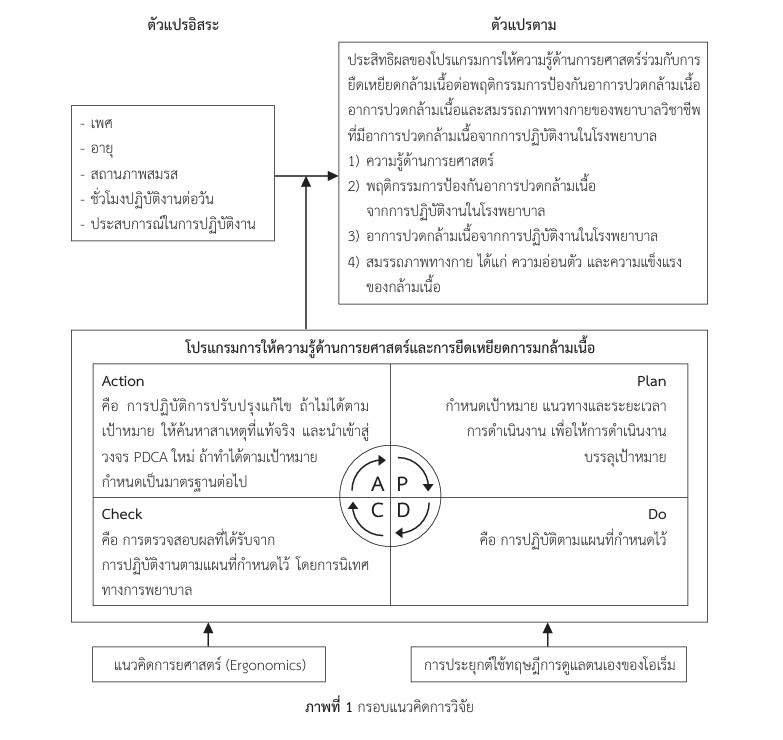
ประสิทธิผลของโปรแกรมการให้ความรู้ด้านการยศาสตร์ร่วมกับการยืดเหยียดกล้ามเนื้อ ต่อพฤติกรรมการป้องกันอาการปวดกล้ามเนื้อ อาการปวดกล้ามเนื้อ และสมรรถภาพทางกาย ของพยาบาลวิชาชีพที่มีอาการปวดกล้ามเนื้อจากการปฏิบัติงานในโรงพยาบาล
คำสำคัญ:
ความรู้ด้านการยศาสตร์, การยืดเหยียดกล้ามเนื้อ, อาการปวดกล้ามเนื้อ, พยาบาลวิชาชีพบทคัดย่อ
การวิจัยกึ่งทดลองนี้ มีวัตถุประสงค์เพื่อศึกษาประสิทธิผลของโปรแกรมการให้ความรู้ด้านการยศาสตร์ร่วมกับการยืดเหยียดกล้ามเนื้อต่อพฤติกรรมการป้องกันอาการปวดกล้ามเนื้อ อาการปวดกล้ามเนื้อ และสมรรถภาพทางกายของพยาบาลวิชาชีพที่มีอาการปวดกล้ามเนื้อจากการปฏิบัติงานในโรงพยาบาล กลุ่มตัวอย่างเป็นพยาบาลวิชาชีพที่มีอาการปวดกล้ามเนื้อจากการปฏิบัติงานในโรงพยาบาล จำนวน 82 คน คัดเลือกโดยใช้วิธีสุ่มอย่างง่าย เครื่องมือที่ใช้ในงานวิจัย ได้แก่ โปรแกรมการให้ความรู้ด้านการยศาสตร์ร่วมกับการยืดเหยียดกล้ามเนื้อ แนวทางการแก้ไขอาการปวดกล้ามเนื้อจากการปฏิบัติงานในโรงพยาบาลของพยาบาลวิชาชีพตามระเบียบปฏิบัติเลขที่ WI-OCC–002 คู่มือการให้ความรู้ด้านการยศาสตร์ร่วมกับการยืดเหยียดกล้ามเนื้อ แผนการนิเทศทางการพยาบาล เรื่อง แนวทางการแก้ไขอาการปวดกล้ามเนื้อจากการปฏิบัติงานในโรงพยาบาลของพยาบาลวิชาชีพ แบบสอบถามความรู้ด้านการยศาสตร์ พฤติกรรมการป้องกันอาการปวดกล้ามเนื้อ อาการปวดกล้ามเนื้อ และแบบบันทึกผลการทดสอบสมรรถภาพทางกาย ซึ่งผ่านการตรวจสอบความตรงเชิงเนื้อหาจากผู้ทรงคุณวุฒิและผู้เชี่ยวชาญ ค่าความเชื่อมั่นของแบบสอบถามความรู้ด้านการยศาสตร์ และพฤติกรรมการป้องกันอาการปวดกล้ามเนื้อ เท่ากับ 0.79 และ 0.96 ตามลำดับ วิเคราะห์ข้อมูลทั่วไปด้วยสถิติเชิงพรรณนา และเปรียบเทียบผลก่อน-หลังการทดลองโดยใช้สถิติ Paired t-test
ผลการวิจัย พบว่า หลังใช้โปรแกรมฯ กลุ่มตัวอย่างมีค่าเฉลี่ยคะแนนความรู้ด้านการยศาสตร์ พฤติกรรมการป้องกันอาการปวดกล้ามเนื้อ ผลการทดสอบสมรรถภาพทางกายด้านความอ่อนตัวและความแข็งแรงของกล้ามเนื้อ สูงกว่าก่อนใช้โปรแกรมฯ อย่างมีนัยสำคัญทางสถิติ (t = 22.30, p-value < 0.001; t = 17.89, p-value < 0.001; t = 10.01, p-value < 0.001; t = 10.40, p-value < 0.001) และค่าเฉลี่ยคะแนนอาการปวดกล้ามเนื้อ ลดลงกว่าก่อนใช้โปรแกรมฯ อย่างมีนัยสำคัญทางสถิติ (t = -17.21, p-value < 0.001) จากผลการวิจัยแสดงให้เห็นว่าโปรแกรมการให้ความรู้ด้านการยศาสตร์ร่วมกับการยืดเหยียดกล้ามเนื้อมีประสิทธิผลทำให้ความรู้ด้านการยศาสตร์ พฤติกรรมการป้องกันอาการปวดกล้ามเนื้อ อาการปวดกล้ามเนื้อ และสมรรถภาพทางกายด้านความอ่อนตัวและความแข็งแรงของกล้ามเนื้อเปลี่ยนแปลงไปในทางดีขึ้น บุคลากรด้านสุขภาพหรือกลุ่มอาชีพอื่นที่มีลักษณะงานใกล้เคียงกันสามารถนำโปรแกรมฯ ไปประยุกต์ใช้ได้
เอกสารอ้างอิง
Amornrattanapaijit, R., & Krungkraiwong, S. (2001). Ergonomic in workplace. Bangkok: Riangsam graphic design. [In Thai]
Buatum, P., Nawamawat, J., & Prompradit, T. (2022). Factors associated with work-related musculoskeletal disorders among registered nurses and nurse’s aides at Uthaithani hospital. Journal of Nursing and Health Care, 40(4), 1/11-12/11. [In Thai]
Bureau of Occupational and Environmental Diseases, Department of Disease Control, Ministry of Public Health. (2011). Manual for Risk Assessment of Work Performance of Personnel in Hospitals (Revised Edition 2011). (3rd ed.). Nonthaburi: Printing House of Agricultural Cooperatives of Thailand Co., Ltd. [In Thai]
Butmee, T. (2015). Ergonomics risk factors affecting to work-related musculoskeletal disorders in nurses and prevention. KKU Journal for Public Health Research, 8(4), 1-5. [In Thai]
Chamnan, S., Pichainarong, N., & Butsaenkom, R. (2016). The results of ergonomics health promotion program for behavioral modification of work-related muscuroskeletal disorders risk reduction among Srisomdet hospital personnel, Srisomdet district, Roi Et province. Journal The Office of DPC 7 Khon Kaen, 23(3), 56-66. [In Thai]
Chancharoen, K. (2009). Identifying population and sample. In Jirojanakul, P. (Ed.), Nursing research: concept, principle and practice (pp. 85-114). Nonthaburi: Praboromarajchanok Institute for Health Workforce Development, Ministry of Public Health. [In Thai]
Department of Labor Protection and Welfare. (n.d.). Learning package on safety and occupational health in ergonomics. Retrieved from https://osh.labour.go.th/index.php?option=com_k2&view=item&id=201
Health Promotion Foundation (ThaiHealth). (2018). Prevent muscle pain. Retrieved from https://www.thaihealth.or.th/?p=229029
Intajak, T. (2021). Herbal used behavior of people in Mueang district, Mae Hong Son province. (Research Report). Chiang Mai: Chiang Mai Rajabhat University. [In Thai]
Jaijum, P., & Tantipanyaporn, T. (2018). Effectiveness of muscle stretching with ergonomics training program to relieve back pain and increase back muscle stretching in hand weaving workers, Mae Rang sub-district, Pa Sang district, Lamphun province. Journal of Science and Technology Ubon Ratchathani University, 20(3), 29-39. [In Thai]
Khunhankaew, T. (2015). Effects of flexibility training on agility in professional Thai boxers of Quest Thailand Camp. Master’s Thesis, Sports Science, Chiang Mai University. [In Thai]
Likert, R.A. (1993). A technique for the measurement of attitude. Chicago: Rand McNally. Meepradit, P. (2016). Ergonomics risk assessment. Bangkok: O.S. Printing House. [In Thai]
Occupational medicine department, Chao Phraya Abhaibhubejhr Hospital. (2023). Summary of the results of the health risk assessment in Chao Phraya Abhaibhubejhr Hospital for the year 2023. Prachinburi: Chaophya Abhaibhubejhr Hospital. [In Thai]
Ontam, N. (2019). PDCA (Deming Cycle) Management techniques. Journal of Association of Professional Development of Educational Administration of Thailand (JAPDEAT), 1(3), 39-46. [In Thai]
Pattamaranggoul, W., & Singlumpong, Y. (2018). A comparative study of different techniques in recovery peroid of physical fitness of athletics. Academic Journal Institute of Physical Education, 10(1), 89-102. [In Thai]
Pimarn, R., & Wongmatikul, V. (2017). Prevalence and risk factors of low back pain among nurses at King Chulalongkorn Memorial Hospital. Chulalongkorn Medical Journal, 61(1), 87-102. [In Thai]
Potchana, K. (2022). The effect of stretching exercises and ergonomics on pain and quality of life in nurses with myofascial pain syndrome (MPS). Udonthani Hospital Medical Journal, 30(1), 45-57. [In Thai]
Prasan, S. (2021). Prevalence and ergonomic factors associated with work-related musculoskeletal disorders among non-medical hospital personnel. Thai Journal of Public Health, 51(2), 149-158. [In Thai]
Prayunvong, A., Wachiraphantham, W., Srisanit, R., Kanmali., Y. & Phonmana, P. (2023). Model development of nursing service to solve health problems caused by ergonomic health hazards in hospital personnel, Chaophya Abhaibhubejhr hospital, Prachinburi Province. Journal of Public Health Nursing, 37(3), 48-71. [In Thai]
Sports Science Institute, Department of Physical Education, Ministry of Tourism and Sports. (2019). Manual for testing and physical fitness standards of children, youth and Thai people. Bangkok: World Expert. [In Thai]
Sripanya, B., & Sittibannakul, B. (2020). Effects of educational ergonomics with rubber chain exercise program on low back pain, functional ability and back muscle strength among indigo-dyed weaving workers. Journal of Liberal Arts and Management Science Kasetsart University, 37(7), 27-40. [In Thai]
Srirach, C., & Yiammit, C. (2019). Flexibility Development with a muscle stretching program for improving physical wuality of the life of elderly in Chanthaburi province. NRRU Community Research Journal, 15(3), 104-115. [In Thai]
Thailand Institute of Occupational Safety and Health (Public Organization). (2019). Ergonomics manual for lifting and handling operations improvement. Bangkok: Chayakorn Printing. [In Thai]
Vorapongsathorn, T., & Vorapongsathorn, S. (2018). Sample size calculation for research using G*Power program. Thailand Journal of Health Promotion and Environmental Health, 41(2), 11-21. [In Thai]
Wiratchai, N. (2012). Sample sizing in research hypothesis testing. Retrieved from http://lllskill.com/web/files/GPower.pdf
Wongsri, P., & Chintapanyakun, T. (2018). Utilization of Orem’s theory with caring and advice forpatients with heart failure. Journal of The Police Nurses, 10(1), 209–219. [In Thai]
ดาวน์โหลด
เผยแพร่แล้ว
รูปแบบการอ้างอิง
ฉบับ
ประเภทบทความ
สัญญาอนุญาต

อนุญาตภายใต้เงื่อนไข Creative Commons Attribution-NonCommercial-NoDerivatives 4.0 International License.