Factors Influencing Uptake of Cervical Cancer Screening among Women in Wenzhou, China
Keywords:
Cervical cancer screening, Health belief, Perceived barriers, Self-efficacy, ChinaAbstract
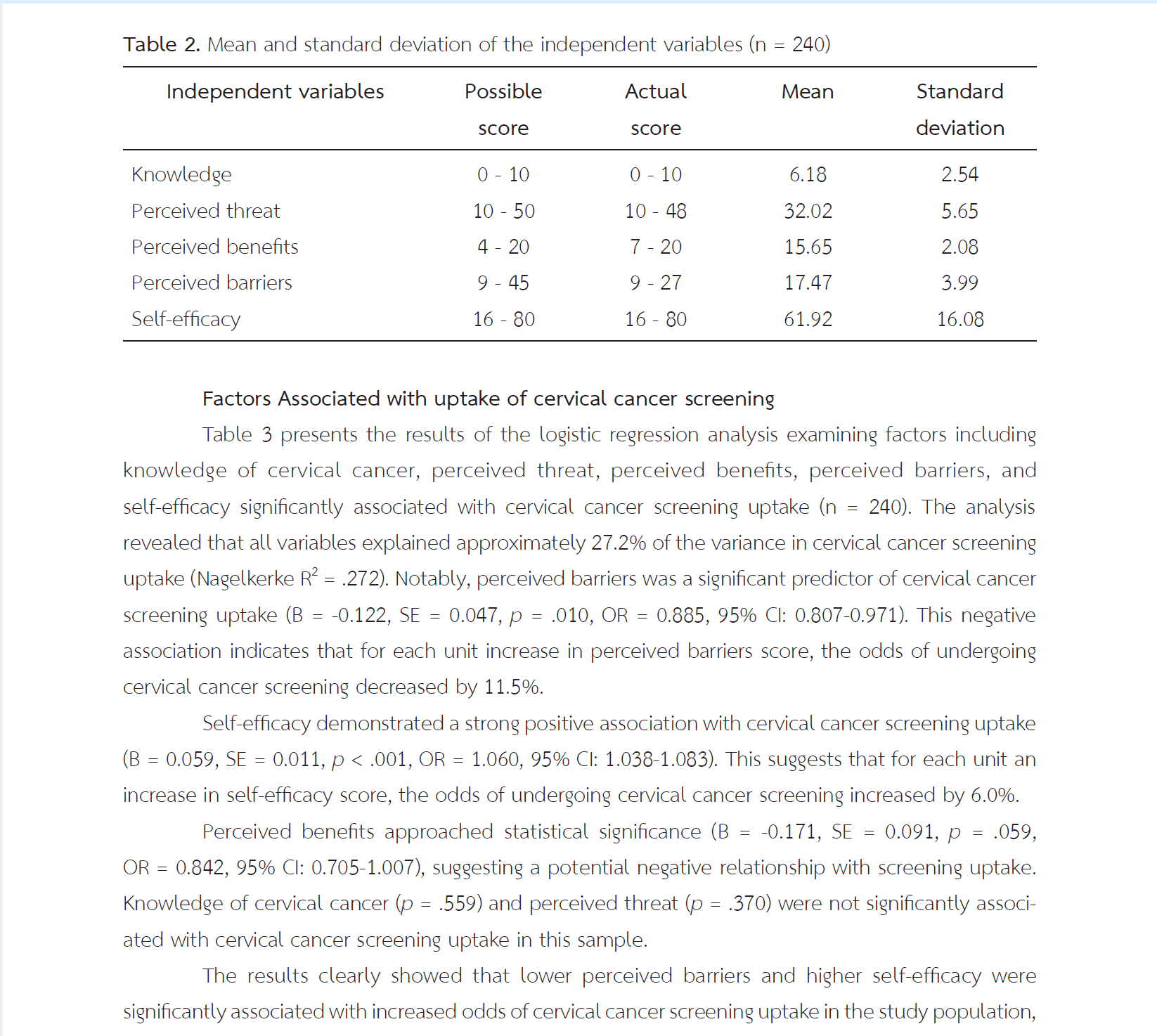
This study aimed to examine the uptake of cervical cancer screening and to determine if knowledge of cervical cancer, perceived threat of cervical cancer, perceived benefits of cervical cancer screening, perceived barriers to cervical cancer screening, and self-efficacy about the uptake of cervical cancer screening could predict the uptake of cervical cancer screening among women in Wenzhou, China. A simple random sampling technique was used to recruit 240 individuals, who came to check up on their health at two Physical Examination Centers of one hospital in Wenzhou, China. Research instruments included the demographic data questionnaire, the Chinese version of the cervical cancer prevention knowledge questionnaire with the KR 20 of .76, the Chinese version of the cervical cancer screening belief scale including perceived threat, perceived benefit, perceived barrier, and the Chinese version of the cervical cancer screening self-efficacy scale, with Cronbach’s alpha values of .86, .72, .91, and .96 respectively. Descriptive statistics and binary logistic regression were used to analyze the data.
Results revealed that 63.3% of the participants had been screened for cervical cancer. The logistic regression model including all five independent variables explained approximately 27.2% of the variance in cervical cancer screening (Nagelkerke R2 = .272). Perceived barriers (Odds Ratio [OR] = 0.885, 95% Confidence Interval [CI]: 0.807-0.971, p <.05) and self-efficacy (OR = 1.060, 95% CI: 1.038-1.083, p < .001) were the strongest contributors to this prediction.
The results indicate that perceived barriers and self-efficacy are significant factors influencing the decision to undergo cervical cancer screening. These findings can be applied to develop strategies promoting cervical cancer screening among women in the future.
References
Al‐Ani, A., Hammouri, M., Sultan, H., Al‐Huneidy, L., Mansour, A., & Al‐Hussaini, M. (2024). Factors affecting cervical screening using the health belief model during the last decade: A systematic review and meta‐analysis. Psycho‐ Oncology, 33(1), e6275.
Bao, H., Zhang, L., Wang, L., Zhang, M., Zhao, Z., Fang, L., . . . Wang, L. (2018). Significant variations in the cervical cancer screening rate in China by individual‐level and geographical measures of socioeconomic status: A multilevel model analysis of anationally representative survey dataset. Cancer Medicine, 7(5), 2089-2100.
Brisson, M., Kim, J. J., Canfell, K., Drolet, M., Gingras, G., Burger, E. A., . . . Boily, M.-C. (2020). Impact of HPV vaccination and cervical screening on cervical cancer elimination: A comparative modelling analysis in 78 low-income and lower-middle-income countries. The Lancet, 395(10224), 575-590.
Champion, V. L., & Skinner, C. S. (2008) The health belief model. In Glanz, K., Rimer, B. K., & Viswanath, K. (Eds.). Health behavior and health education; Theory, research, and practice (4th ed., pp. 45-65). San Francisco: Jossey-Bass/Wiley.
Client, W. N. (2023). In 2023, Wenzhou "two cancers" free screening started! Last year, more than 150,000 women in urban and rural areas received the "two cancer screening" and 846 of them were abnormal. Retrieved from https://wjw.wenzhou.gov.cn/art/2023/4/14/art_1229459404_58914626.html
Dsouza, J. P., Broucke, S. V. d., Pattanshetty, S., & Dhoore, W. (2022). A comparison of behavioural models explaining cervical cancer screening uptake. BMC Women's Health, 22(1), 235.
Emereonye, C. F., Areloegbe, S. E., Oladele, C. A., Akpor, O. A., & Olaniyi, K. S. (2025). The role of cervicovaginal microbiome in the pathogenesis of cervical cancer. Indian Journal of Gynecologic Oncology, 23(1), 1-11.
Getachew, S., Getachew, E., Gizaw, M., Ayele, W., Addissie, A., & Kantelhardt, E. J. (2019). Cervical cancer screening knowledge and barriers among women in Addis Ababa, Ethiopia. PloS One, 14(5), e0216522.
Guvenc, G., Akyuz, A., & Açikel, C. H. (2011). Health belief model scale for cervical cancer and pap smear test: Psychometric testing. Journal of Advanced Nursing, 67(2), 428-437.
Khoshnazar, M. S., Tarrahi, M. J., & Shahnazi, H. (2024). Impact of virtual education based on health belief model on cervical cancer screening behavior in middle‐aged women: A quasi‐experimental study. Cancer Reports, 7(4), e2058.
Kuder, G. F., & Richardson, M. W. (1937). The theory of the estimation of test reliability. Psychometrika, 2(3), 151-160.
Lei, W. (2015). Study on reliability and validity analysis of health belief scale used in screening for cervical cancer with cytology smear. (Master's thesis). Taishan Medical College, Medical and Health Technology.
Li, L., Hongguang, W., Sulian, Y., Xixi, Z., & Chune, M. (2013). Comparative analysis of cervical cancer screening results and prevention knowledge questionnaire survey in Suzhou district. Chinese Primary Health Care, 27(9), 67-69. doi:10.3969/j.issn.1001-568X.2013.09.0026
Liang, J., qian, X., Zhang, X., Jiang, S., Xu, A., & Xu, C. (2014). Analysis on reliability and validity of cervical cancer screening self - efficacy scale. Maternal and Child Health Care in China, 29(06), 923-926.
Liu, X., Wang, Y., Gao, B., Lu, X., Wang, Y., & Lu, W. (2025). Modeling optimal combination of breast and cervical cancer screening strategies in China. BMC Women's Health, 25, 56.
Mertler, C. A., Vannatta, R. A., & LaVenia, K. N. (2021). Advanced and multivariate statistical methods: Practical application and interpretation. New York : Routledge.
Meteor, L. t. t. f. o. t. (2021). 2021 Latest news of Free screening for two cancers in Wenzhou (list of maternal and child health care institutions in wenzhou). Retrieved from http://wz.bendibao.com/news/2021413/52540.shtm
Monk, B. J., Tan, D. S., Chagüi, J. D. H., Takyar, J., Paskow, M. J., Nunes, A. T., & Pujade-Lauraine, E. (2022). Proportions and incidence of locally advanced cervical cancer: A global systematic literature review. International Journal of Gynecological Cancer, 32(12), 1531-1539.
Morowatisharifabad, M. A., Momayyezi, M., & Ghaneian, M. T. (2012). Health belief model and reasoned action theory in predicting water saving behaviors in Yazd, Iran. Health Promotion Perspectives, 2(2), 136.
Okyere, J., Ayebeng, C., & Dickson, K. S. (2024). Factors associated with age at first screening for cervical cancer among adult Cape Verdean women: A cross-sectional study. BMC Public Health, 24(1), 2444.
Parker, S. L., Amboree, T. L., Bulsara, S., Daheri, M., Anderson, M. L., Hilsenbeck, S. G., . . . Deshmukh, A. A. (2024). Self-sampling for human papillomavirus testing: Acceptability in a US safety net health system. American Journal of Preventive Medicine, 66(3), 540-547.
Pötter, R., Tanderup, K., Schmid, M. P., Jürgenliemk-Schulz, I., Haie-Meder, C., Fokdal, L. U., . . .Segedin, B. (2021). MRI-guided adaptive brachytherapy in locally advanced cervical cancer (EMBRACE-I): A multicentre prospective cohort study. The Lancet Oncology, 22(4), 538-547.
Sung, H., Ferlay, J., Siegel, R. L., Laversanne, M., Soerjomataram, I., Jemal, A., & Bray, F. (2021). Global cancer statistics 2020: GLOBOCAN estimates of incidence and mortality worldwide for 36 cancers in 185 countries. CA: A Cancer Journal for Clinicians, 71(3), 209-249.
Wenzhou Maternal and Child Health Hospital. (2024). In 2024, Wenzhou will implement free cervical and breast cancer (hereinafter referred to as "two cancers") screening for urban and rural. Retrieved from https://wjw.wenzhou.gov.cn/art/2024/10/24/art_1229459409_58918004.html
Woldetsadik, A. B., Amhare, A. F., Bitew, S. T., Pei, L., Lei, J., & Han, J. (2020). Socio-demographic characteristics and associated factors influencing cervical cancer screening among women attending in St. Paul’s Teaching and Referral Hospital, Ethiopia. BMC Women's Health, 20(1), 1-9.
World Health Organization [WHO]. (2024). WHO guideline for screening and treatment of Cervical pre-cancer lesions for cervical cancer prevention: use of dual-stain cytology to triage women after a positive test for human papillomavirus (HPV): World Health Organization.
Yadav, A., Dobe, M., Paul, B., & Taklikar, C. (2022). A cross-sectional study on assessment of perceived threat to cervical cancer using health belief model among women in a slum area of Kolkata. Journal of education and health promotion, 11, 124. https://doi.org/10.4103/jehp.jehp_392_21
Ye, S., & Yang, L. (2025). Wenzhou urban and rural women "two cancers" free screening, start. Retrieved from https://news.66wz.com/system/2025/02/24/105673690.shtml
Yirsaw, A. N., Tefera, M., Bogale, E. K., Anagaw, T. F., Tiruneh, M. G., Fenta, E. T., . . . Jemberu, L. (2024). Applying the Health Belief Model to cervical cancer screening uptake among women in Ethiopia: A systematic review and meta-analysis. BMC Cancer, 24(1), 1-13.
Yuan, M., Zhao, X., Wang, H., Hu, S., & Zhao, F. (2023). Trend in cervical cancer incidence and mortality rates in China, 2006–2030: A Bayesian age-period-cohort modeling study. Cancer Epidemiology, Biomarkers & Prevention, 32(6), 825-833.
Yue, Z. (2016). Definition of detachment, withdrawal, and loss of follow-up in clinical trials. Chinese Radiation Therapy Oncology Group. Retrieved from http://www.crtog.org/v6-4431.html
Zhang, M., Wang, L., Zhang, X., Li, C., Zhao, Z., Yu, M., . . . Wang, L. (2025). Cervical Cancer Screening Rates Among Chinese Women—China, 2023–2024. China CDC Weekly, 7(10), 321.
Zheng, R. (2019). Wenzhou to launch 2019 "two cancer" free screening will benefit 159,000 people. Retrieved from http://news.66wz.com/system/2019/03/08/105152788.shtml
Zheng, R. (2020). Wenzhou launches free cancer screening in 2020. Wenzhou Business News. Retrieved from http://www.wenzhou.gov.cn/art/2020/3/31/art_1217832_42438763.html
Downloads
Published
How to Cite
Issue
Section
License

This work is licensed under a Creative Commons Attribution-NonCommercial-NoDerivatives 4.0 International License.