Factors Associated with Health-Related Quality of Life among Breast Cancer Patients Receiving Postoperative Chemotherapy in Hangzhou, China
Keywords:
Health-related quality of life, breast cancer, Chemotherapy, symptom experience, social supportAbstract
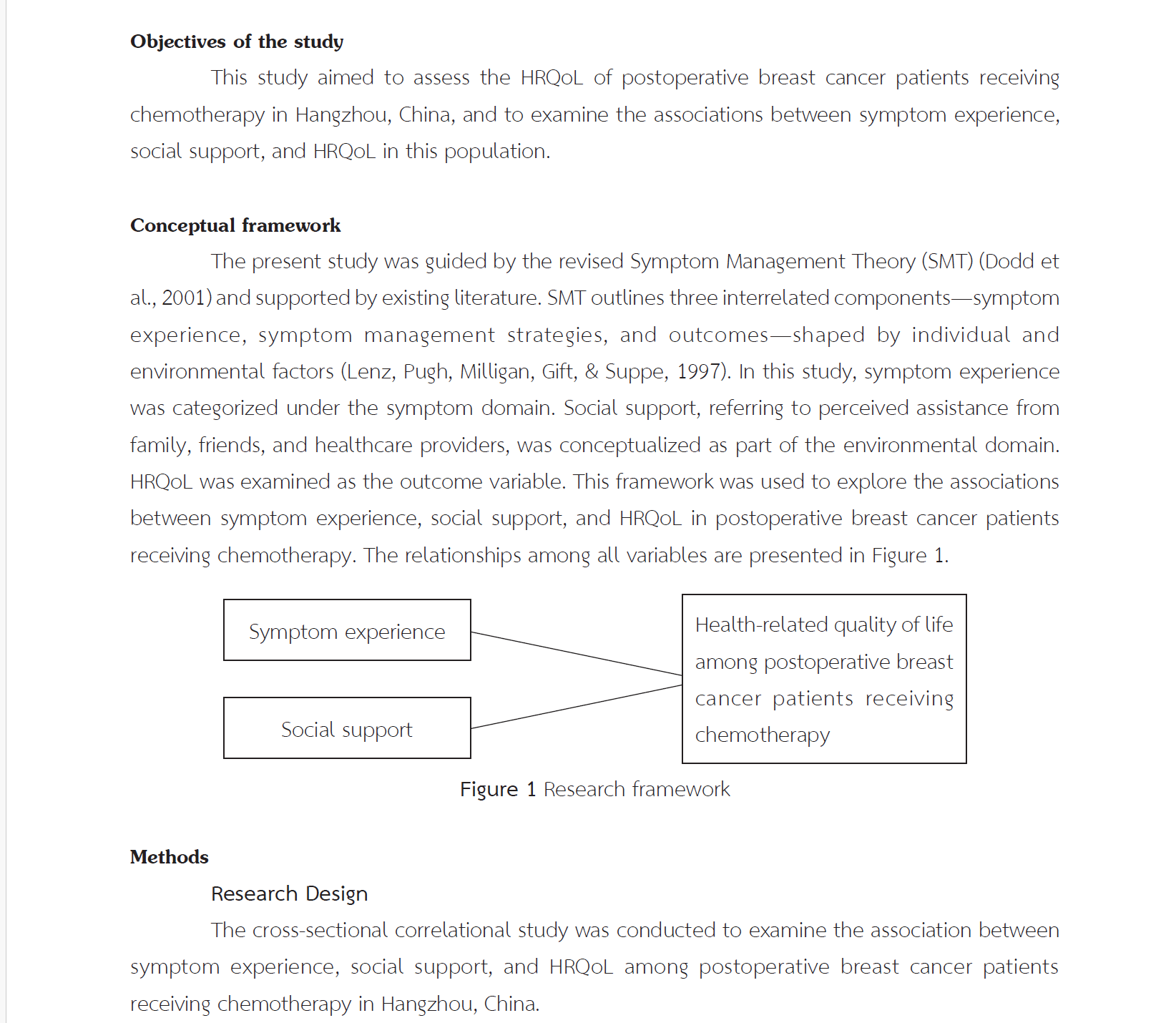
This cross-sectional correlational study aimed to describe health-related quality of life (HRQoL) and to examine the relationships between symptom experience, social support, and HRQoL among postoperative breast cancer patients receiving chemotherapy in Hangzhou, China. 130 participants were recruited through simple random sampling from the Cancer Daycare Center of Sir Run Run Shaw Hospital in Hangzhou, China. Data were collected using a demographic information questionnaire and three validated Chinese-language scales including the Memorial Symptom Assessment Scale, the Perceived Social Support Scale, and the Functional Assessment of Cancer Therapy–Breast (FACT-B). Data were analyzed by using descriptive statistics and Pearson’s correlation.
Results showed that the mean HRQoL score was 93.45 (SD = 19.56). Symptom experience had a moderate negative correlation with HRQoL (r = -.558, p < .01). While social support had a moderate positive correlation with HRQoL (r = .556, p < .01)
The findings suggest that improving symptom management and enhancing social support may help promote better HRQoL among postoperative breast cancer patients undergoing chemotherapy.
References
Al-Atiyyat, N., Salem, H. F., & Hamam, A. H. M. (2024). Impact of pain on functional status and quality of life in Jordanian women with breast cancer. PLoS ONE, 19(10), e0307271. doi:10.1371/journal.pone.0307271
Barger, S. D., Broom, T. W., Esposito, M. V., & Lane, T. S. (2020). Is subjective well-being independently associated with mortality? A 14-year prospective cohort study in a representative sample of 25 139 US men and women. BMJ Open, 10(1), e031776. doi:10.1136/bmjopen-2019-031776
Binotto, M., Reinert, T., Werutsky, G., Zaffaroni, F., & Schwartsmann, G. (2020). Health-related quality of life before and during chemotherapy in patients with early-stage breast cancer. Ecancermedicalscience, 14, 1007. doi:10.3332/ecancer.2020.1007
Bray, F., Laversanne, M., Sung, H., Ferlay, J., Siegel, R. L., Soerjomataram, I., & Jemal, A. (2024). Global cancer statistics 2022: GLOBOCAN estimates of incidence and mortality worldwide for 36 cancers in 185 countries. CA: A Cancer Journal for Clinicians, 74(3), 229-263. doi: 10.3322/caac.21834
Browall, M., Sarenmalm, E. K., Nasic, S., Wengström, Y., & Gaston-Johansson, F. (2013). Validity and reliability of the Swedish version of the Memorial Symptom Assessment Scale (MSAS): An instrument for the evaluation of symptom prevalence, characteristics, and distress. Journal of Pain and Symptom Management, 46(1), 131-141. doi:10.1016/j.jpainsymman.2012.07.023
Chen, W., Xia, C., Zheng, R., Zhou, M., Lin, C., Zeng, H., . . . Sun, K. (2019). Disparities by province, age, and sex in site-specific cancer burden attributable to 23 potentially modifiable risk factors in China: A comparative risk assessment. The Lancet Global Health, 7(2), e257-e269. doi:10.1016/S2214-109X(18)30488-1
Cheng, K. K., Wong, E. M., Ling, W., Chan, C. W., & Thompson, D. R. (2009). Measuring the symptom experience of Chinese cancer patients: A validation of the Chinese version of the memorial symptom assessment scale. Journal of Pain and Symptom Management, 37(1), 44-57. doi:10.1016/j.jpainsymman.2007.12.019
Cordova, L. Z., Hunter-Smith, D. J., & Rozen, W. M. (2019). Patient reported outcome measures (PROMs) following mastectomy with breast reconstruction or without reconstruction: A systematic review. Gland Surgery, 8(4), 441. doi:10.21037/gs.2019.07.02
Cui, C., Wang, L., & Wang, X. (2021). Health-related quality of life and social constraints among Chinese breast cancer patients: A cross-sectional study. Health and Quality of Life Outcomes, 19, 1-8. doi:10.1186/s12955-021-01871-0
DeSantis, C. E., Ma, J., Gaudet, M. M., Newman, L. A., Miller, K. D., Goding Sauer, A., . . . Siegel, R. L. (2019). Breast cancer statistics, 2019. CA: A Cancer Journal for Clinicians, 69(6), 438-451. doi:10.3322/caac.21583
Dodd, M., Janson, S., Facione, N., Faucett, J., Froelicher, E. S., Humphreys, J., . . . Rankin, S. (2001). Advancing the science of symptom management. Journal of Advanced Nursing, 33(5), 668-676. doi:10.1046/j.1365-2648.2001.01697.x
Esteva, F. J., Hubbard-Lucey, V. M., Tang, J., & Pusztai, L. (2019). Immunotherapy and targeted therapy combinations in metastatic breast cancer. The Lancet Oncology, 20(3), e175-e186. doi:10.1016/s1470-2045(19)30026-9
Griggs, J. J., Mangu, P. B., Anderson, H., Balaban, E. P., Dignam, J. J., Hryniuk, W. M., . . . Rosner, G. L. (2012). Appropriate chemotherapy dosing for obese adult patients with cancer: American Society of Clinical Oncology clinical practice guideline. Journal of Clinical Oncology, 30(13), 1553-1561. doi:10.1200/jco.2011.39.9436
Henry, D. H., Viswanathan, H. N., Elkin, E. P., Traina, S., Wade, S., & Cella, D. (2008). Symptoms and treatment burden associated with cancer treatment: Results from a cross-sectional national survey in the U.S. Supportive Care in Cancer, 16(7), 791-801. doi:10.1007/s00520-007-0380-2
Huang, L., Jiang, Q., & Ren, W. (1996). Correlation between coping style, social support and psychosomatic symptoms in cancer patients. Chinese Mental Health Journal, 10(4), 160-161.
Jang, Y., Seong, M., & Sok, S. (2023). Influence of body image on quality of life in breast cancer patients undergoing breast reconstruction: Mediating of self‐esteem. Journal of Clinical Nursing, 32(17-18), 6366-6373. doi:10.1111/jocn.16621
Jones, L. W., Eves, N. D., Haykowsky, M., Joy, A. A., & Douglas, P. S. (2008). Cardiorespiratory exercise testing in clinical oncology research: Systematic review and practice recommendations. The Lancet Oncology, 9(8), 757-765. doi:10.1016/S1470-2045(08)70195-5
Lenz, E. R., Pugh, L. C., Milligan, R. A., Gift, A., & Suppe, F. (1997). The middle-range theory of unpleasant symptoms: An update. Advances in Nursing Science, 19(3), 14-27.
Li, Q., & Loke, A. Y. (2014). A literature review on the mutual impact of the spousal caregiver–cancer patients dyads:‘communication’,‘reciprocal influence’, and ‘caregiver–patient congruence’. European Journal of Oncology Nursing, 18(1), 58-65. doi:10.1016/j.ejon.2013.09.003
Li, W., Zhang, Q., Xu, Y., Sun, H., Wen, Y., Xu, W., . . . Yang, Y. (2022). Group-based trajectory and predictors of anxiety and depression among Chinese breast cancer patients. Frontiers in Public Health, 10, 1002341. doi:10.3389/fpubh.2022.1002341
M. D. Anderson Cancer Center. (2023). 7 chemotherapy side effects and how to manage them. Retrieved from https://www.mdanderson.org/cancerwise/7-chemotherapy-side-effects-and-how-to-manage-them.h00-159621012.html
Matthies, L. M., Taran, F.-A., Keilmann, L., Schneeweiss, A., Simoes, E., Hartkopf, A. D., . . . Wallwiener, S. (2019). An electronic patient-reported outcome tool for the FACT-B (functional assessment of cancer therapy-breast) questionnaire for measuring the health-related quality of life in patients with breast cancer: Reliability study. Journal of Medical Internet Research, 21(1), e10004. doi:10.2196/10004
Miaskowski, C., Barsevick, A., Berger, A., Casagrande, R., Grady, P. A., Jacobsen, P., . . . Xiao, C. (2017). Advancing symptom science through symptom cluster research: Expert panel proceedings and recommendations. JNCI: Journal of the National Cancer Institute, 109(4), djw253. doi:10.1093/jnci/djw253
Milbury, K., Kavanagh, A., Meng, Z., Chen, Z., Chandwani, K. D., Garcia, K., . . . Nagarathna, R. (2017). Depressive symptoms and positive affect in Chinese and United States breast cancer survivors: A cross-cultural comparison. Supportive Care in Cancer, 25, 2103-2109. doi:10.1007/s00520-017-3612-0
Nyrop, K. A., Monaco, J., Vohra, S., Deal, A. M., Wood, W. A., Shachar, S. S., . . . Muss, H. B. (2023). Body mass index and patient-reported function, quality of life and treatment toxicity in women receiving adjuvant chemotherapy for breast cancer. Supportive Care in Cancer, 31(3), 196. doi:10.1007/s00520-023-07637-2
Onzi, G. R., D’Agustini, N., Garcia, S. C., Guterres, S. S., Pohlmann, P. R., Rosa, D. D., & Pohlmann, A. R. (2022). Chemobrain in breast cancer: Mechanisms, clinical manifestations, and potential interventions. Drug safety, 45(6), 601-621. doi:10.1007/s40264-022-01182-3
Park, J.-H., Jung, Y. S., Jung, Y.-M., & Bae, S. H. (2019). The role of depression in the relationship between cognitive decline and quality of life among breast cancer patients. Supportive Care in Cancer, 27, 2707-2714. doi:10.1007/s00520-018-4546-x
Paterson, C. L., Lengacher, C. A., Donovan, K. A., Kip, K. E., & Tofthagen, C. S. (2016). Body image in younger breast cancer survivors: A systematic review. Cancer Nursing, 39(1), E39-E58. doi:10.1097/ncc.0000000000000251
Romeo, A., Di Tella, M., Ghiggia, A., Tesio, V., Gasparetto, E., Stanizzo, M. R., . . . Castelli, L. (2019). The traumatic experience of breast cancer: Which factors can relate to the post-traumatic outcomes? Frontiers in Psychology, 10, 891. doi:10.3389/fpsyg.2019.00891
Wan, C., Zhang, D., Yang, Z., Tu, X., Tang, W., Feng, C., . . . Tang, X. (2007). Validation of the simplified Chinese version of the FACT-B for measuring quality of life for patients with breast cancer. Breast Cancer Research and Treatment, 106, 413-418. doi:10.1007/s10549-007-9511-1
Whisenant, M. S., Williams, L. A., Mendoza, T., Cleeland, C., Chen, T.-H., Fisch, M. J., & Shi, Q. (2022). Identification of breast cancer survivors with high symptom burden. Cancer Nursing, 45(4), 253-261. doi:10.1097/ncc.0000000000001019
World Health Organization. (2024). WHOQOL: Measuring Quality of Life. Retrieved from https://www.who.int/tools/whoqol
Yang, X., Xue, M., Pauen, S., & He, H. (2024). Psychometric Properties of the Chinese Version of Multidimensional Scale of Perceived Social Support. Psychology Research and Behavior Management, 17, 2233-2241. doi:10.2147/PRBM.S463245
Zhang, H., Zhao, Q., Cao, P., & Ren, G. (2017). Resilience and Quality of Life: Exploring the Mediator Role of Social Support in Patients with Breast Cancer. Medical Science Monitor, 23, 5969-5979. doi:10.12659/msm.907730
Zhang, L., Wang, Z., Wang, X., Chen, Z., Shao, L., Tian, Y., . . . Gao, R. (2020). Prevalence of overweight and obesity in China: Results from a cross-sectional study of 441 thousand adults, 2012-2015. Obesity Research & Clinical Practice, 14(2), 119-126. doi:10.1016/j.orcp.2020.02.005
Zimet, G. D., Dahlem, N. W., Zimet, S. G., & Farley, G. K. (1988). The multidimensional scale of perceived social support. Journal of Personality Assessment, 52(1), 30-41. doi:10.1207/s15327752jpa52012
Downloads
Published
How to Cite
Issue
Section
License

This work is licensed under a Creative Commons Attribution-NonCommercial-NoDerivatives 4.0 International License.