
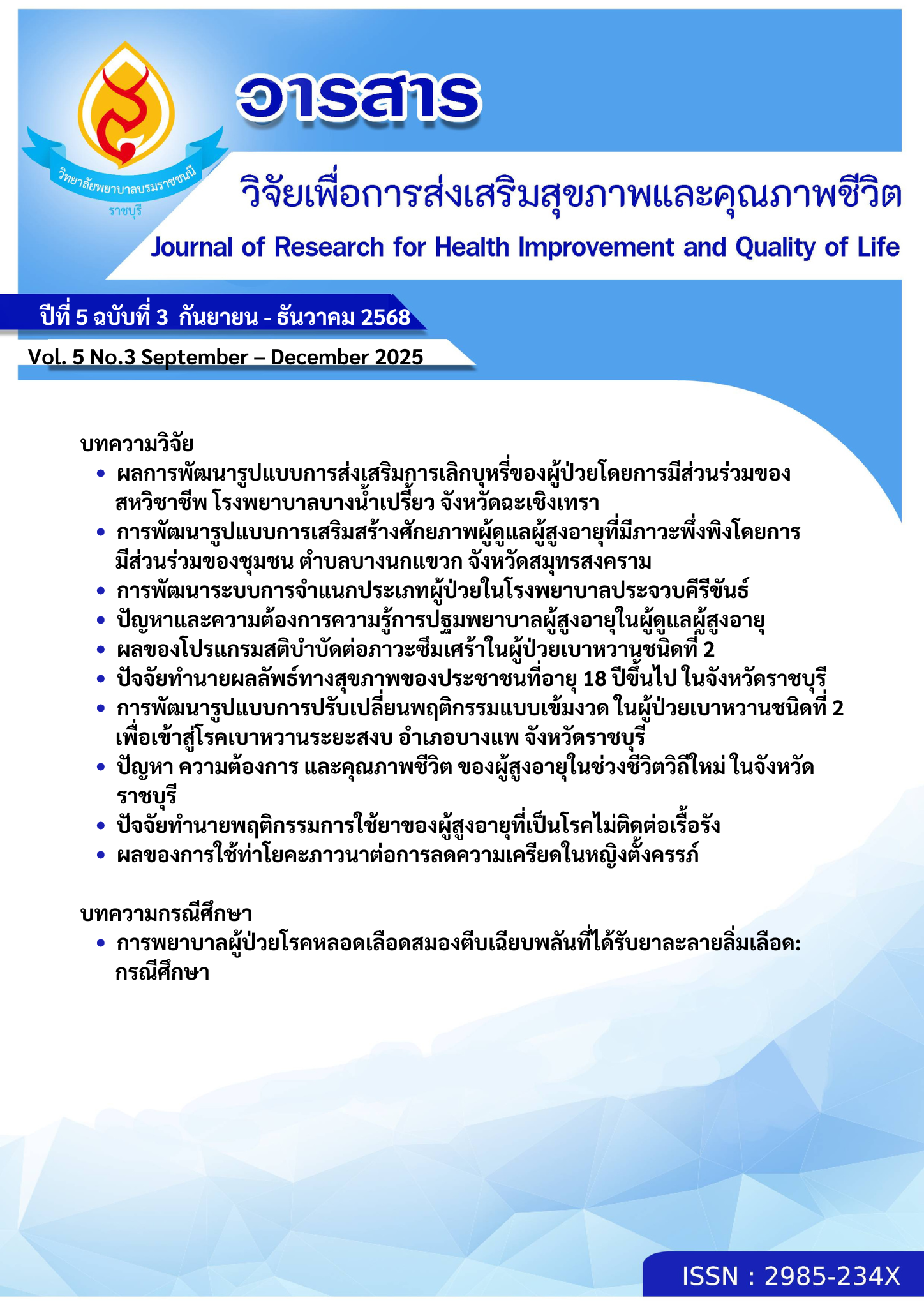
ปัจจัยทำนายพฤติกรรมการใช้ยาของผู้สูงอายุในมหาวิทยาลัยผู้สูงอายุแห่งหนึ่ง ในจังหวัดปทุมธานี
คำสำคัญ:
ปัจจัยทำนาย , พฤติกรรมการใช้ยา , ผู้สูงอายุ, โรคไม่ติดต่อเรื้อรัง , มหาวิทยาลัยผู้สูงอายุบทคัดย่อ
การวิจัยแบบความสัมพันธ์เชิงทำนายนี้ มีวัตถุประสงค์เพื่อ 1) ศึกษาระดับพฤติกรรมการใช้ยาของผู้สูงอายุที่เป็นโรคไม่ติดต่อเรื้อรัง และ 2) ศึกษาปัจจัยทำนายพฤติกรรมการใช้ยาของผู้สูงอายุที่เป็นโรคไม่ติดต่อเรื้อรัง จากปัจจัยต่างๆ ได้แก่ ความรู้เกี่ยวกับโรคและการใช้ยา ความเชื่อด้านสุขภาพ ความเชื่อมั่นในความสามารถของตนเอง และการสนับสนุนทางสังคม กลุ่มตัวอย่าง คือ สูงอายุที่เข้าศึกษาในมหาวิทยาลัยผู้สูงอายุลำลูกกา เครื่องมือวิจัย ประกอบด้วย แบบสอบถามข้อมูลส่วนบุคคล แบบทดสอบความรู้เกี่ยวกับโรคและการใช้ยา แบบสอบถามความเชื่อด้านสุขภาพ ความเชื่อมั่นในความสามารถของตนเอง การสนับสนุนทางสังคม และพฤติกรรมการใช้ยา วิเคราะห์ข้อมูลด้วยสถิติเชิงพรรณนา และการถดถอยพหุคูณแบบขั้นตอน ผลการวิจัย พบว่า
1. กลุ่มตัวอย่างมีพฤติกรรมการใช้ยาในระดับดี (M= 43.50, SD = 2.70)
2. ตัวแปรที่สามารถทำนายพฤติกรรมการใช้ยาของผู้สูงอายุที่เป็นโรคไม่ติดต่อเรื้อรังได้อย่างมีนัยสำคัญ ได้แก่ ความรู้เกี่ยวกับโรคและการใช้ยา ความเชื่อด้านสุขภาพ และความเชื่อมั่นในความสามารถของตนเอง (β= 426; β= 0.217; β= 0.216, p<.001) และการสนับสนุนทางสังคม (β= 0.119, p< .05) โดยทั้ง 4 ปัจจัย สามารถร่วมกันทำนายพฤติกรรมการใช้ยาได้ร้อยละ 64.0 (Adjusted R²= .630, p< .001)
ผลการศึกษาเป็นประโยชน์ต่อการพัฒนาแนวทางส่งเสริมพฤติกรรมการใช้ยาโดยเน้นการสร้างความรู้ การส่งเสริมความเชื่อด้านสุขภาพ การเพิ่มความเชื่อมั่นในความสามารถของตนเอง และการสนับสนุนทางสังคม
เอกสารอ้างอิง
Alani Abdallah, S., Ahmad, M., & Al-Daken, L. I. (2024). Evaluating the health belief model in predicting medication adherence among patients with chronic diseases: A systematic review. Journal of Health Psychology, 29(4), 512–525. https://doi.org/10.1177/13591053231180000
American Diabetes Association. (2023). Pharmacologic approaches to glycemic treatment: Standards of medical care in diabetes—2023. Diabetes Care, 46(Suppl. 1), S140–S157. https://doi.org/10.2337/dc23-S009
Bandura, A. (1977). Social learning theory. Prentice-Hall.
Brown, M. T., & Bussell, J. K. (2011). Medication adherence: WHO cares? Mayo Clinic Proceedings, 86(4), 304–314. https://doi.org/10.4065/mcp.2010.0575
Champion, V. L., & Skinner, C. S. (2008). The health belief model. In K. Glanz, B. K. Rimer, & K. Viswanath (Eds.), Health behavior and health education: Theory, research, and practice (4th ed., pp. 45–65). Jossey-Bass.
Cutler, R. L., Fernandez-Llimos, F., Frommer, M., Benrimoj, C., & Garcia-Cardenas, V. (2018). Economic impact of medication non-adherence by disease groups: A systematic review. BMJ Open, 8(1), e016982. https://doi.org/10.1136/bmjopen-2017-016982
Department of Disease Control. (2024). Annual epidemiological surveillance report 2024. Ministry of Public Health. (in Thai)
DiMatteo, M. R. (2004). Social support and patient adherence to medical treatment: A meta-analysis. Health Psychology, 23(2), 207–218. https://doi.org/10.1037/0278-6133.23.2.207
Fernandez, S., Chaplin, W., Schoenthaler, A. M., & Ogedegbe, G. (2008). Revision and validation of the medication adherence self-efficacy scale (MASES) in hypertensive African Americans. Journal of Behavioral Medicine, 31(6), 453–462. https://doi.org/10.1007/s10865-008-9170-7
Gallant, M. P. (2003). The influence of social support on chronic illness self-management: A review and directions for research. Health Education & Behavior, 30(2), 170–195. https://doi.org/10.1177/1090198102250303
Gast, A., & Mathes, T. (2019). Medication adherence influencing factors-An (updated) overview of systematic reviews. Systematic Reviews, 8(1), 112. https://doi.org/10.1186/s13643-019-1014-8
Kini, V., & Ho, P. M. (2018). Interventions to improve medication adherence: A review. JAMA, 320(23), 2461–2473. https://doi.org/10.1001/jama.2018.19271
Komkhuntod, C. (2011). Factors predicting medication adherence behaviors among older adults with hypertension [Master’s thesis, Mahidol University]. (in Thai)
National Economic and Social Development Council. (2023). Population projections for Thailand 2010–2040 (Revised edition). (in Thai)
Osterberg, L., & Blaschke, T. (2005). Adherence to medication. New England Journal of Medicine, 353(5), 487–497. https://doi.org/10.1056/NEJMra050100
Ploylearmsang, C., Kongkaew, C., & Chaiyakunapruk, N. (2021). Medication adherence and quality of life among elderly patients with chronic diseases: A cross-sectional study in community settings. International Journal of Clinical Pharmacy, 43(2), 456–465. https://doi.org/10.1007/s11096-020-01165-y
Rosenstock, I. M., Strecher, V. J., & Becker, M. H. (1988). Social learning theory and the health belief model. Health Education Quarterly, 15(2), 175–183. https://doi.org/10.1177/109019818801500203
Schoenthaler, A., Chaplin, W. F., Allegrante, J. P., Fernandez, S., Diaz-Gloster, M., Tobin, J. N., & Ogedegbe, G. (2009). Provider communication effects medication adherence in hypertensive African Americans. Patient Education and Counseling, 75(2), 185–191. https://doi.org/10.1016/j.pec.2008.09.018
Thuy, L. T., Monkong, S., Pookboonmee, R., Leelacharas, S., & Viwatwongkasem, C. (2020). Factors explaining medication adherence of older adults with hypertension: A cross-sectional study. Pacific Rim International Journal of Nursing Research, 24(3), 306–320.
Vatcharavongvan, P., & Uttaranchal, S. (2017). Adherence to antihypertensive medications among patients in a primary care setting in Thailand. Journal of Primary Care & Community Health, 8(4), 314–319. https://doi.org/10.1177/2150131917724240
World Health Organization. (2024). Noncommunicable diseases fact sheet. https://www.who.int/news-room/fact-sheets/detail/noncommunicable-diseases
ดาวน์โหลด
เผยแพร่แล้ว
ฉบับ
ประเภทบทความ
สัญญาอนุญาต
ลิขสิทธิ์ (c) 2025 วิทยาลัยพยาบาลบรมราชชนนี ราชบุรี

อนุญาตภายใต้เงื่อนไข Creative Commons Attribution-NonCommercial-NoDerivatives 4.0 International License.
บทความทีตีพิมพ์ในวารสารนี้ถือว่าเป็นลิขสิทธิ์ของวิทยาลัยพยาบาลบรมราชชนนี ราชบุรี และผลงานวิชาการหรือวิจัยของคณะผู้เขียน ไม่ใช่ความคิดเห็นของบรรณาธิการหรือผู้จัดทํา