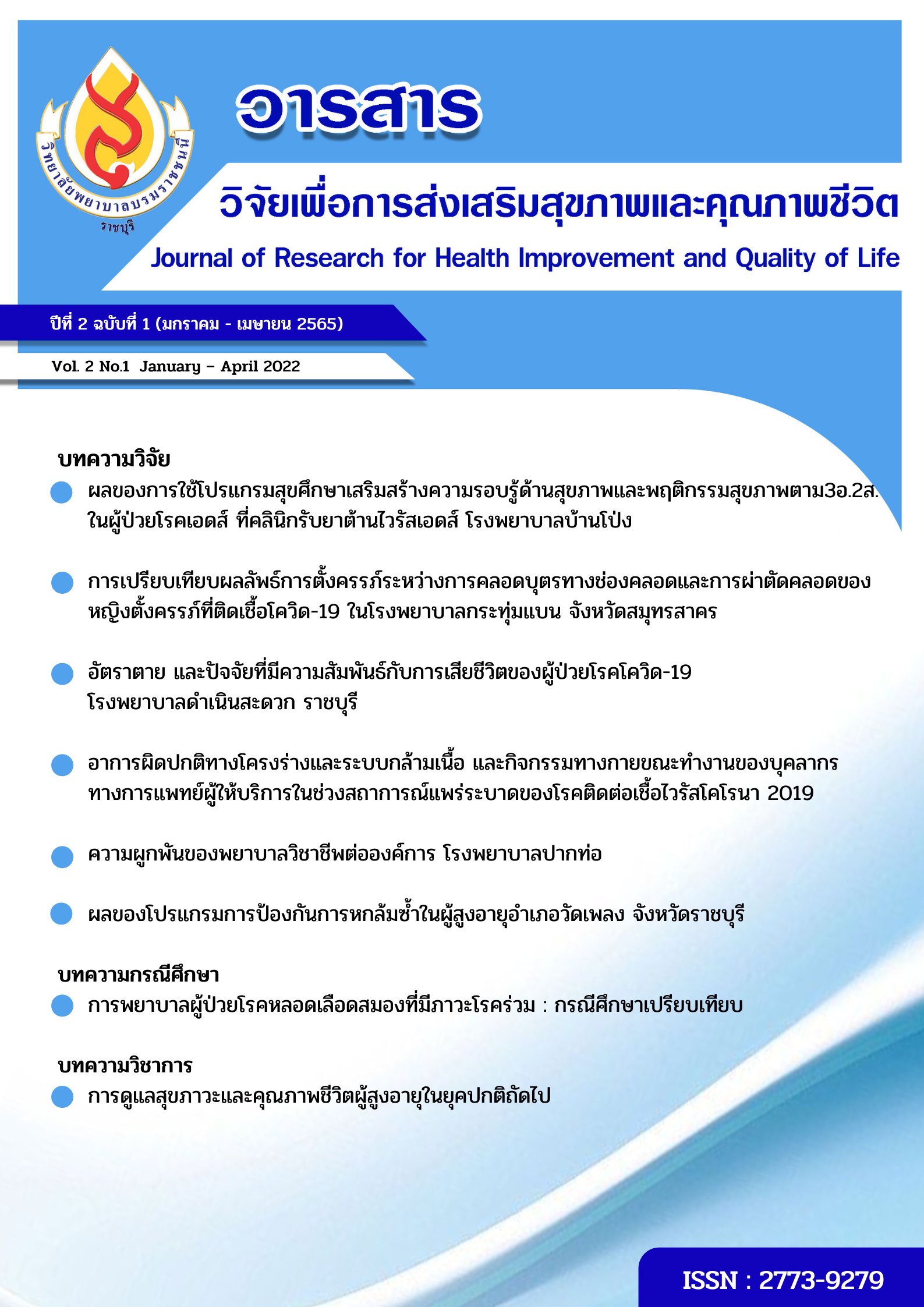
การดูแลสุขภาวะและคุณภาพชีวิตผู้สูงอายุในยุคปกติถัดไป
คำสำคัญ:
การดูแลสุขภาวะ, คุณภาพชีวิต, ผู้สูงอายุ, ยุคปกติถัดไปบทคัดย่อ
ความเปลี่ยนแปลงทางสังคมจากการระบาดของโรค Covid 19 ส่งผลต่อการดำเนินชีวิตและคุณภาพชีวิตผู้สูงอายุที่ปรับเปลี่ยนจากยุคปกติเป็นยุคปกติใหม่ และกำลังก้าวสู่ยุคปกติถัดไป การดูแลสุขภาวะจึงต้องเปลี่ยนแปลงตามไปเพื่อแก้ปัญหาสุขภาพให้สอดคล้องกับบริบทชุมชน ปัจจุบันการดูแลสุขภาวะผู้สูงอายุ อย่างต่อเนื่อง แบ่งเป็น 4 รูปแบบ ได้แก่ การดูแลแบบเฉียบพลัน การดูแลฟื้นฟูระยะกลาง การดูแลระยะยาว และการดูแลแบบประคับประคอง โดยปัญหาการดูแลสุขภาวะมีสาเหตุจากหลายปัจจัย ได้แก่ ความเสื่อม ด้านร่างกาย การปรับตัว ด้านเศรษฐกิจ การเข้าถึงระบบสุขภาพ การขาดความพร้อมในการเข้าสู่วัยสูงอายุ และการระบาดของโรค Covid 19 เป็นต้น ความเปลี่ยนแปลงของการดูแลสุขภาวะในยุคปกติใหม่ที่ผ่านมาเน้นป้องกันเกิดผู้ป่วยรายใหม่ด้วยการใช้มาตรการลดการเดินทาง มาตรการ DMHTT และการเสริมสร้างภูมิคุ้มกันด้วยการรับวัคซีน ซึ่งยังไม่สามารถควบคุมโรคโดยเฉพาะในกลุ่มผู้สูงอายุ การดูแลสุขภาวะผู้สูงอายุในยุคปกติถัดไปจึงต้องปรับเปลี่ยนให้สอดคล้องกับการดำเนินชีวิตที่โรค Covid 19 กลายเป็นโรคประจำถิ่น ด้วยการลดการสัมผัสและส่งเสริมการประยุกต์ใช้ระบบเทคโนโลยีสารสนเทศรวมทั้งปัญญาประดิษฐ์ช่วยในกระบวนการบริการผู้สูงอายุทั้งในสถานบริการและชุมชน รวมทั้งส่งเสริมศักยภาพในการดูแลตนเองแก่ผู้สูงอายุ ครอบครัว และแกนนำชุมชนเพื่อร่วมสร้างสุขภาวะดีแก่ผู้สูงอายุในยุคปกติถัดไป
เอกสารอ้างอิง
Bank of Thailand. (2020). Adaptive mind in the new normal. BOT MAGAZINE, 8(6), 8-10. (in Thai)
Bakhshi, H., Downing, J., Osborne, M. & Schneider, P. (2017). The future of skills: employment in 2030. London: Pearson and Nesta.
Beadle-Brown, J., Murphy, G., & DiTerlizzi, M. (2009). Quality of life for the Camberwell cohort. Journal of Applied Research in Intellectual Disabilities, 22(4), 380-390.
Boonprakob T, Sasat S. (2019). Selected factors related to postoperative recovery in older person with total knee arthroplasty. Royal Thai Navy Medical Journal, 46(2):355-68. (in Thai)
Chayarut, P., Roojanavech, S., & Chatdokmaiprai, K. (2019). The effects of health risk communication program among diabetic retinopathy patients in a community Samut Sakhon Province. Journal of The Royal Thai Army Nurses, 20(3), 206-217. (in Thai)
Department of older persons. (2022). Statistics of the older adult infected with covid 19 in Thailand. Retrieved March 10, 2022 from https://www.dop.go.th/th/know/side/1/1/1167.
Fivecoat HC, Sayers SL, Riegel B. (2018). Social support predicts self-care confidence in patients with heart failure. Eur J Cardiovasc Nurs, 17(7):598-604.
Karimy, M., Koohestani, H., R., & Araban, M. (2018). The association between attitude, self-efficacy, and social support and adherence to diabetes self-care behavior. Diabetology & Metabolic Syndrome, 10(86), 1-6.
Khakhuen, S., Kongmaha, H., & Thasanoh, P., E. (2020). Mental health and related factors among older adults. Journal of Health and Nursing Research, 36(3), 150-163. (in Thai)
Kleinman, A. (1980). Patients and healers in the context of culture. Berkeley: University of California Press.
Kulprateepunya, K., Reungsit, W., Wongprasert, J. (2018). Factor and theory associated with
health promotion behaviors of Thai elderly : A Literature review. UMT Poly Journal, 16(1), 295-305. (in Thai)
Nakasaney, S. (2018). Self-healthcare behavior of the elderly in Bangkok. Rajabhat Rambhai
Barni Research Journal, 12(1), 39-48. (in Thai)
National Statistical office, Ministry of Digital Economy and Society. (2020). The 2021 health
and welfare survey (1st ed.). Bangkok: TANA PRESS & GRAPHIC COMPANY LIMITED.
Office of the Education Council, Ministry of Education .(2021). Future skills to prepare for
development of quality Thai people for all and Supporting rapid Disruption of the world in the 21st century: results and guidelines (1sted.). Nakhon Pathom: Phetkasem Printing Group. (in Thai)
Pienjongkol, C., & Thaipisuttikul, P .(2020). Prospective cohort study of 1-ear incidence of cognitive impairment in patients with elderly depression at psychiatric outpatient unit, Ramathibodi Hospital. J Psychiatr Assoc Thailand, 65(1), 89-102. (in Thai)
Preechakoon, B., Molek, R., Chuwongin, D., Gongmuang, P., Sombutboon, M. (2020). Nursing
in data technology era. The Journal of Chulabhorn Royal Academy, 3(1), 19-39. (in Thai)
Suthamchai, B., Keskpichayawattana, J., & Kaeowichian, N. (2015).A synthesis of integrated
care service model for Thai elderly. Journal of Health Science, 24(6), 1017-1029. (in Thai)
Suwancheep. (2011). Transcript of interviews on the older adult care experiences. 2 December 2011. At the meeting room of Bureau of the Mental Health Development, Department of Mental Health. (in Thai)
Tabrizi, J., S., Behghadami, M., A., Saadati, M. (2018). Self-care ability of older people living in
urban areas of Northwestern Iran. Iran J Public Health, 47(12), 1899-1905.
Tachavijitjaru C. (2018).Health literacy: a key indicator towards good health behavior and
health outcomes. Journal of The Royal Thai Army Nurses, 19(Suppl 1):1-11. (in Thai)
Thaithae, S., Thanaboonpuang, P., & Mahaprom, T. (2021). Factors affecting health care
behaviors of the elderly among urban community in Bangkok. Royal Thai Navy Medical Journal, 48(2), 393-406. (In Thai)
Uchmanowicz, z., Polanska, B., J., Mazur, G., & Froelicher, E., S. (2017). Cognitive deficits and
self-care behaviors in elderly adults with heart failure. Clinical Interventions in Aging, 12, 1565-1572.
ดาวน์โหลด
เผยแพร่แล้ว
ฉบับ
ประเภทบทความ
สัญญาอนุญาต
ลิขสิทธิ์ (c) 2022 วิทยาลัยพยาบาลบรมราชชนนี ราชบุรี

อนุญาตภายใต้เงื่อนไข Creative Commons Attribution-NonCommercial-NoDerivatives 4.0 International License.
บทความทีตีพิมพ์ในวารสารนี้ถือว่าเป็นลิขสิทธิ์ของวิทยาลัยพยาบาลบรมราชชนนี ราชบุรี และผลงานวิชาการหรือวิจัยของคณะผู้เขียน ไม่ใช่ความคิดเห็นของบรรณาธิการหรือผู้จัดทํา