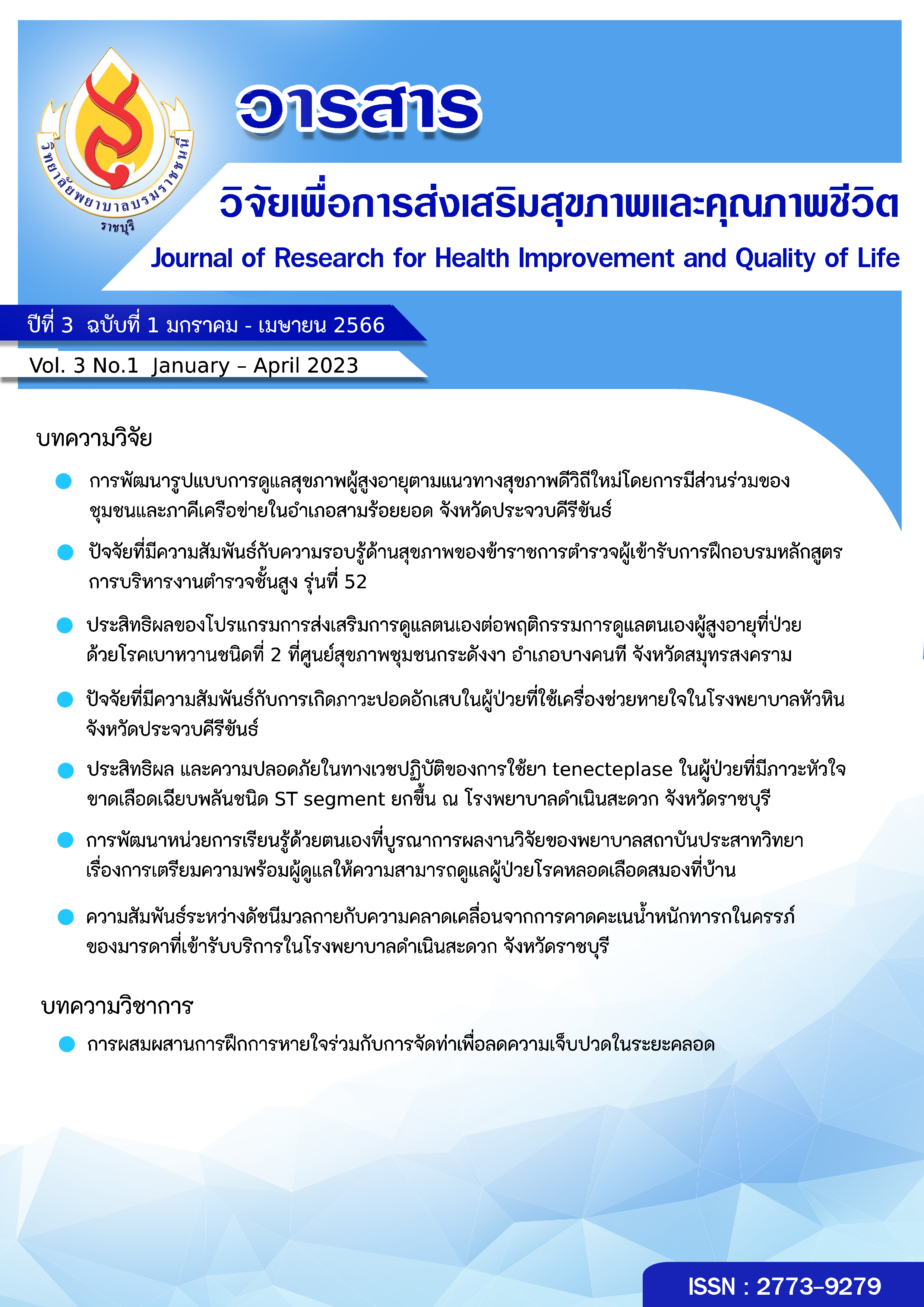
The Integration of Breathing Exercise with Positioning Nursing Practice to Painfulness on the duration of Labour
Keywords:
Breathing exercise, Positioning based, Patients with Hypertension, Duration of laborAbstract
Labour is a natural process that a parturient must face painfulness. The painfulness affects to the increasing of epinephrine and cortisol level, and then the uterine contraction is slower or intermittent. These effects can cause to a prolong labour and lead to be operative obstetrics. The integration of breathing exercise and positioning based on clinical nursing during a labour time will relax abdominal muscles and reduce the resistance between abdominal wall and uterus; hence the maternal heart-rate and blood pressure will decrease, and also lower on energy that will help to be lower tired. Upright position during labour is well influence to the parturient and fetuses. Together with the Earth’s gravity pulling, their heads will be moving down well, causing to be more and more cervix dilatation.
Therefore, the integration of breathing exercise with nursing practice of upright positioning is an effective method; easily operate, save for parturient, reduce painfulness and shorten first period of labour.
References
Abushaikha, L. & Oweis, A. (2005). Labour pain experience and intensity : a Jordanian perspective, International Journal of nursingPractice, 11(1), 33-38.
Alqattan H, Cleland J, & Morrison Z. (2018). An evaluation of patient safety culture in a secondary care setting in Kuwait. Journal of Taibah University Medical Sciences, 13(3), 272-80.
Barbara, S. (1984). Contral of pain in labor. Nursing Mirror, 7(3), 31-33.
Bobak, I. M. & Jensen, M. D. (1993). Maternity and gynecologic care: The nurse and the family. (5th ed.). St. Louis: Mosby.
D’Arcy YM. (2007). Pain management evidence-based tools and techniques for nursing professionals. United States of America: HCPro Inc.
Dick-Read, L. (2007). Real natural childbirth. Regaining our most fundamental birth right. Dick-Read School for Natural Childbirth. Australia.
Fahami , F., Masoudfar, S. & Davazdahemami, Sh. (2007). The effect of lamaze practices on the outcome of pregnancy and labor in primpara women. Iranian Journal of Nursing and Midwifery Research, 12(3), 111-114.
Khamvongsa, J. (2018). The effects of continuous support program during labor by nurses on pain levels and pain coping behaviors in primiparous adolescents at Buengkan hospital. Udonthani Hospital Medical Journal. 26(3):164-75.
Khwanmueang P, Chunuan S, & Thitimapong B. (2020). Effect of childbirth preparation program with continuous labor support on labor pain of first-time teenage pregnant women. Nursing Journal of The Ministry of Public Health, 30(3), 115-27.
Khwepeya, M., Lee, G. T., Chen, S. R., & Kuo, S. Y. (2018). Childbirth fear and related factors among pregnant and postpartum women in Malawi. BMC pregnancy and childbirth, 18(1), 391- 398.
Lawrence , A., Lewis, L., Hofmeyr, G. J., Dowswell, T. & Styles, C.(2009). Maternal positions and mobility during first stage labour. The Cochrane Library. Oxford, UK: Update Software.
Leeman , L. et al. (2003). The nature and management of labor pain: part I. nonpharmacologic pain relief. American Family Physician, 68(6), 1109-1112.
Lowdermilk, D.L., et al., (1999). Maternity nursing. St.Louis :Mosby
Lowdermilk, D.L. & Fishel, A.H. (1991). Computer simulations as a measure of nursing students decision – making. Journal of Nurse Education, 30(1), 34-39.
Lowdermilk, D.L. & Perry, S. E. (2004). Maternity& women health care.(8th ed.) St. Louis :Mosby
Mander, R. (2011). Pain in childbearing and its control. SPI Publisher Services, Pondicherry, India.
Marmor, T. R. & Krol, D. M. (2002). Labor pain management in the United States: understanding patterns and the issue of choice. American Journal of Obstetrics and Gynecology, 186(5), 173-180.
Mayberry, L.J., Clemmens, D. & De, A. (2002). Epidural Analgesia side effects, co-interventions and care of women during childbirth : a systematic review. American Journal Obstetrics & Gynecology, 186, S81-S93.
McDonald, S. (2003). Physiology and management of the third stage of labour. In D. Fraser and M.Cooper. Myles Textbook for midwives. Edin-burgh: Churchill Livingstone.
McNeil, A., & Jomeen, J. (2010). 'Gezellig': a concept for managing pain during labour and childbirth. British Journal Of Midwifery, 18(8), 515-520.
Mercer R.T. (1981). A theoretical framework for studying factors that impact on the maternal role. Nursing research, 30, 73 – 77.
Nichols, F.H. & Zwilling, E. (1997). Maternal- newborn nursing: Theory and Practice. Philladelphia: W.B. Saunder.
Novak, J.C., & Broom, B.L., (1995). Maternal and child health nursing. St. Louis: Mosby
Sauls D. J. (2004) Adolescents' perception of support during labor. The Journal of Perinatal Education, 13(4), 36–42.
Steel, A., Adams, J., Sibbritt, D., Broom, A., Gallois, C., & Frawley, J.(2015). Managing the pain of labour: factors associated with the use of labour pain management for pregnant Australian women. Health expectations. An international journal of public
Participation in health care and health policy, 18(5), 1633-1644.
Thomson G, Feeley C, Moran VH, Downe S, & Oladapo OT. (2019). Women's experiences of pharmacological and non-pharmacological pain relief methods for labour and childbirth: a qualitative systematic review. Reprod Health, 16(1), 71-79.
Tzeng YL, Yang YL, Kuo PC, Lin YC, & Chen SL. (2017). Pain, anxiety, and fatigue during labor: a prospective, repeated measures study. J Nurs Res, 25(1), 59-67.
Worawong, D., Anusornteerakul, S., & Chaisiwamongkol, W. (2011). Mother's pain level in the first stage of labor after receiving pain relief. using breathing techniques Abdominal stroking and coccyx massage. Journal of Nursing Science and Health, 34(3), 31-39.
Downloads
Published
Issue
Section
License
Copyright (c) 2023 ฺ

This work is licensed under a Creative Commons Attribution-NonCommercial-NoDerivatives 4.0 International License.
บทความทีตีพิมพ์ในวารสารนี้ถือว่าเป็นลิขสิทธิ์ของวิทยาลัยพยาบาลบรมราชชนนี ราชบุรี และผลงานวิชาการหรือวิจัยของคณะผู้เขียน ไม่ใช่ความคิดเห็นของบรรณาธิการหรือผู้จัดทํา