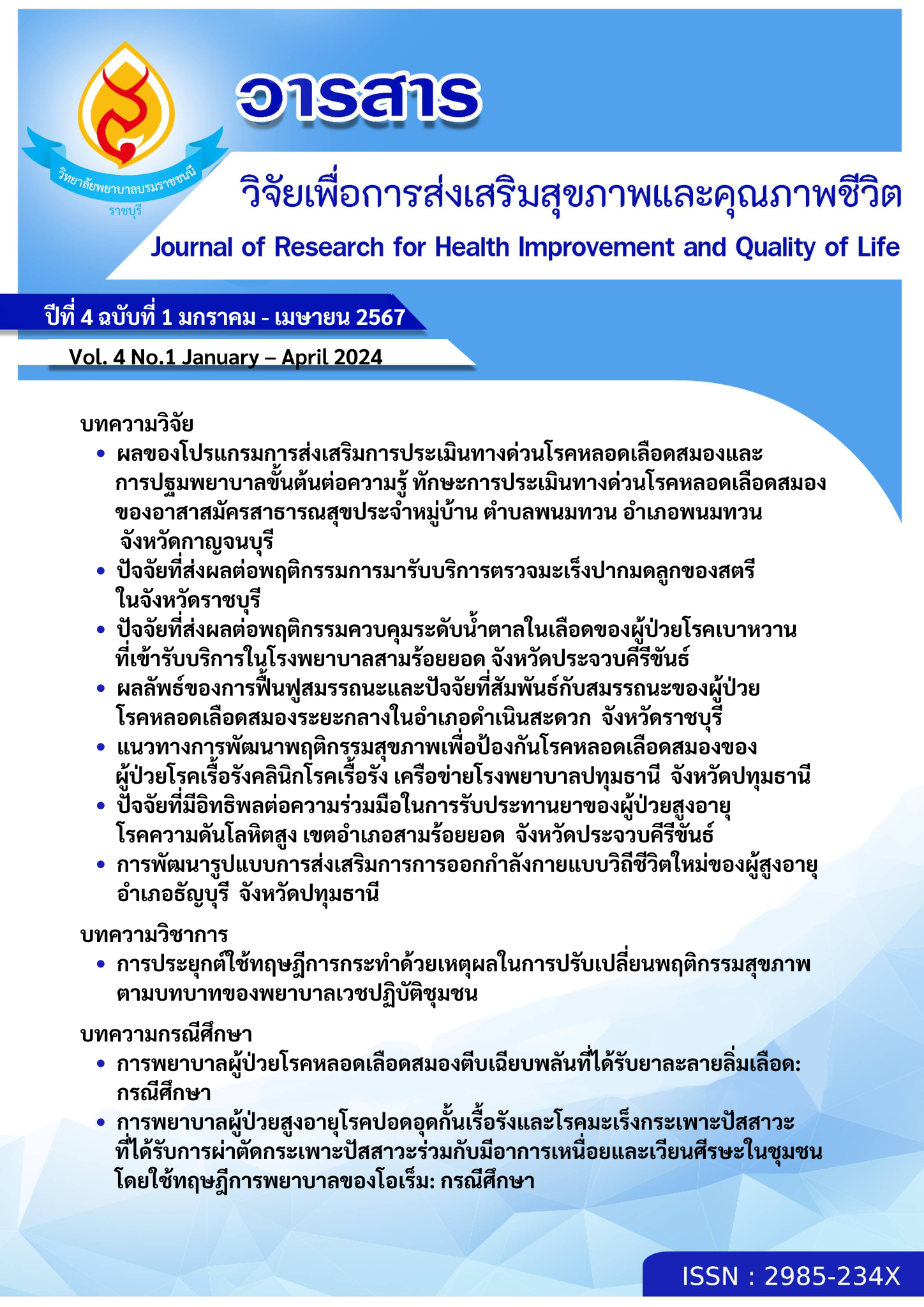
The effects of Promoting Stroke Fast Track assessment and basic first aid Continuing knowledge and skills in evaluating Stroke Fast Track of village health volunteers, Phanom Thuan Subdistrict, Phanom Thuan District, Kanchanaburi Province
Keywords:
Stroke fast track, First aid, Village health volunteersAbstract
The purpose of this quasi-experimental study was to investigate the effects of Promoting Stroke Fast Track assessment and basic first aid Continuing knowledge and skills in evaluating Stroke Fast Track. Of selecting a specific number of people 30 subjects. The data were collected using 3 –part questionnaire: 1) demographic data, 2) knowledge about cerebrovascular disease and 3) stroke fast track assessment skills. The reliability of questionnaires approached by Cronbach's Alpha Coefficient were 0.84 respectively, and knowledge approached by KR.-20 was 0.82. The data were analyzed using descriptive statistics, and t-test. The results revealed as follows:
1. After entering the program, the average score of knowledge about stroke in the post-trial period was higher. The pre-experiment period was statistically significantly. (p <.001).
2. After entering the Stroke Fast Track assessment skills program in the post-experiment period, more than The pre-experiment period was statistically significantly. (p <.001).
In conclusion, public health volunteers should be prepared to assess stroke risk together with the promotion of Stroke Fast Track assessment skills to increase the potential to care for people at risk in their work.
References
Angkhan, P., & Sukwan, C. (2022). Development of a model for accessing the emergency medical service system for stroke patients through a network Kantharalak District Sisaket Province, Journal of Primary Public Health (Northeast). Primary Health Care Journal (Northeastern Edition), 38(2), 52-63. (in Thai)
AungKharn, P., Sukawan,C., (2023). The effectiveness of the stroke assessment skill development program of village volunteers.https://www2.nkh.go.th/ nkh/journal/doc/31.pdf. (in Thai)
Chanagarn, C., & Phutthikhamin N. (2016). Perceptions on stroke risk factors warning signs treatment and preventive behaviors among health risk people. Joumal of Nursing Science & Health, 39(1), 70-77. (in Thai)
Dharmasaroja, P., Ratanakorn, D., Nitinon, S., Charnnarong, N., Chutinet, O., Keandoungchun, J., Hanchaiphiboolkul, S. Nilanont, Y., Udommongkol, J., Tantirittisak, T., Mungtaweephongsa, S., & Supachutikul, A. (2015) . Certified Primary Stroke Center ; CPSC. Journal of Thai Stroke Society, 14(2), 75-83. (in Thai)
Lamduan, K., Uthen, S., and Wanida, P. (2018). Effects of the program on knowledge enhancement and the ability on to assess and refer stroke patients of Bo Thong District Public Health Volunteers, Chonburi Province. Journal of the Association of Private Higher Education Institutions of Thailand under the Royal Patronage of Her Royal Highness Princess Maha Chakri Sirindhorn, 7(2), 127-136. (in Thai)
Sangseechan, T. (2015). Providing knowledge and skill training programs to caregivers to reduce anxiety in caring for stroke patients at Ban Phaeo Hospital. Veridian E-Journal,Slipakom University, 8(3), 572-595. (in Thai)
Suwintrakorn, C., Kalampakorn, S., & Rawiworraku, T. (2019). The effects of self-effificacy enhancement program for health volunteers on stroke surveillance and prevention. Thai Journal of Nursing, 68(1), 39-48. (in Thai)
World Stroke Organization.(2019). Annual reports. http://www.world stroke.org/about.wso/annual-reports
Downloads
Published
Issue
Section
License
Copyright (c) 2024 ฺ

This work is licensed under a Creative Commons Attribution-NonCommercial-NoDerivatives 4.0 International License.
บทความทีตีพิมพ์ในวารสารนี้ถือว่าเป็นลิขสิทธิ์ของวิทยาลัยพยาบาลบรมราชชนนี ราชบุรี และผลงานวิชาการหรือวิจัยของคณะผู้เขียน ไม่ใช่ความคิดเห็นของบรรณาธิการหรือผู้จัดทํา