
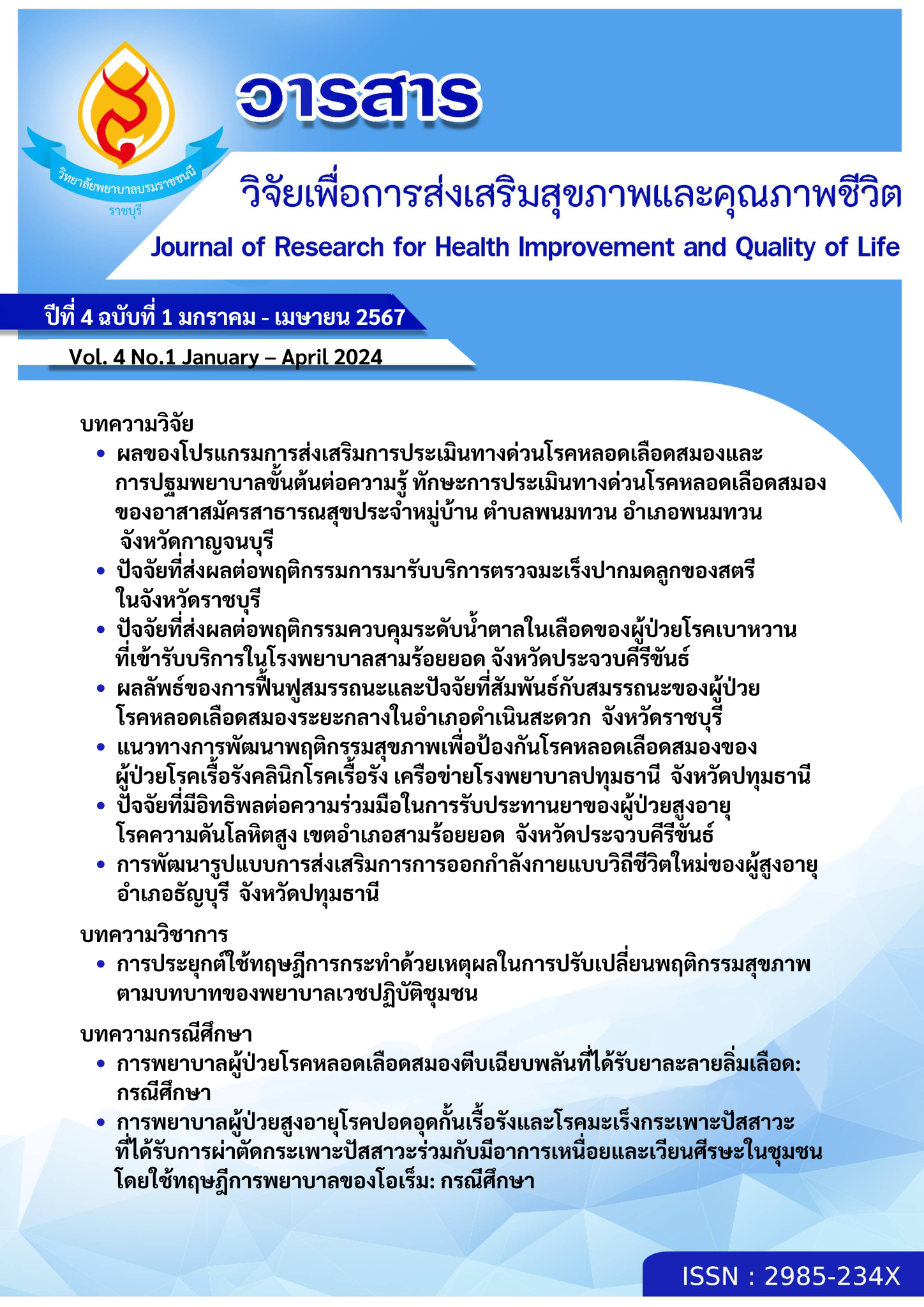
Guidelines for Developing Health Behaviors to Prevent Stroke in Patients with Chronic Diseases, Chronic Disease Clinic Pathum Thani Hospital Network, Pathum Thani Province
Keywords:
Health behavior, Stroke, Chronic disease patientsAbstract
The objectives of this study were to study 1) factors influencing health behavior to prevent stroke and 2) developing guidelines for health behavior to prevent stroke in patients with chronic diseases. The sample group consisted of 400 patients with chronic diseases who had notbeen diagnosed with stroke and 20 people stakeholders. Data were analyzed by using descriptive statistics and multiple regression analysis. The results found that:
1. Perception of cerebrovascular disease overall were at a moderate level (M= 3.03, SD= 0.48). When considering each aspect, it was found that the perception of benefits in disease prevention was the highest mean score at a high level (M= 4.42, SD = 0.38). The aspect with the lowest mean score was perception of barriers to disease prevention was at the low level (M = 2.10, SD = 0.44).
2. All 4 variables of perception of stroke can predict behavior to prevent stroke by 13.70 percent (R2 = .137).
3. Guidelines for developing health behaviors to prevent stroke in patients with chronic diseases is to emphasize knowledge on self-care, participation of families and communities in helping care for patients.
Therefore, the development of health behaviors to prevent stroke in patients with chronic diseases should emphasize educating patients and create participation in family and community care.
References
Becker, M. H. (1974). The health belief model and personal health behavior. New Jersey: Charles B. Slack.
Bloom B S. (1956). Taxonomy of educational objectives, the classification of educational goals –Handbook I: cognitive domain. New York: McKay.
Cochran, W. G. (1977). Sampling techniques (3rd ed.). New York: John Wilay & Sons.
Charoensin, S. (2021). Factors influencing stroke prevention behavior in patients. High blood pressure Mueang District, Nakhon Sawan Province. Thesis for the Master of Public Health Program Naresuan University. (in Thai).
Khiawkwao, P. (2019, September - December). Results of the stroke prevention program in high-risk patients. Journal of Health and Nursing Research, 35(3), 120-132. (in Thai).
Office for International Health Policy Development. (2016). Burden of disease: years of health lost and years of life. Estimated average health status of the Thai population. Journal of Public Health, 25(2), 342-350. (in Thai).
Rosenstock, I. M., Strecher, V. J., & Becker, M. H. (1988). Social learning theory and the health belief model. Health education quarterly, 15(2), 175-183.
Statistics and medical records Chronic Disease Clinic Pathum Thani Hospital Network. (2023). Report on treatment of chronically ill patients Chronic Disease, Clinic Pathum Thani Hospital Network, Pathum Thani Province in 2023. Chronic Disease Clinic Pathum Thani Hospital Network, Pathum Thani Province. (in Thai)
Thongyoo, C., & Dangdomyouth, P. (2017). The effect of health belief enhancement program on medication compliance behavior of schizophrenic patients. The Journal of Psychiatric Nursing and Mental Health, 31(1), 75-87.
World Health Organization. (2018). Assessing national capacity for the prevention and control of NCDs. WHO, http://www.who.int/ncds/surveillance/ncd-capacity/en/
World Stroke Organization. (2017). What’s your reason for preventing stroke [Internet]. Vienna: World Stroke Organization. https://www.worldstroke.org/assets/downloads/English-World Stroke Day 2017 Brochure 20170720.pdf
Downloads
Published
Issue
Section
License
Copyright (c) 2024 ฺ

This work is licensed under a Creative Commons Attribution-NonCommercial-NoDerivatives 4.0 International License.
บทความทีตีพิมพ์ในวารสารนี้ถือว่าเป็นลิขสิทธิ์ของวิทยาลัยพยาบาลบรมราชชนนี ราชบุรี และผลงานวิชาการหรือวิจัยของคณะผู้เขียน ไม่ใช่ความคิดเห็นของบรรณาธิการหรือผู้จัดทํา