
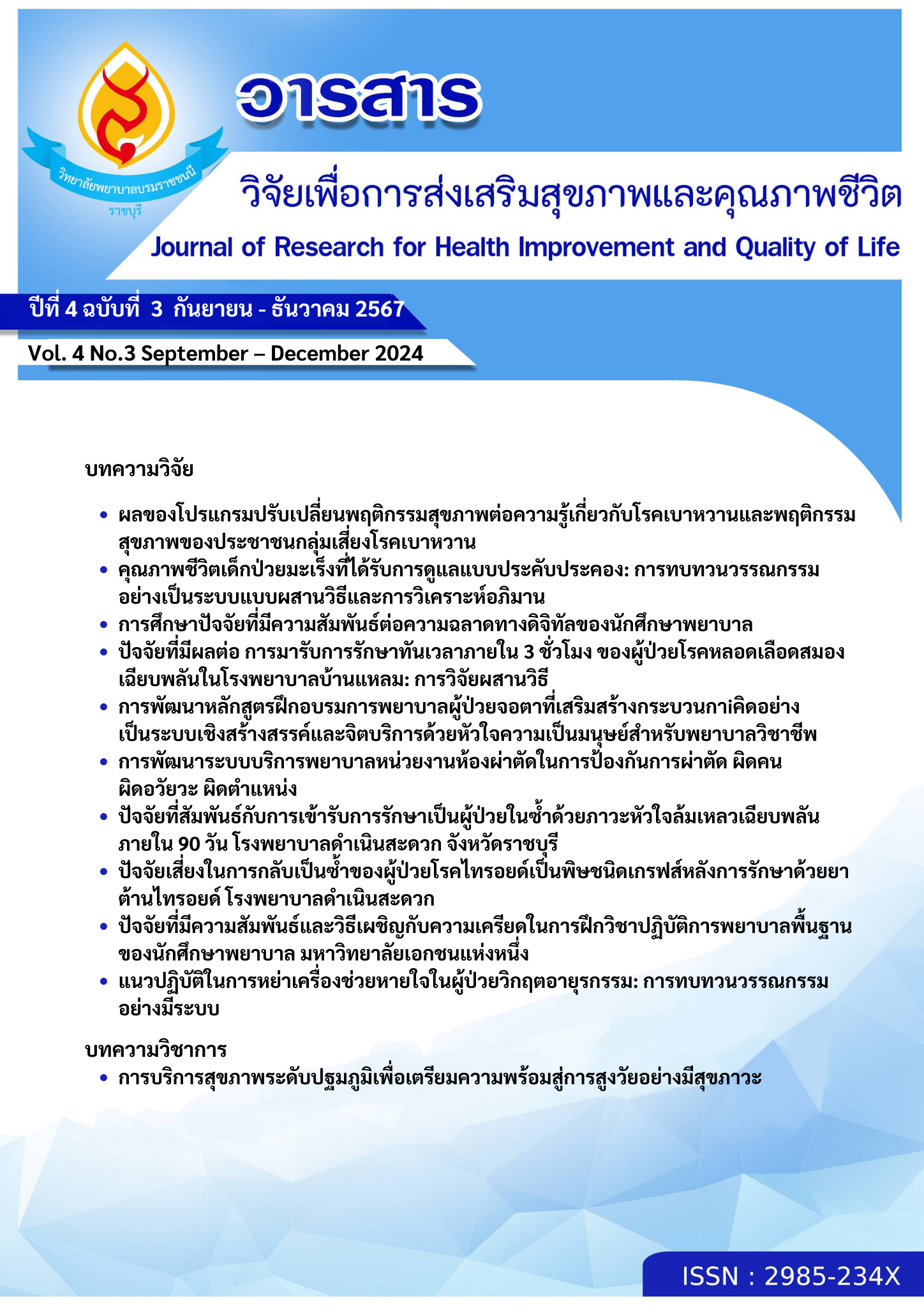
A Study of Factors Affecting Digital Intelligence Quotient of Nursing Students
Keywords:
Digital Intelligence Quotient, Nursing Students, Internal Factors, External FactorsAbstract
This research aimed to study the factors related to and influencing the digital intelligence quotient of nursing students using descriptive correlation research. Data were collected from a sample of 110 nursing students from the nursing faculty of private universities and government nursing faculty. The instrument used to collect data was a questionnaire, divided into 4 parts: Personal information questionnaire, Digital Intelligence Quotient questionnaire, internal factors questionnaire, and External factors questionnaire. Data analysis used descriptive statistics, Spearman correlation analysis, and multiple regression analysis. The findings are as follows:
The internal factors related to the digital intelligence quotient of nursing students were interest (ρ = 0.333, p< 0.01), motivation (ρ = 0.296, p< 0.01), and learning personality (ρ= 0.278, p< 0.01), which could predict digital intelligence by 43 per cent (R² = 0.436). The external factors related to the digital intelligence quotient were learning opportunities (ρ = 0.421, p< 0.01) and learning environment support (ρ= 0.348, p< 0.01), which could predict Digital Intelligence Quotient by 49 percent (R² = 0.497).
The results of this research indicate that both the internal and external factors mentioned above play an important role in the development of the digital intelligence quotient in nursing students. Therefore, it is proposed to develop a program that focuses on promoting these factors to systematically enhance the digital quotient potential of nursing students.
References
Aitken, M., Clancy, B., & Nass, D. (2017). The growing value of digital health in the United Kingdom. IMS Institute for healthcare Informatics. https://www.iqvia.com/insights/the-iqvia-institute/reports-and-publications/reports/the-growing-value-of-digital-health
De Young, C. G., Quilty, L. C., & Peterson, J. B. (2007). Between facets and domains: 10 aspects of the Big Five. Journal of Personality and Social Psychology, 93(5), 880-896. https://doi.org/10.1037/0022-3514.93.5.880
DQ Institute. (2019). DQ framework 2.0: Empowering the next generation with digital intelligence. Retrieved from https://www.dqinstitute.org
Eshet-Alkalai, Y. (2012). Evaluating digital literacy in education: Methods and approaches. Educational Technology & Society, 15(2), 1-10. Retrieved from https://www.jstor.org/stable/jeductechsoci.15.2.1
Hampshire, K., Mwase-Vuma, T., Alemu, K., Abane, A., Munthali, A., Awoke, T., ... & Kasim, A. (2021). Informal mhealth at scale in Africa: Opportunities and challenges. World development, 140, 105257. https://doi.org/10.1016/ j.worlddev.2020.105257
Hargittai, E. (2010). Digital naiveté? Teenagers' lack of online knowledge and skills. Consequences for online behavior. Journal of Computer-Mediated Communication, 16(2), 230-253. https://doi.org/10.1111/j.1083-6101.2010.01552.x
Kane, G. C., Palmer, D., Phillips, A. N., Kiron, D., & Buckley, N. (2015). Strategy, not technology, drives digital transformation. MIT Sloan Management Review, 14, 1-25. https://sloanreview.mit.edu/projects/strategy-drives-digital-transformation/
Livingstone, S., & Helsper, E. J. (2007). Gradations in digital inclusion: Children, young people and the digital divide. New Media & Society, 9(4), 671-696. https://doi.org/10.1177/1461444807080335
Insights, D. (2019). Deloitte's 2019 global blockchain survey. Blockchain Gets Down to Business. Deloitte. https://www2.deloitte.com/us/en/insights/industry/ telecommunications/global-mobile-consumer-survey-2019.html
Ogundaini, O. O., de la Harpe, R., & McLean, N. (2021). Integration of mHealth information and communication technologies into the clinical settings of hospitals in sub-Saharan Africa: qualitative study. JMIR mHealth and uHealth, 9(10), e26358. https://doi.org/10.2196/26358
Park, Y. (2016). Digital intelligence: The key to success in the digital age. Journal of Computer and Information Technology, 34(2), 235-246.
Rivoltella, P. C. (2018). Digital literacy and digital competence: Between promise and illusion. In M.Ranieri (Ed.), Digital literacy, technology, and social inclusion: Making sense of one-to-one computer programs (pp. 15-32). Springer.
Siling, V., Hengudomsub, P., Vatanasin, D., & Buri, C. (2023). Factors associated with Digital intelligence quotient among Lower secondary school students. Medical and Public Health Journal of Region 4,13(2), 39–52. (in Thai)
Van Deursen, A. J. A. M., & van Dijk, J. A. G. M. (2014). The digital divide shifts to differences in usage. New Media & Society, 16(3), 507-526. https://doi.org/10.1177/1461444813487959
Selwyn, N. (2004). Reconsidering political and popular understandings of the digital divide. New Media & Society, 6(3), 341-362. https://doi.org/10.1177/1461444804042519
Tsai, C. C., Chai, C. S., & Lee, C. S. (2018). Teachers’ digital literacy and their integration of technology in the classroom. Computers & Education, 119, 1-10. https://doi.org/10.1016/j.compedu.2018.01.013
Thongmeekhaun,T.,Sungkhachat,B.,Kitrungroap,T.,Juntaveemuang,V., & Meena,S.(2018). Computer Related Health Problems: Risk Perception in Protection Behaviors among Supporting Staffs.The Southern College Network Journal of Nursing and Public Health,5(2),258-271.
Downloads
Published
Issue
Section
License
Copyright (c) 2024 ฺ

This work is licensed under a Creative Commons Attribution-NonCommercial-NoDerivatives 4.0 International License.
บทความทีตีพิมพ์ในวารสารนี้ถือว่าเป็นลิขสิทธิ์ของวิทยาลัยพยาบาลบรมราชชนนี ราชบุรี และผลงานวิชาการหรือวิจัยของคณะผู้เขียน ไม่ใช่ความคิดเห็นของบรรณาธิการหรือผู้จัดทํา