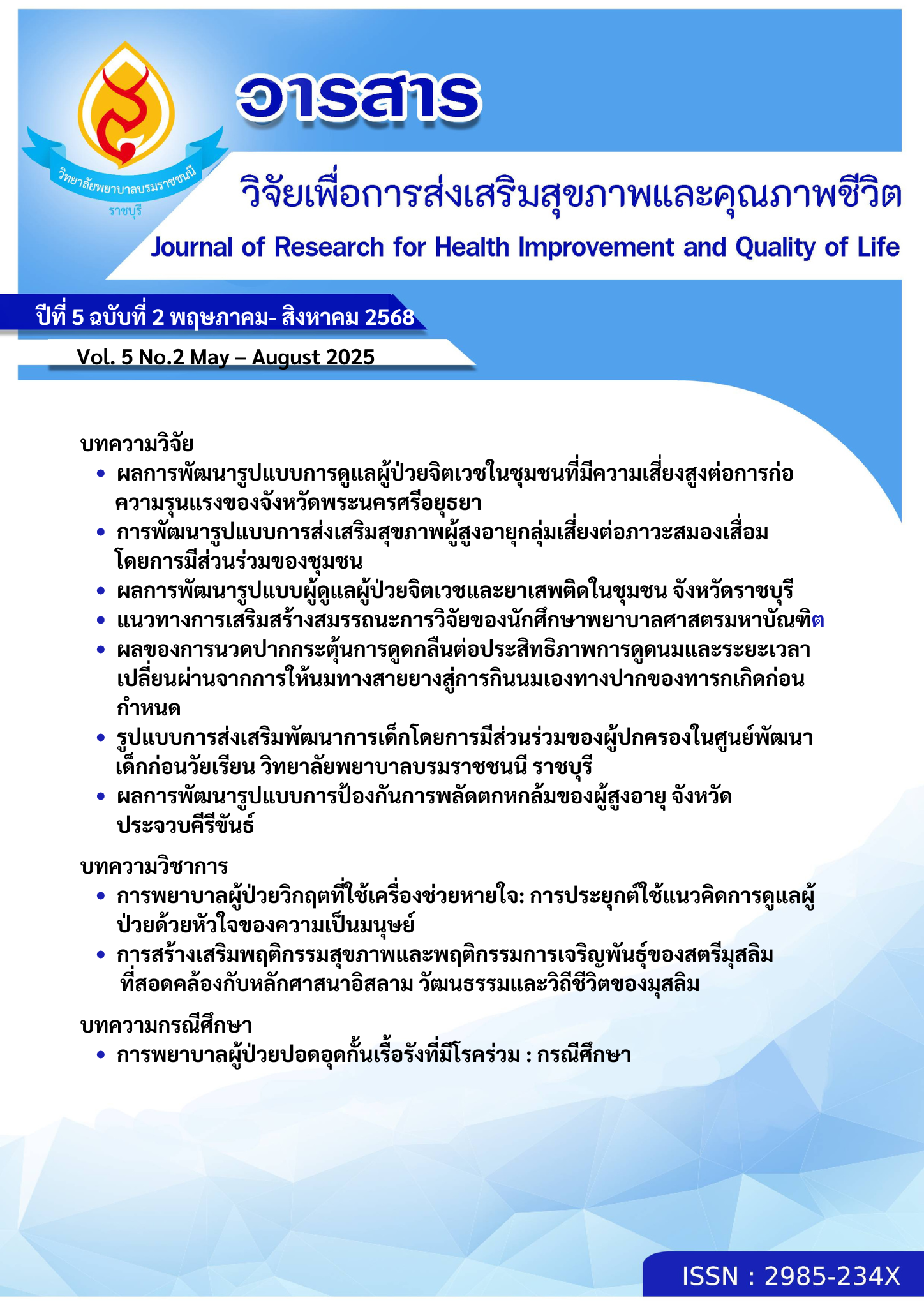
Promoting Health Behaviors and Reproductive Behaviors Aligned with Islamic Principles, Culture, and the Way of Life of Muslim Women
Keywords:
Health Behaviors, Reproductive Behaviors, Community-Based Participatory Research (CBPR), Muslim WomenAbstract
The health behaviors of most Muslim women are characterized by high-fat dietary consumption and insufficient physical activity. Common health problems include chronic conditions such as obesity, hyperlipidemia, diabetes, and hypertension. In terms of reproductive behavior, Muslim women tend to care for themselves according to Islamic principles, local community practices, and medical guidelines, with a preference for temporary contraceptive methods. However, some still believe that contraception, even in high-risk health situations, is against Islamic teachings. According to Islamic doctrine, permanent contraception is prohibited unless justified by medical necessity. Health care emphasizes health promotion and disease prevention rather than curative care. Moderation in food intake is encouraged to maintain good health, which in turn supports the ability to fulfill religious duties. Family plays a significant role in influencing decisions related to accessing health services, while religious leaders hold an important position in disseminating knowledge and guiding community members’ behaviors. Therefore, health promotion in Muslim communities must respect cultural norms and involve collaboration with religious leaders to foster proper understanding and behavior change. Promoting health and reproductive behaviors among Muslim women should integrate Islamic principles with modern health practices. Additionally, the Community-Based Participatory Research (CBPR) approach should be adopted to empower Muslim women in managing their own health. Such integration can lead to more effective, culturally sensitive, and sustainable health promotion tailored to the needs of Muslim women.
References
Ayhan, H., Yaman, A., Baykara, Z. G.,& Duru, P. (2014). Normal saline instillation before
endotracheal suctioning: “What does the evidence say?What do the nurses think?” Multimethod study. Journal of Critical Care, 30(4), 762–767. https://doi.org/10.1016/j.jcrc.2014.02.010
Bumrungphong, B., Aumnate, C., & Pakdeechote, P. (2018). Extubation and duration of
mechanical ventilation among critically ill patients receiving evidence-based nursing practice. Kuakarun Journal of Nursing, 22(1), 129–143. (in Thai)
Chanphen, N., Deuanram, R., & Warathip, K. (2020). Professional nursing competencies in caring for patients using ventilators. Journal of Nursing and Health Care, 28(1), 6-14. (in Thai)
Florence, N. (1969). Notes on nursing: What it is and what it is not. Dover.
Jiaranai, C. (2017). Nursing care for patients with oxygenation and ventilation disorders
(4th ed.). Charansanitwong Printing. (in Thai)
Kulsirin, K., & Kachonam, S. (2018). Professional nursing competency in ventilator patient care at Nopparat Rajathanee Hospital. Vajira Nursing Journal, 20(2), 1–12. (in Thai)
Limumnoilap, S. & Tumnong, C. (2014). Critical Care Nursing (7th ed.). Klungnana Vitthaya Press. (in Thai)
Nakrit, B., Namwongphrom, A., & Phakdeewong, N. (2015). Unplanned extubation and
duration of mechanical ventilation in critically ill patients managed with evidence-based nursing practice. Kuakarun Journal of Nursing, 22(1), 129-143. (in Thai)
Panthu, K. (2021). Caring for patients using ventilators. Chulalongkorn University Publishing House. (in Thai)
Phongphaew, K., & Kachanam, S. (2018). Competencies in managing ventilator-dependent patients among professional nurses at Nopparat Rajathanee Hospital. Vajira Nursing Journal, 20(2), 1-12. (in Thai)
Plotplueang, A., Meenasantirak, A., Plianbamrung, D., Rakbanglaem, C., & Ounprommee, S.
(2018). Learning experiences of humanized care practice. Journal of MCU Nakhonsawan, 5(3), 745–770. (in Thai)
Ponsirirat, T., & Phoolkarung, Y. (2018). A nursing manual for acute respiratory failure patients treated with non-invasive positive pressure ventilation. Siriraj Hospital, Mahidol University. (in Thai)
Sricharoenchai, T. (2016). Ventilator for the beginners: When to start invasive ventilation and what to gve? In Dusit Sataworn, and Kronchit Piyawechawirat (Editor), All about critical care: Toward critical care excellence (pp. 145-164). Nonthaburi: Beyond Enterprise Company Limited. (in Thai)
Suwannaew, R. (2024). Humanized health care: A holistic approach to patient care. (in Thai)
Tabutwong, W., & Julamet, P. (2015). Elderly patients using ventilators: Psychosocial care. Journal of Faculty of Nursing, Burapha University, 23(2), 41-51. (in Thai)
Thailand nursing and midwifery council. (2010). Competencies of registered nurses. 2nd ed. Siriyod printing. (in Thai)
Williams, S. (2013). Chapter 10: Nursing care for critically ill patients with respiratory
disorders. In S. Lim-amnuaylap, K. Simacharuek, P. Siripakan, & C. Thamnong (Eds.), Critical care nursing for adult patients (pp. 145-173). Khon Kaen: Khlang Nana Witya. (in Thai)
Yooyangket, A., & Ketphichayawattana, J. (2019). Effects of a humanitude care program on anxiety among elderly patients in a cardiac ICU. Journal of Health and Nursing Research, 35(2), 129-139. (in Thai)
Yuyangket, A., & Kasepitchayawatana, J. (2019). Effects of a humanitude care program on anxiety among elderly patients in a cardiac ICU. Journal of Health and Nursing Research, 35(2), 129–139. (in Thai)
Downloads
Published
Issue
Section
License
Copyright (c) 2025 ฺ

This work is licensed under a Creative Commons Attribution-NonCommercial-NoDerivatives 4.0 International License.
บทความทีตีพิมพ์ในวารสารนี้ถือว่าเป็นลิขสิทธิ์ของวิทยาลัยพยาบาลบรมราชชนนี ราชบุรี และผลงานวิชาการหรือวิจัยของคณะผู้เขียน ไม่ใช่ความคิดเห็นของบรรณาธิการหรือผู้จัดทํา