
The Effects of Evidence-Based Nursing Practice Teaching in Nursing Administration Practicum Subject on Cognitive Skills of Nursing Students
Keywords:
Cognitive skill Evidence-based practice Nursing Administration Practicum subjectAbstract
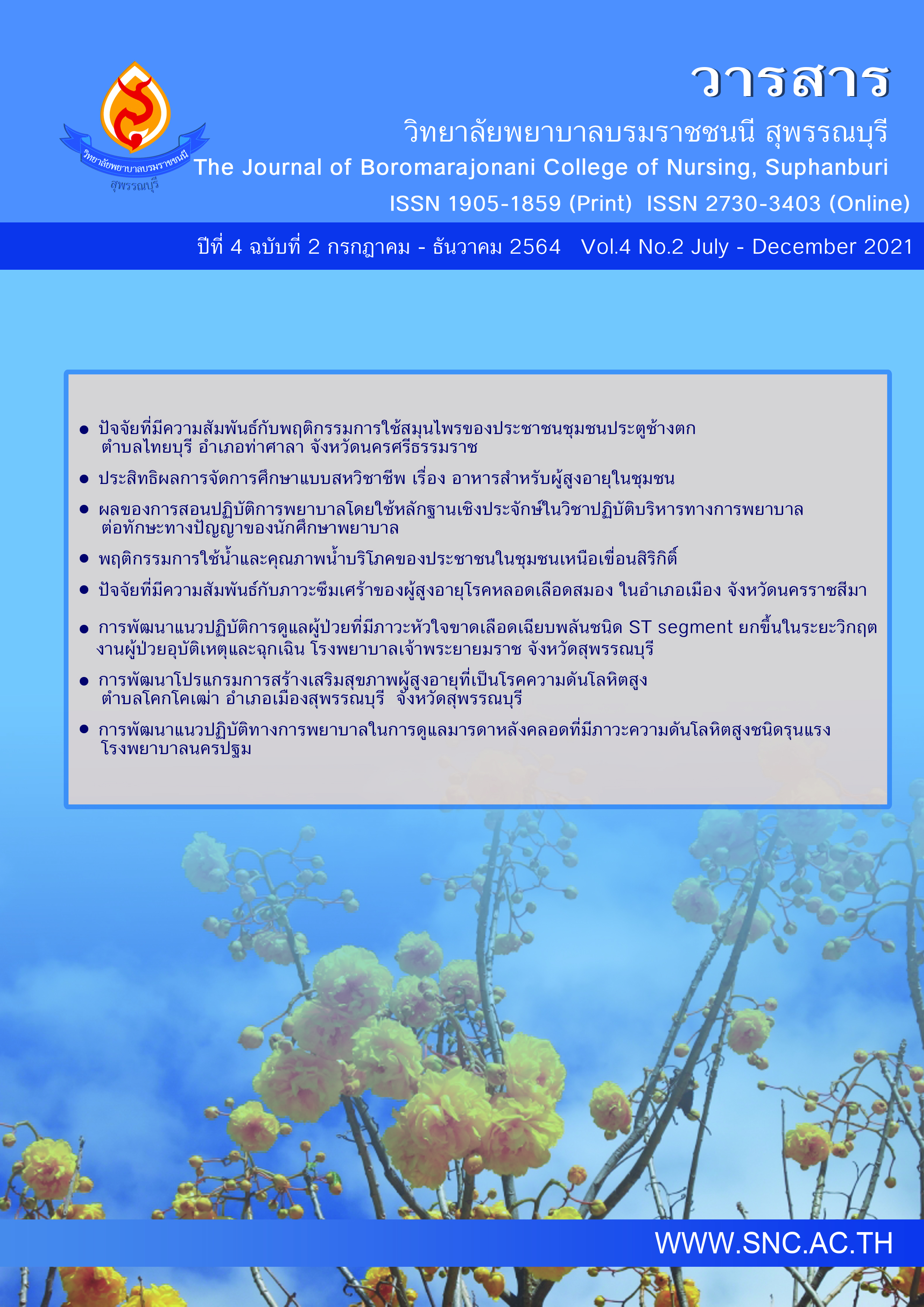
The purpose of this quasi-experimental study (two group pretest – posttest design) was to compare cognitive skills of undergraduate nursing students at before and after teaching the Evidence-Based Nursing Practice(EBNP) in nursing administration practicum subject . The study samples were the fourth- year nursing students which were divided into 2 groups with 30 in the experimental group and 30 in the control group. The sample size was calculated using G*power 3.1.9.4 program and selected a specific sample group. The research instruments consisted of 2 parts : 1) Methods of teaching and learning according to the Evidence-Based Procedures of Flemming & Fenton.(2002) and 2) Cognitive skills scales 1 and 2, Cronbach's Alpha confidence coefficient were 0.79 and 0.74, respectively. Descriptive statistics,and t-test were used for data analysis.
The results showed that the mean and standard deviation of cognitive skill scores after teaching nursing practice of the experimental group using the evidence-based in the nursing administration practicum subject were higher than the normally taught control group statistically significant at the .01 level. Besides, It was found that the mean and standard deviation of cognitive skill scores after teaching nursing practice of the experimental group using the evidence-based in the nursing administration practice subject were higher than the control group taught by normal on all sides statistically significant at the .01 level when separated by aspects. The recommendation should be apply to enhance the cognitive skills of nursing students in other nursing practice subjects.
References
เกียรติกำจร กุศล เสาวลักษณ์ วงศ์นาถ และอุไร จเรประพาฬ. (2551). ผลการจัดการเรียนการสอนโดยใช้ ปัญหาเป็นหลักต่อความสามารถในการคิดอย่างมีวิจารณญาณของนักศึกษาพยาบาลในรายวิชาปฏิบัติการพยาบาลเด็กและวัยรุ่น. การพยาบาลและการศึกษา, 1(2), 32-45.
คณะกรรมการการอุดมศึกษา. (2552). ประกาศแนวทางการปฏิบัติตามกรอบมาตรฐานคุณวุฒิระดับอุดม
ศึกษาแห่งชาติ พ.ศ. 2552.
ทิศนา แขมมณี. (2550). ศาสตร์การสอนองค์ความรู้เพื่อการจัดกระบวนการเรียนรู้ที่มีประสิทธิภาพ พิมพ์ครั้งที่ 6. กรงเทพฯ: สำนักพิมพ์แห่งจุฬาลงกรณ์มหาวิทยาลัย.
ทิศนา แขมมณีและคณะ. (2554). ทักษะการคิดวิเคราะห์ สังเคราะห์ สร้างสรรค์และการคิดอย่างมี วิจารญาณ: การบูรณาการในการจัดการเรียนรู้.กรุงเทพฯ: สำนักธรรมศาสตร์และการเมือง
ราชบัณฑิตยสถาน.
ทัศนีย์ เกริกกุลธร. (2555). การพยาบาลโดยใช้หลักฐานเชิงประจักษ์: ขั้นตอนการปฏิบัติและกรณีศึกษา.
พิมพ์ครั้งที่ 2 (ฉบับปรับปรุง). สระบุรี: โรงพิมพ์ไทยศิริ.
ธนพร แย้มสุดา. (2551). การพัฒนาการคิดอย่างมีวิจารณญาณทางพยาบาลศาสตร์. สารวิทยาลัยพยาบาล
กองทัพเรือ, 7(3), 8-17.
นุสรา นามเดชและคณะ. (2560). ผลของการสอนปฎิบัติการพยาบาลโดยใช้หลักฐานเชิงประจักษ์ในวิชา
ปฏิบัติ การพยาบาลบุคคลที่มีปัญหาทางสุภาพจิตต่อทักษะทางปัญญาของนักศึกษา.วารสารวิทยาลัย
พยาบาลบรมราชชนนี กรุงเทพ, 33(2), 111-121.
นุสรา ประเสริฐศรี มณีรัตน์ จิรัปปภาและอภิรดี เจริญนุกูล. (2559). ผลของโปรแกรมการสอนตามแนวคิดการ ใช้หลักฐานเชิงประจักษ์ต่อสมรรถนะการพยาบาล ตามหลักฐานเชิงประจักษ์ในนักศึกษาพยาบาลวารสารการพยาบาล การสาธารณสุขและการศึกษา, 17 (3) ,145-155.
นิธิภัทร บาลศิริ. (2553). ปัจจัยที่ส่งผลต่อการคิดอย่างมีวิจารณญาณของนักศึกษาปริญญาบัณฑิต : การ
ประยุกต์ใช้โมเดลพัฒนาการพหุระดับแบบผสม. กรุงเทพมหานคร: จุฬาลงกรณ์มหาวิทยาลัย.
พิชฌาย์วีร์ สินสวัสดิ์และชุมชนนักปฏิบัติ. (2560). แนวปฏิบัติการการสอนเพื่อพัฒนาทักษะทางปัญญา.
วิทยาลัยพยาบาลบรมราชชนนี ราชบุรี.
พิริยลักษณ์ ศิริศุภลักษณ์. (2556). การสอนนักศึกษาพยาบาลเพื่อพัฒนาทักษะการคิดอย่างมีวิจารณญาณ.
วารสารวิทยาลัยพยาบาลบรมราชชนนี นครราชสีมา, 19(2), 5-19.
วิทยาลัยพยาบาลบรมราชชนนี สุพรรณบุรี. (2563). รายงานผลคุณภาพบัณฑิตในการปฏิบัติงานของบัณฑิต
ที่จบในปีการศึกษา 2562 ตามกรอบมาตรฐานคุณวุฒิระดับอุดมศึกษาแห่งชาติ สาขาพยาบาล
ศาสตร์. เอกสารอัดสำเนา.
Cohen, J. (1988). Statistical power analysis for the behavioral sciences. Hillsdale, New Jersey: Lawrence
Erlbaum Associates.
Faul, F., Erdfelder, E., Buchner, A., & Lang, A.-G. (2009). Statistical power analysis using G*Power 3.1:
Test for correlation and regression analyses. Behav Res Methods , 41(11), 49-60.
Flemming, K., & Fenton, M. (2002). Making sense of research evidence to inform decision making. In C.
Thompson & D. Dowding (Eds.). Clinical decision making and judgment in nursing. Edinburgh :
Churchill Livingstone, 109-129.
Fin, P. (2005). Critical thinking: Knowledge and skills for Evidence-Based Practice. Language, Speech,
and Hearing Service in School, 42, 69-72.
Melnyk, B. M., Fineout-Overholt, E., Stillwell, S. B., & Williamson, K. M. (2010). Evidence-based
practice: step by step: the seven steps of evidence-based practice. AJN The American Journal of Nursing, 110(1), 51-53.
Melnyk B.M., Fineout-Overholt, E. (2015). Evidence-based practice in nursing & healthcare: Aguide to
best practice. 3 rd ed. Philadelphia: Wolters Kluwer Health.
The Joanna Briggs Institute. (2014). Reviewers’ Manual 2014 Edition. Australia: Solito Fine Colour
Printers. Retrieved May 1, 2016 from http: www.joannabriggs.org/assets/
docs/sumari/reviewersmanual.
Thiel, L. & Ghosh, Y. (2008). Determining Registered Nurses’ Readiness for Evidence-Based Practice.
Worldviews on Evidence-Based Nursing, 5(4), 182–192.
Downloads
Published
Issue
Section
License
Copyright (c) 2021 Boromarajonani College of Nursing, Suphanburi

This work is licensed under a Creative Commons Attribution-NonCommercial-NoDerivatives 4.0 International License.
บทความที่ได้รับการตีพิมพ์เป็นลิขสิทธิ์ของวารสารวิทยาลัยพยาบาลบรมราชชนนี สุพรรณบุรี
ข้อความที่ปรากฏในบทความแต่ละเรื่องในวารสารวิชาการเล่มนี้เป็นความคิดเห็นส่วนตัวของผู้เขียนแต่ละท่านไม่เกี่ยวข้องกับวิทยาลัยพยาบาลบรมราชชนนี สุพรรณบุรี และคณาจารย์ท่านอื่นๆในวิทยาลัยฯ แต่อย่างใด ความรับผิดชอบองค์ประกอบทั้งหมดของบทความแต่ละเรื่องเป็นของผู้เขียนแต่ละท่าน หากมีความผิดพลาดใดๆ ผู้เขียนแต่ละท่านจะรับผิดชอบบทความของตนเองแต่ผู้เดียว


