
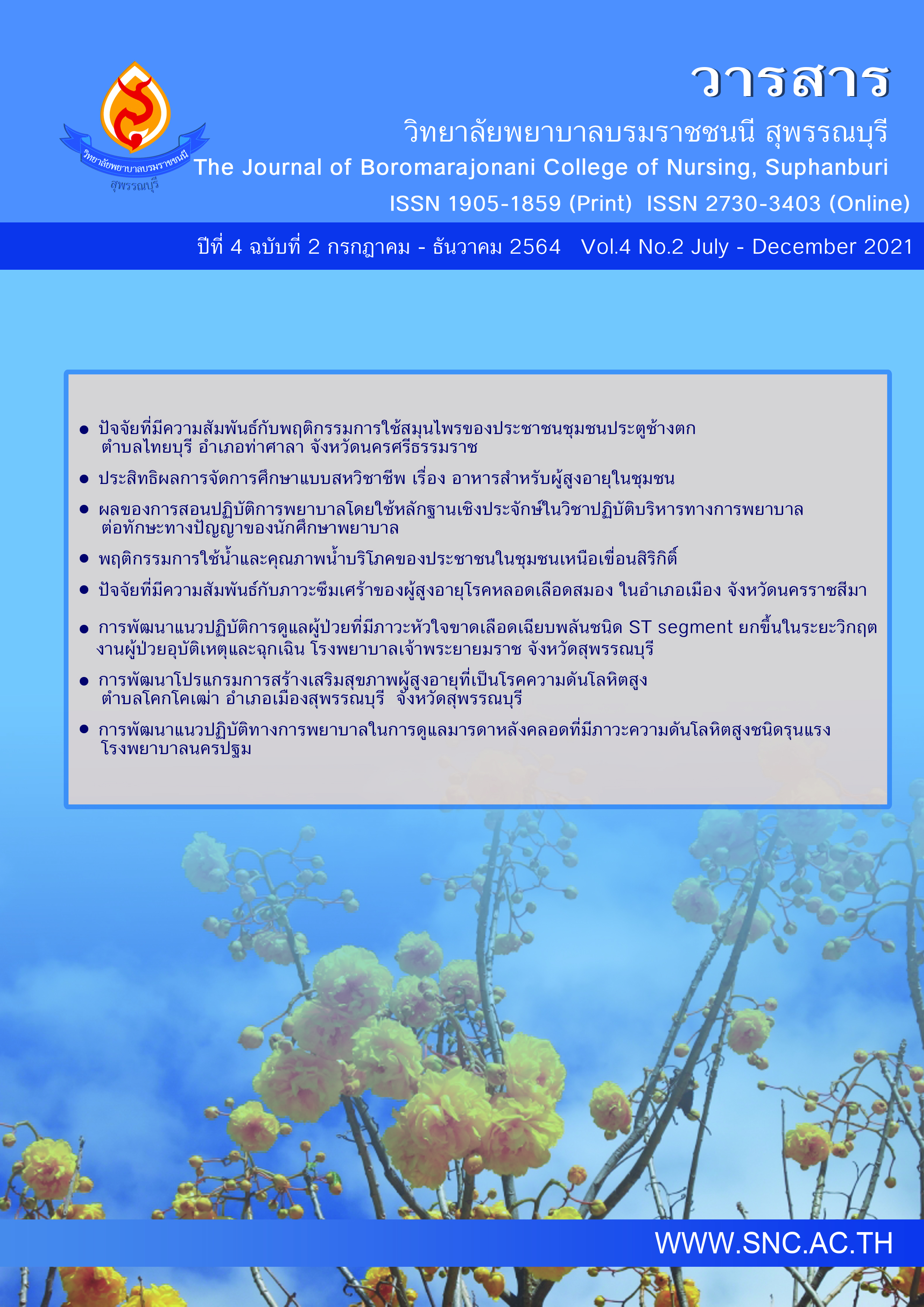
Development of Practice Guideline for Patient with ST Elevation Myocardial Infarction during the critical period, Emergency Department.
Keywords:
Myocardial Infarction Development of Practice Guideline Action ResearchAbstract
The Action Research aimed to develop and analyze clinical practice guideline care for patient with ST Elevation Myocardial Infarction during the critical period in the Emergency department, Chaopraya yommaraj Hospital, Suphanburi Province. Steps for this study consist of 4 steps follow by The Action Research Spiral (Kemmis & McTaggart, 1988). The 4 steps consist of plan action observe and reflect. The measurements for data collecting were patient’ documents, interviews base on questionnaires, observational forms, and semi-structured for focus group discussion. Qualitative data were analyzed by content analysis. Quantitative data were analyze by descriptive statistic such as percentage, mean, standard deviation and comparing by analytical statistic use Independent t-test statistical. The results were found that participation and creative action between multidisciplinary teams have a guideline for patients with ST-Elevation Myocardial Infarction during the critical period care in the Emergency department, Chaopraya yommaraj Hospital, Suphanburi Province. The results of the implementation of the clinical practice guidelines used were found that nurses who care for patients with ST-Elevation Myocardial Infarction during the critical period overall level completeness. The numbers of patients who have received coagulant drugs (door to needle time) in 30 minutes were statistically different from before the guideline was applied at p-value < .05.References
กระทรวงสาธารณสุข HDC version 4. (2562). สืบค้นเมื่อ 30 กันยายน 2562, จากวิกิพีเดีย https://hdcservice.moph.go.th.
กองการพยาบาล สำนักงานปลัดกระทรวง กระทรวงสาธารณสุข. (2561). บทบาทหน้าที่ของพยาบาลวิชาชีพ. นนทบุรี : สำนักพิมพ์สื่อตะวัน.
ณรงค์กร ชัยวงศ์ และปณวัตร สันประโคน. (2562). ภาวะหัวใจขาดเลือดเฉียบพลัน: ความท้าทายของ
พยาบาลฉุกเฉินในการดูแลผู้ป่วยระยะวิกฤติ.วารสารไทยเภสัชศาสตร์และวิทยาการสุขภาพ, 43-51.
วรรณิภา เสนุภัย และคณะ. (2562). การพัฒนาแนวปฏิบัติทางการพยาบาลผู้ป่วยโรคกล้ามเนื้อหัวใจขาดเลือดเฉียบพลัน แผนกฉุกเฉิน โรงพยาบาลสงขลานครินทร์.วารสารมหาวิทยาลัยนราธิวาสราชนครินทร์ ,11 , 104-116.
ศศิธร ช่างสุวรรณ์ และคณะ. (2561). การพัฒนาระบบการพยาบาลระยะฉุกเฉินในผู้ป่วย STEMI งานอุบัติเหตุและฉุกเฉิน โรงพยาบาลพระนครศรีอยุธยา. วารสารสมาคมเวชศาสตร์ป้องกันแห่งประเทศไทยปีที่, 8, 372-384.
ศิริวรรณ เสรีรัตน์ และคณะ. (2549). การวิจัยการตลาดฉบับปรับปรุงใหม่. กรุงเทพมหานคร : บริษัท ธรรมสาร จำกัด.
สถาบันรับรองคุณภาพสถานพยาบาล (องค์การมหาชน). สืบค้นเมื่อ 30 กันยายน 2562, จากวิกิพีเดีย
https://www.ha.or.th/TH/AboutUs.
สมาคมแพทย์โรคหัวใจแห่งประเทศไทยในพระบรมราชูปถัมภ์. (2557). แนวทางเวชปฏิบัติในการดูแลผู้ป่วยโรคหัวใจขาดเลือดในประเทศไทย ฉบับปรับปรุง ปี 2557. พิมพ์ครั้งที่ 2. กรุงเทพมหานคร : ศรีเมืองการพิมพ์.
สำนักการพยาบาล กรมการแพทย์ กระทรวงสาธารณสุข. (2551). มาตรฐานการพยาบาลในโรงพยาบาล. พิมพ์ครั้งที่ 3. นนทบุรี : องค์การสงเคราะห์ทหารผ่านศึก.
อรวดี กาลสงค์. (2563). การพัฒนาแนวปฏิบัติการพยาบาลผู้ป่วย STEMI ที่ได้รับยา Streptokinase ของโรงพยาบาลสะเดา. ราชาวดีสาร วิทยาลัยพยาบาลบรมราชชนนี สุรินทร์,10 (2), 38-53.
โอษิษฐ์ บำบัด และปิยาภรณ์ ศิริจันทร์ชื่น. ผลของการพัฒนาระบบการส่งต่อ STEMI FAST PASS ในเครือข่ายโรคหัวใจเชียงราย-พะเยา. เชียงรายเวชสาร, 13(1).
Bloom. B.S. (1968). Mastery learning. UCLA – CSEIP Evaluation Comment. 1 (2) Losangeles.
University of California at Los Angeles
Kemmis, S., & McTaggart, R. (1988). The Action Research Planner (3rd ed.). Geelong, Australia:
Deakin University Press
กองการพยาบาล สำนักงานปลัดกระทรวง กระทรวงสาธารณสุข. (2561). บทบาทหน้าที่ของพยาบาลวิชาชีพ. นนทบุรี : สำนักพิมพ์สื่อตะวัน.
ณรงค์กร ชัยวงศ์ และปณวัตร สันประโคน. (2562). ภาวะหัวใจขาดเลือดเฉียบพลัน: ความท้าทายของ
พยาบาลฉุกเฉินในการดูแลผู้ป่วยระยะวิกฤติ.วารสารไทยเภสัชศาสตร์และวิทยาการสุขภาพ, 43-51.
วรรณิภา เสนุภัย และคณะ. (2562). การพัฒนาแนวปฏิบัติทางการพยาบาลผู้ป่วยโรคกล้ามเนื้อหัวใจขาดเลือดเฉียบพลัน แผนกฉุกเฉิน โรงพยาบาลสงขลานครินทร์.วารสารมหาวิทยาลัยนราธิวาสราชนครินทร์ ,11 , 104-116.
ศศิธร ช่างสุวรรณ์ และคณะ. (2561). การพัฒนาระบบการพยาบาลระยะฉุกเฉินในผู้ป่วย STEMI งานอุบัติเหตุและฉุกเฉิน โรงพยาบาลพระนครศรีอยุธยา. วารสารสมาคมเวชศาสตร์ป้องกันแห่งประเทศไทยปีที่, 8, 372-384.
ศิริวรรณ เสรีรัตน์ และคณะ. (2549). การวิจัยการตลาดฉบับปรับปรุงใหม่. กรุงเทพมหานคร : บริษัท ธรรมสาร จำกัด.
สถาบันรับรองคุณภาพสถานพยาบาล (องค์การมหาชน). สืบค้นเมื่อ 30 กันยายน 2562, จากวิกิพีเดีย
https://www.ha.or.th/TH/AboutUs.
สมาคมแพทย์โรคหัวใจแห่งประเทศไทยในพระบรมราชูปถัมภ์. (2557). แนวทางเวชปฏิบัติในการดูแลผู้ป่วยโรคหัวใจขาดเลือดในประเทศไทย ฉบับปรับปรุง ปี 2557. พิมพ์ครั้งที่ 2. กรุงเทพมหานคร : ศรีเมืองการพิมพ์.
สำนักการพยาบาล กรมการแพทย์ กระทรวงสาธารณสุข. (2551). มาตรฐานการพยาบาลในโรงพยาบาล. พิมพ์ครั้งที่ 3. นนทบุรี : องค์การสงเคราะห์ทหารผ่านศึก.
อรวดี กาลสงค์. (2563). การพัฒนาแนวปฏิบัติการพยาบาลผู้ป่วย STEMI ที่ได้รับยา Streptokinase ของโรงพยาบาลสะเดา. ราชาวดีสาร วิทยาลัยพยาบาลบรมราชชนนี สุรินทร์,10 (2), 38-53.
โอษิษฐ์ บำบัด และปิยาภรณ์ ศิริจันทร์ชื่น. ผลของการพัฒนาระบบการส่งต่อ STEMI FAST PASS ในเครือข่ายโรคหัวใจเชียงราย-พะเยา. เชียงรายเวชสาร, 13(1).
Bloom. B.S. (1968). Mastery learning. UCLA – CSEIP Evaluation Comment. 1 (2) Losangeles.
University of California at Los Angeles
Kemmis, S., & McTaggart, R. (1988). The Action Research Planner (3rd ed.). Geelong, Australia:
Deakin University Press
Downloads
Published
2021-12-27
Issue
Section
Research Articles
License
Copyright (c) 2021 Boromarajonani College of Nursing, Suphanburi

This work is licensed under a Creative Commons Attribution-NonCommercial-NoDerivatives 4.0 International License.
บทความที่ได้รับการตีพิมพ์เป็นลิขสิทธิ์ของวารสารวิทยาลัยพยาบาลบรมราชชนนี สุพรรณบุรี
ข้อความที่ปรากฏในบทความแต่ละเรื่องในวารสารวิชาการเล่มนี้เป็นความคิดเห็นส่วนตัวของผู้เขียนแต่ละท่านไม่เกี่ยวข้องกับวิทยาลัยพยาบาลบรมราชชนนี สุพรรณบุรี และคณาจารย์ท่านอื่นๆในวิทยาลัยฯ แต่อย่างใด ความรับผิดชอบองค์ประกอบทั้งหมดของบทความแต่ละเรื่องเป็นของผู้เขียนแต่ละท่าน หากมีความผิดพลาดใดๆ ผู้เขียนแต่ละท่านจะรับผิดชอบบทความของตนเองแต่ผู้เดียว


