
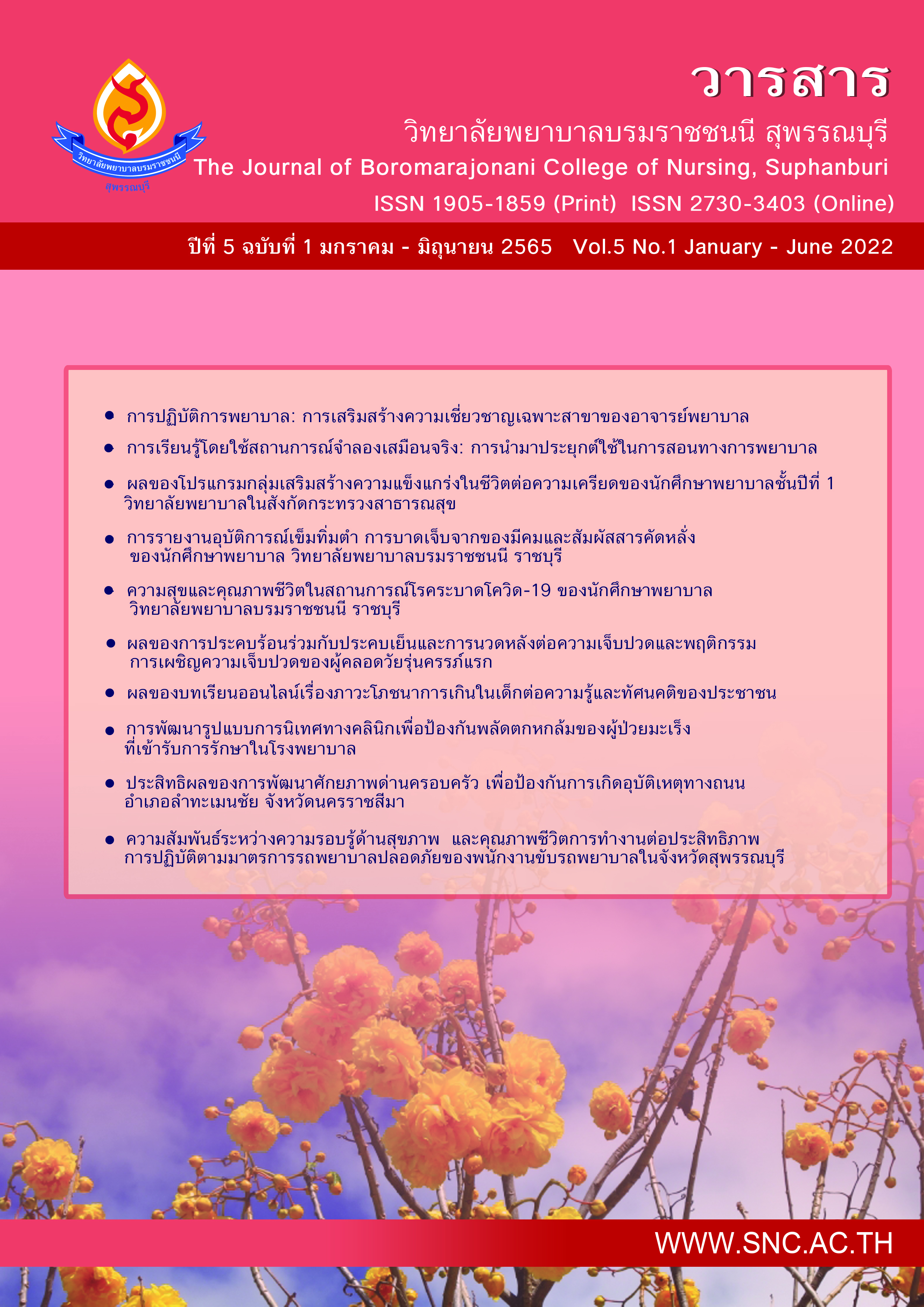
การปฏิบัติการพยาบาล: การเสริมสร้างความเชี่ยวชาญเฉพาะสาขาของอาจารย์พยาบาล
Keywords:
faculty practice expertise nursing instructorAbstract
Nursing is practical science. Nursing faculty practice is one of the important roles of nursing instructors working with a multidisciplinary team. The goals of doing faculty practice are to demonstrate professionalism and to develop expertise in their specialty areas. It can improve the nursing competencies of nursing instructors identified by Thailand Nursing and Midwifery Council. These practices are included a nursing clinical practicing, teaching, counseling, doing research, and service system management among specific target populations or areas of intertest. It will improve clinical outcomes, enhance network of care, and bridge the gaps between theories and practices.
References
สภาการพยาบาล. (2562). ข้อบังคับสภาการพยาบาลว่าด้วยหลักเกณฑ์การรับรองสถาบันการศึกษาวิชาการพยาบาลและการผดุงครรภ์ พ.ศ. 2562. นนทบุรี: สภาการพยาบาล.
สภาการพยาบาล. (2563). คู่มือการรับรองสถาบันการศึกษาวิชาการพยาบาลและการผดุงครรภ์ พ.ศ. 2562. นนทบุรี: บริษัทจุดทอง จำกัด.
ศิริอร สินธุ. (2564). การปฏิบัติการพยาบาลทางคลินิกของอาจารย์ (Faculty practice). จดหมายข่าวสภาการพยาบาล, 23(2), 7-9.
อรสา พันธ์ภักดี และคณะ. (2553). รูปแบบการจัดการศึกษาและการพัฒนาอาจารย์เพื่อผลิตพยาบาลปฏิบัติการพยาบาลขั้นสูงในประเทศไทย. วารสารสภาพารพยาบาล, 25(3), 89-107.
Akram, A. S., Mohamad, A., & Akram, S. (2018). The role of clinical instructor in bridging the gap between theory and practice in nursing education. International Journal of Caring Sciences, 11(2), 876-882.
Black, B. (2019). Professional nursing E-Book: Concepts & challenges 9th ed. Elsevier Health Sciences.
Bosold, C., & Darnell, M. (2012). Faculty practice: Is it scholarly activity?. Journal of Professional Nursing, 28(2), 90-95.
Budden, L. (1994). Nursing faculty practice: Benefits vs costs. Journal of Advanced Nursing, 19(6), 1241-1246.
Catalano, J. T. (2019). Nursing Now: Today's Issues, Tomorrows Trends 8th ed. Philadelphia: FA Davis.
Chitty, K.K., & Black, B.P. (2014). Professional nursing: Concepts and challenges 7th ed. Missouri: Saunders.
Good, D. M., & Schubert, C. R. (2001). Faculty practice: How it enhances teaching. Journal of Nursing Education, 40(9), 389-396.
Krafft, S. K. (1998). Faculty practice: why and how. Nurse Educator, 23(4), 45-48.
Leddy, S.K., & Pepper, J.M. (2014). Conceptual bases of professional nursing 8thed. Philadelphia: Lippincott-Raven.
Marsilio, M., Torbica, A., & Villa, S. (2017). Health care multidisciplinary teams: the sociotechnical approach for an integrated system-wide perspective. Health care management review, 42(4), 303-314.
McArthur, D. B. (2019). Emerging infectious diseases. Nursing Clinics, 54(2), 297-311.
Milani, R. V., Bober, R. M., & Lavie, C. J. (2016). The role of technology in chronic disease care. Progress in cardiovascular diseases, 58(6), 579-583.
Miller, B.K. (1988). A model for professionalism in nursing. Today’ s OR Nurse 10(1): 18-23.
Miller, V. G. (1997). Coproviding continuing education through faculty practice: A win-win opportunity. The Journal of Continuing Education in Nursing, 28(1), 10-13.
Taylor D. (1996). Faculty practice: Uniting advanced nursing practice and nursing education. In, Hamric A, Spross J, Hanson C (eds.) Advanced nursing practice: An integrative approach. Philadelphia: Saunders.
Downloads
Published
Issue
Section
License
Copyright (c) 2022 Boromarajonani College of Nursing, Suphanburi

This work is licensed under a Creative Commons Attribution-NonCommercial-NoDerivatives 4.0 International License.
บทความที่ได้รับการตีพิมพ์เป็นลิขสิทธิ์ของวารสารวิทยาลัยพยาบาลบรมราชชนนี สุพรรณบุรี
ข้อความที่ปรากฏในบทความแต่ละเรื่องในวารสารวิชาการเล่มนี้เป็นความคิดเห็นส่วนตัวของผู้เขียนแต่ละท่านไม่เกี่ยวข้องกับวิทยาลัยพยาบาลบรมราชชนนี สุพรรณบุรี และคณาจารย์ท่านอื่นๆในวิทยาลัยฯ แต่อย่างใด ความรับผิดชอบองค์ประกอบทั้งหมดของบทความแต่ละเรื่องเป็นของผู้เขียนแต่ละท่าน หากมีความผิดพลาดใดๆ ผู้เขียนแต่ละท่านจะรับผิดชอบบทความของตนเองแต่ผู้เดียว


