
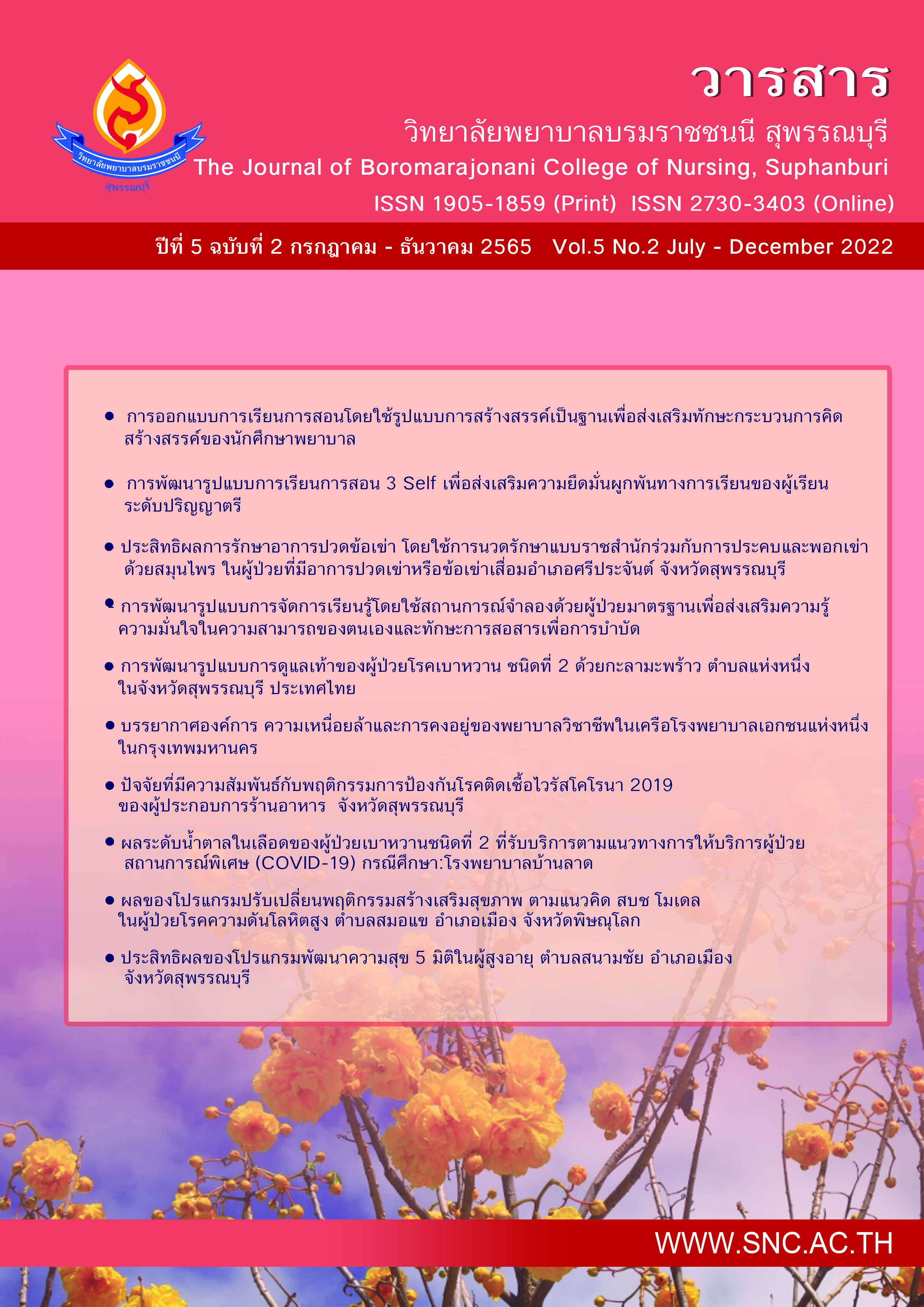
Development of Simulation- Based Learning with Standardized Patient Model to Promote Knowledge, Perceived Self-Confidence and Therapeutic of Communication Skill
Keywords:
simulation- based learning; standardized patient knowledge perceived self-confidence therapeutic of communication skillAbstract
The purpose of this research was to construct a simulation-based learning with a standardized patient model to enhance knowledge, perceived self-confidence, and therapeutic communication skills. 1) To design and create simulation-based learning with a model of a standardized patient 2) To assess the efficacy of simulation-based learning using standardized patients. The development procedure consisted of four steps: Step 1: Analyze the situations, Step 2: Design simulation-based learning with a standard patient model, Step 3: Conduct a pilot study of simulation-based learning with a standard patient model, and Step 4: Evaluate the learning model. This study's participants were nursing students from Boromarajonanicollege of nursing, Suphanburi. This project utilized purposive sampling method, and two groups of nursing students were sampled. In group one, thirty nursing students were used in a pilot study, and seventy-five third-year nursing students were evaluated for knowledge attainment, perceived self-confidence, and therapeutic communication skill. In a four-step process, three experts evaluated the instruments using a content-analysis methodology. The values for content validity are 0.80 to 0.96, while the Cronbach's alpha coefficient ranges from 0.75 to 0.97. Utilizing a paired t-test, the difference in assessment scores before and after using the model was evaluated.
This study demonstrates that there are six components of simulation-based learning using a standardized patient model that boost knowledge, increase perceived self-confidence, and develop therapeutic communication skills. (1) The learning outcome must include knowledge, perceived self-confidence, and therapeutic communication skills. (2) Content is precise on therapeutic communication; (3) Scenarios include a number of Situations; (4) Simulation-based learning method is thorough; and (5) students' reflection guidelines are clear and empowering (6) Individual evaluation was objective, and nursing students scored higher on The confidence and therapeutic communication competence between the pre- and post-tests, with a 0.05 level of statistical significance.
References
ดวงกมล หน่อแก้ว . (2558). การเรียนรู้โดยใช้สถานการณ์เสมือนจริงทางพยาบาลศาสตร์ศึกษา.วารสารวิทยาลัยพยาบาลบรมราชชนนี กรุงเทพ, 31 (3), 112-122.
ดวงใจ พรหมพยัคฆ์, วราภรณ์ สัตยวงศ์, จุฑามาศ รัตนอำภา, ภาวดี เหมทานนท์และวิไลภร รังควัต. (2562) . ผลของการจัดการเรียนการสอนโดยใช้สถานการณ์จำลองเสมือนจริงร่วมกับการส่งเสริมทักษะการสะท้อนคิดของนักศึกษาพยาบาลต่อพฤติกรรมการสะท้อนคิดและความสามารถในการตัดสินใจทางคลินิกของนักศึกษาพยาบาล. วารสารวิทยาลัยพยาบาลบรมราชชนนี นครราชสีมา, 25 (2), 57-71.
พรรณี ปานเทวัญ . (2559). การพัฒนาผู้เรียนในศตวรรษที่21 กับการเรียนรู้เชิงรุกในวิชาชีพพยาบาล. วารสารพยาบาลทหารบก , 17(3), 17-24.
ละมัด เลิศล้ำ, ชนิดา ธนสารสุธี, สุภาเพ็ญ ปานะวัฒนพิสุทธิ์ และชัชรีย์ บำรุงศรี. (2562). การพัฒนารูปแบบการจัดการเรียนการสอนด้วยสถานการณ์จำลองเสมือนจริง. วารสารเครือข่ายวิทยาลัยพยาบาลและการสาธารณสุขภาคใต้, 6 ฉบับพิเศษ, 43-58.
วงเดือน สุวรรณคีรี อรพิน จุลมุสิ และฐิติอาภา ตั้งค้าวานิช .(2559). การจัดการเรียนรู้โดยใช้สถานการณ์จำลองสำหรับนิสิตนักศึกษาพยาบาล.วารสารพยาบาลศาสตร์จุฬาลงกรณ์มหาวิทยาลัย, 28(2), 1-14.
ศิริชัย กาญจนวาสี .(2559). การวิจัยและพัฒนาการศึกษาไทยใน.วารสารศิลปากรศึกษาศาสตร์วิจัย, 8(2), 1-18.
สมจิตต์ สินธุชัย และกันยารัตน์ อุบลวรรณ. (2560) การเรียนรู้โดยใช้สถานการณ์จำลองเสมือนจริง: การนำไปใช้ในการจัดการเรียนการสอน. วารสารพยาบาลทหารบก, 18(1), 29-38.
สุภาเพ็ญ ปานะวัฒนพิสุทธิ์, ละมัด เลิศล้ำ และชนิดา ธนสารสุธี. (2562). การพัฒนารูปแบบโจทย์สถานการณ์เพื่อใช้ในการจัดการเรียนการสอนด้วยสถานการณ์จำลองเสมือนจริง. วารสารวิชาการสาธารณสุข, 28ฉบับพิเศษ, 33-41.
Dwi, B., Zuhroidah, I and Sujarwadi, M. (2020).The Effectiveness of Standardized Patient and Role-play Simulation Methods in Improveing Self-confidence and Therapeutic Communication Skills of Nursing Students. Nursing Health Journal, 9(1) .https://doi.org/10.36720/nhjk.vail.128.
Gibbs, G. (1998) Learning by doing: A guide to teaching learning methods. London:FEU.
Jeffries. P.R. and Rogers. K. J. (2012). Theoretical Framework For Simulation Design in Simulation in Nursing Education. USA: Laerdal Medical Corporation.
Kolb, D.A. (1999)Kolb learning cycle. (Online). Retrieved from http:// www.ldu.leeds.ac.uk/ldu/sddu_multimedia/images/kolb_cycle.gif.
Irwin, A. and Colella, C. (2020). Use of standardized Patient in mental health simulation. Journal of mental Health and Addiction Nursin, 4(1), 26-29.
Peplau, H. (1952). Interpersonal relations: A theoretical framework for application in nursing. New York:
G. Putnam & Sons.
Susanne, A. F. (2019). Learning to communicate professionally in Norman, L. K. and Debbie, S. Psychiatric Nursing. Missouri : Elsevier.
Suzanne, H. C., Natalia, D. A., and Ranjit, K. D. Teaching and Evaluating Therapeutic Communication in Suzanne, H. C.(2018). Simulated Scenarios. In Simulated Scenarios for Nursing Educator . New york : Springger Publishing Company, LLC.
Downloads
Published
Issue
Section
License
Copyright (c) 2022 Boromarajonani College of Nursing, Suphanburi

This work is licensed under a Creative Commons Attribution-NonCommercial-NoDerivatives 4.0 International License.
บทความที่ได้รับการตีพิมพ์เป็นลิขสิทธิ์ของวารสารวิทยาลัยพยาบาลบรมราชชนนี สุพรรณบุรี
ข้อความที่ปรากฏในบทความแต่ละเรื่องในวารสารวิชาการเล่มนี้เป็นความคิดเห็นส่วนตัวของผู้เขียนแต่ละท่านไม่เกี่ยวข้องกับวิทยาลัยพยาบาลบรมราชชนนี สุพรรณบุรี และคณาจารย์ท่านอื่นๆในวิทยาลัยฯ แต่อย่างใด ความรับผิดชอบองค์ประกอบทั้งหมดของบทความแต่ละเรื่องเป็นของผู้เขียนแต่ละท่าน หากมีความผิดพลาดใดๆ ผู้เขียนแต่ละท่านจะรับผิดชอบบทความของตนเองแต่ผู้เดียว


