
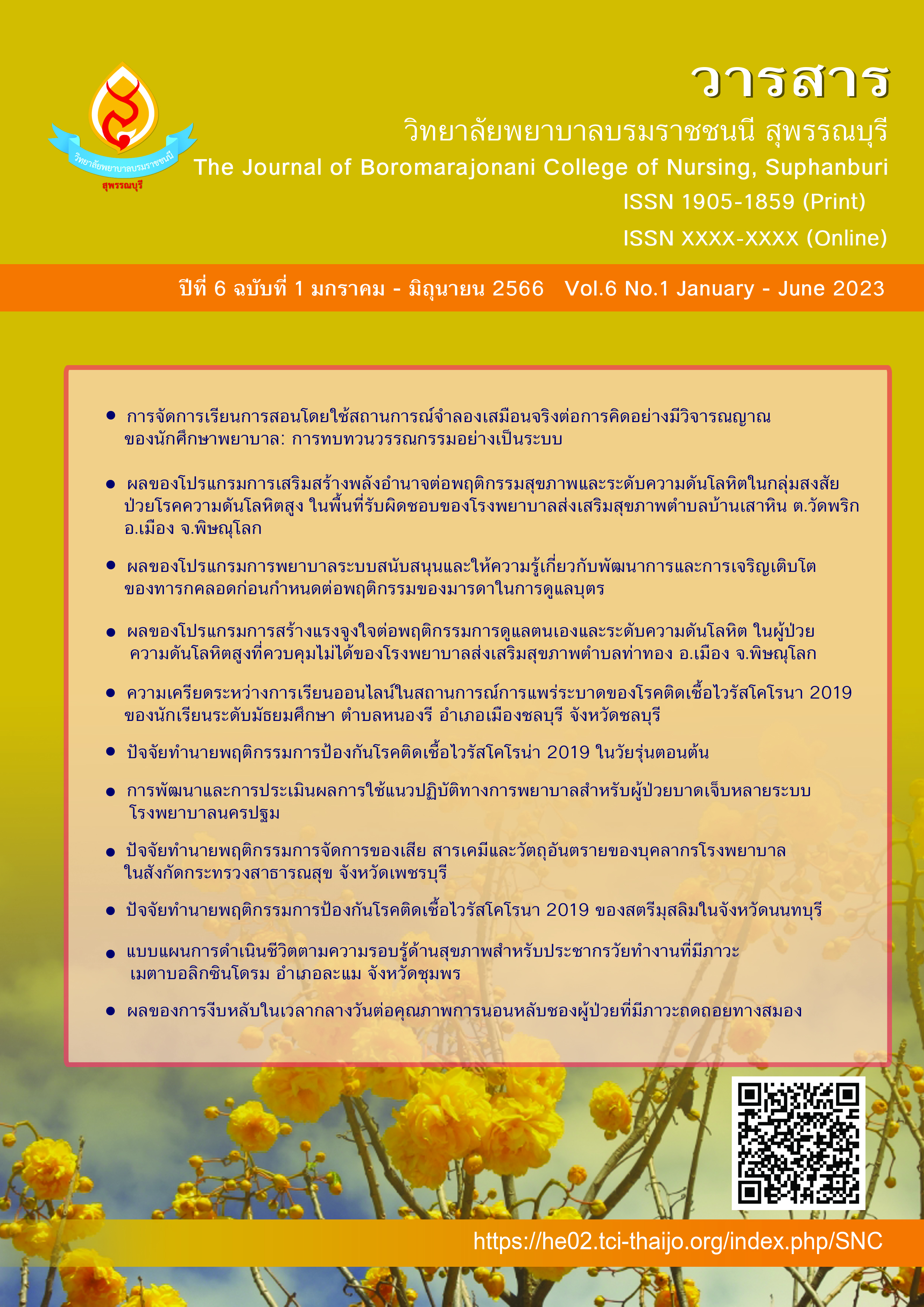
Development and Evaluation of Clinical Nursing Practice Guidelines for Multiple Trauma Patient, Nakhon Pathom Hospital
Keywords:
Development of Clinical Nursing Practice Guidelines Multiple trauma patient.Abstract
This research aimed to development of Clinical Nursing Practice Guideline (CNPGs) for Multiple Trauma Patient .Study the nurse's ability for implementations of the CNPGs. Study the outcomes after using the CNPGs. The target subjects were 61 nurses and orderlies and 88 multiple trauma patients by purposive sampling. The development was divided into 3 phases: 1) the development of NPGs 2) the implementation. 3) the evaluation after using the CNPGs. Data were collected using: the opinion questionnaire, and record form. Data were analyzed by using the descriptive statistics and comparative statistic using Chi--square and Independent t-test.
The results were as follows: 1. The CNPGs for multiple trauma patient consisted of 2 part: Part 1. the pre-hospital care consists of 3 categories: scene size up, primary assessment (A-B-C) and communication. Part 2. the in-hospital care consists of 3 categories: screening, primary assessment (A-B-C-D-E) and discharge 2. The opinion of nurse's ability for implementations of the NPGs: the overall pre-hospital and in-hospital care were at high level (Mean= 3.96 ± 0.08 & Mean= 3.93 ± 0.98 respectively) 3. The outcomes after using the CNPGs: all indicators passed the criteria, and significant outcomes after using NPGs. were (p< 0.05) : oxigen saturation, shock index and duration of multiple truama patients with GCS < 9 get ET Tube insertion (p<0.001).
Conclusion: The clinical nursing practice guidelines for multiple trauma patient is effective in implementation for the pre-hospital and in-hospital care and could be benefit a good outcome
References
กัญญารัตน์ ผึ่งบรรหาร, ฐิติ ภมรศิลปธรรม, ลัดดา มีจันทร์. (2557). การพัฒนารูปแบบการดูแลผู้ป่วยบาดเจ็บหลายระบบในภาวะวิกฤต โรงพยาบาลอุตรดิตถ์. วารสารวิทยาลัยพยาบาลบรมราชชนนีอุตรดิตถ์, 6(1), 24-37.
กรมการแพทย์. (2561). MOPH ED. TRIAGE พิมพ์ครั้งที่ 2. นนทบุรี: กรมการแพทย์.
กรองได อุณหสูต. (2559). การพัฒนาคุณภาพการดูแลผู้ป่วย Multiple Injury ตามแนวทางการจัดการผู้ป่วยMultiple ตามหลักฐานเชิงประจักษ์.ประชุมเชิงปฎิบัติการ ครั้งที่2/2559; 11-12 มิถุนายน 2559 กรุงเทพฯ.
จารุพักตร์ กัญจนิตานนท์, สุชาตา วิภวกานต์, รัตนา พรหมบุตร. (2562). การพัฒนารูปแบบการพยาบาลผู้บาดเจ็บรุนแรงหลายระบบ โรงพยาบาลกระบี่. วารสารพยาบาลทหารบก, 20(1), 339-349.
ดวงกมล สุวรรณ์.2559). ผลการใช้รูปแบบการจัดการรายกรณีต่อผลลัพธ์ในการจัดการดูแลผู้ป่วยบาดเจ็บหลายระบบ. [วิทยานิพนธ์ปริญญาโท].มหาวิทยาลัยสงขลานครินทร์.
ธวัชชัย อิ่มพูล. (2564). การดูแลผู้ป่วยบาดเจ็บเบื้องต้น Initial assessment and management in Trauma: เอกสารประกอบการอบรม การดูแลผู้บาดเจ็บขั้นสูง รุ่นที่ 13 ใน ธวัชชัย อิ่มพูล, สุธิดา จันทร์จรัส และมงคล อัศวภูมิ กองบรรณาธิการ. ขอนแก่น: บริษัทเพ็ญพรินติ้ง.
นวลทิพย์ ธีระเดชากุล, นุชศรา พรมชัย, นงลักษณ์ พลแสน. (2561). ประสิทธิผลการพัฒนาการดูแลผู้ป่วยได้รับบาดเจ็บหลายระบบด้วย Multiple Injury NursingManagement guideline แผนกอุบัติเหตุและฉุกเฉินโรงพยาบาลบุรีรัมย์. วารสารการแพทย์โรงพยาบาลศรีสะเกษ สุรินทร์ บุรีรัมย์, 33(2), 165-177.
พนอ เตชะอธิก, สุนทราพร วันสุพงศ์, และ สุมนา สัมฤทธิ์รินทร์. (2554). ผลการใช้หลักฐานเชิงประจักษ์ในการพยาบาลผู้บาดเจ็บที่หน่วยผู้ป่วยนอกอุบัติเหตุและฉุกเฉิน. วารสารพยาบาลศาสตร์และสุขภาพ, 30(4), 65-74.
มะลิสา โรจนหิรัณย์. (2563). ประสิทธิผลการใช้แนวทางปฏิบัติในการพยาบาลผู้ป่วยบาดเจ็บหลายระบบ หน่วยงานอุบัติเหตุและฉุกเฉินโรงพยาบาลอุดรธานี. วารสารการแพทย์โรงพยาบาลอุดรธานี, 28(3), 413-425.
ณภัคคนันท์ ยุวดี, จินดา ผุดผ่อง, นพพรพงศ์ ว่องวิกย์การ และ นฤมล จันทร์สุข. (2562). การพัฒนารูปแบบการจัดการรายกรณีผู้ป่วยบาดเจ็บหลายระบบ โรงพยาบาลอุทัยธานี. วารสารสมาคมเวชศาสตร์ป้องกันแห่งประเทศไทย, 9(3), 280-296.
เยาวลักษณ์ ผุยหัวโทน และ จุไรพร กนกวิจิตร. (2563). การศึกษาระบบการคัดกรองผู้ป่วยฉุกเฉินแผนกผู้ป่วยฉุกเฉิน โรงพยาบาลประสาทเชียงใหม่.
รักรุ่ง ด่านภักดี. (2559). การประเมินประสิทธิผลในการดูแลผู้บาดเจ็บหลายระบบของพยาบาลก่อนและหลังใช้แนวปฏิบัติ. ชัยภูมิเวชสาร, 36(1), 50-59.
ราชวิทยาลัยศลยแพทย์แห่งประเทศไทย. (2556). การดูแลผู้ป่วยบาดเจ็บเมื่อแรกรับ: แนวทางการรักษาพยาบาลด้านศัลยกรรม Clinical practice guidelines in surgery.
สถาบันการแพทย์ฉุกเฉินแห่งชาติ. (2558). คู่มือทางการปฏิบัติตามหลักเกณฑ์ และวิธีปฏิบัติการคัดแยกผู้ป่วยฉุกเฉินและจัดลําดับการบริบาล ณ ห้องฉุกเฉินตามหลักเกณฑ์ที่กพฉ.กําหนด.นนทบุรี สถาบันการแพทย์ฉุกเฉิน.
สุพัตรา อยู่สุข และคณะ.(2560).พัฒนารูปแบบการดูแลภาวะช็อกจากการเสียเลือดในผู้ป่วยบาดเจ็บหลายระบบโรงพยาบาลสวรรค์ประชานรักษ์.วารสารการแพทย์. 42(6), 90-101.
Baker, CC, Oppenheimer, L, Stephens, B, Lewis, FR, Trunkey, DD. (1980). Epidemiology of trauma deaths. Am J Surg, 140(1), 144–50.
Butcher, N. E., & Balogh, Z. J. (2014). Update on the definition of polytrauma. European Journal of Trauma and Emergency Surgery, 40(2), 107–111.
Hasler,R.M., Nuesch,E., Juni, P., Bouamra,O., Exadaktylos A. K., Lecky, F. (2011). Systolic bloodpressure below 110 mmHg is associated withincreased mortality in blunt major trauma patients: multicentre cohort study. Resuscitation, 82: 1202-27.
NAEMT. (2014). Prehospital trauma life support. 8th ed. Jones & Bartlett learning.
Newberry, L. (2003). Emergency nursing principle and practice. Philadephia: Mosby.
NHMRC, (1998). A guide to the development, Implement and evaluation of clinical practice guidelines. Available from: http://www .nhmrc.gov.au/publications/_files/cp30.pdf.
NSW ITIM. (2016). Major trauma in NSW 2015. A report from the NSW trauma registry.
Downloads
Published
Versions
- 2024-03-20 (3)
- 2023-06-22 (2)
- 2023-06-17 (1)
Issue
Section
License
Copyright (c) 2023 Boromarajonani College of Nursing, Suphanburi

This work is licensed under a Creative Commons Attribution-NonCommercial-NoDerivatives 4.0 International License.
บทความที่ได้รับการตีพิมพ์เป็นลิขสิทธิ์ของวารสารวิทยาลัยพยาบาลบรมราชชนนี สุพรรณบุรี
ข้อความที่ปรากฏในบทความแต่ละเรื่องในวารสารวิชาการเล่มนี้เป็นความคิดเห็นส่วนตัวของผู้เขียนแต่ละท่านไม่เกี่ยวข้องกับวิทยาลัยพยาบาลบรมราชชนนี สุพรรณบุรี และคณาจารย์ท่านอื่นๆในวิทยาลัยฯ แต่อย่างใด ความรับผิดชอบองค์ประกอบทั้งหมดของบทความแต่ละเรื่องเป็นของผู้เขียนแต่ละท่าน หากมีความผิดพลาดใดๆ ผู้เขียนแต่ละท่านจะรับผิดชอบบทความของตนเองแต่ผู้เดียว


