
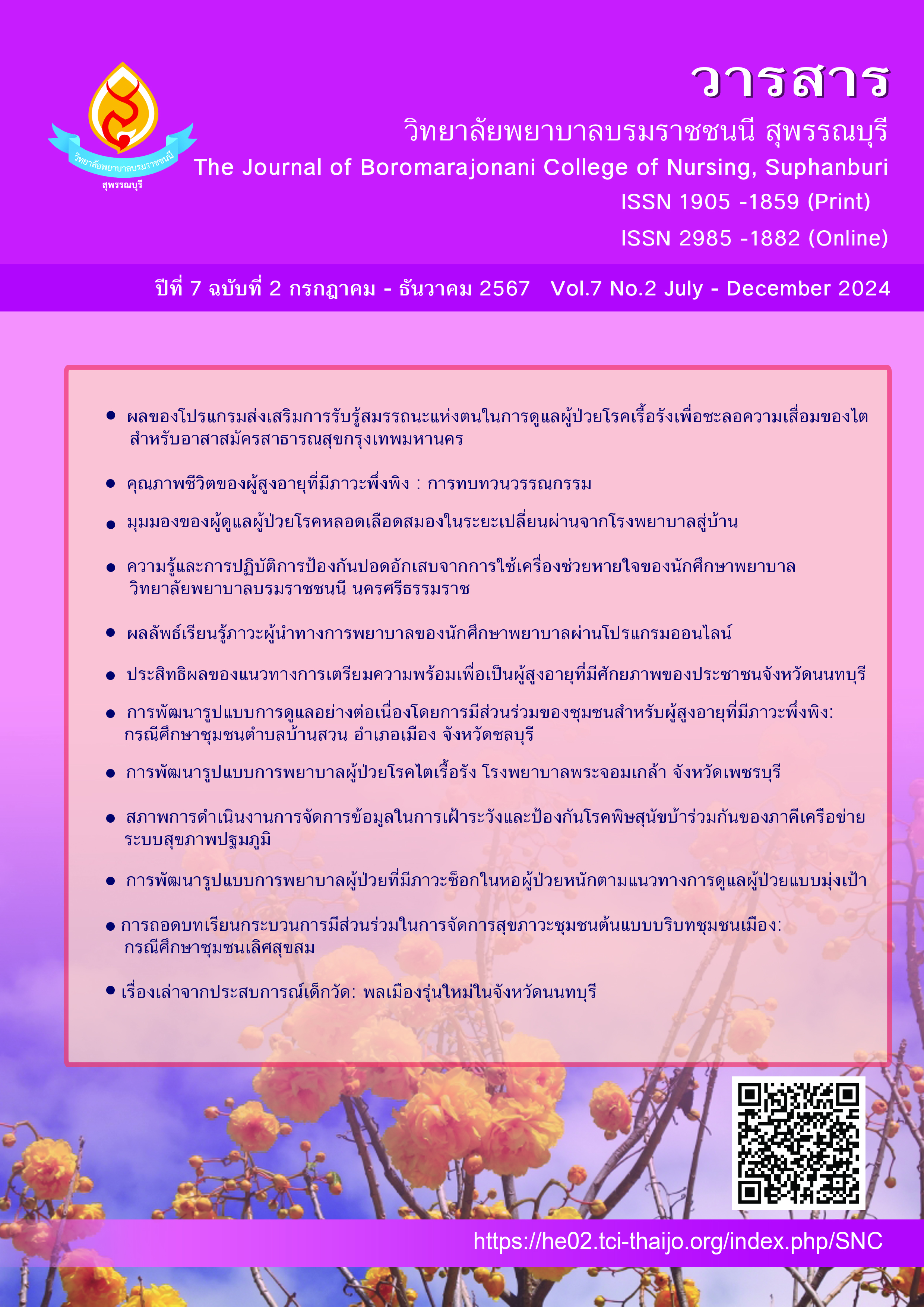
Effetcs of Self-efficacy Promotion Training Program in Caring for Patients with Chronic Disease to Delay Kidney Degeneration for Village Health Volunteers, Bangkok Metropolitan
Keywords:
Self-efficacy, Chronic Kidney Disease, Delay Kidney Degeneration, Village Health Volunteer Bangkok MetropolitanAbstract
The purpose of this study was to examine the effect of a self-efficacy promotion training program for public health volunteers in Bangkok Metropolitan on their ability to care for patients with chronic diseases and thereby delay kidney degeneration. The study was a quasi-experimental study, with a two-group pre-test and post-test design. The participants were Bangkok Metropolitan public health volunteers. Using the method of simple random sampling, a total of sixty participants were divided into experimental and control groups. Thirty participants were allocated to each group. Over a total of seven weeks of intervention, the intervention was divided into 2 phases: a 3-week intervention phase and a 4-week follow-up phase, from December 2021 to January 2022.
The self-efficacy promotion training program is composed of various activities, including the utilization of models, demonstrations, and practical exercises, home visit monitoring, and ensuring the continuity of care for patients with chronic conditions to delay renal degradation via the LINE application group. The data was collected through the utilization of a self-administered questionnaire and analyzed using descriptive statistics, Chi-square test, Independent t-test, and repeated measure ANOVA.
The findings of the study revealed that the average score on knowledge, perceived self-efficacy, and behaviors regarding the management of patients with chronic illnesses to delay the progression of kidney degeneration after participating in the self-efficacy program was statistically significantly higher than before participating in the program and was statistically significantly higher than the control group (p < .05).
The results of this research suggested that the self-efficacy promotion training program can be used to enhance public health volunteers’ competency in caring for patients with chronic illnesses to delay the progression of kidney degeneration. The application of the self-efficacy concept should be applied through various activities that involve providing knowledge, utilizing models, demonstrations, practice exercises, home visits monitoring, and ensuring the continuity of care for patients with chronic conditions to delay renal degradation via the LINE application group.
References
กรมควบคุมโรค สำนักโรคไม่ติดต่อ. (2559). คู่มือการจัดการโรคไตเรื้อรัง (CKD) สำหรับอาสาสมัครสาธารณสุขประจำหมู่บ้าน (อสม.). กรุงเทพมหานคร: สำนักงานกิจการโรงพิมพ์องค์การ สงเคราะห์ทหารผ่านศึก ในพระบรมราชูปถัมภ์. กรุงเทพมหานคร: สมาคมโรคไตแห่งประเทศไทย.
กองการพยาบาสาธารณสุข สำนักอนามัย กรุงเทพมหานคร. (2562). การอบรมพัฒนาศักยภาพผู้ดูแล เพื่อช่วยเหลืองานพยาบาลผู้ป่วยและผู้สูงอายุโรคไตที่ต้องได้รับการดูแลต่อเนื่องที่บ้าน. กรุงเทพมหานคร.
กองสร้างเสริมสุขภาพ สำนักอนามัย กรุงเทพมหานคร. (2557). หลักสูตรการอบรมเพิ่มพูนความรู้สำหรับอาสาสมัครสาธารณสุขกรุงเทพมหานคร. ลักษมีนานาภัณฑ์.
จิรัชยา สุวินทรากร. (2562). ผลของโปรแกรมการส่งเสริมการรับรู้ความสามารถตนเองของอาสาสมัครสาธารณสุขในการเฝ้าระวัง และป้องกันโรคหลอดเลือดสมอง. วารสารพยาบาล, 68(1), 39-48.
ปิยนุช ภิญโย, กิตติภูมิ ภิญโย, สายสุดา จันหัวนา, วชิรศักดิ์ อภิพัฒฐ์กานต์, ธรณิศ สายวัฒน์ และอมรรัตน์ อัครเศรษสกุล. (2560). ประสิทธิผลของโปรแกรมเสริมสร้างความสามารถแห่งตนต่อความรู้ ทัศนคติ และพฤติกรรมการดูแลของอาสาสมัครสาธารณสุขประจำ หมู่บ้านในการดูแลผู้สูงอายุระยะยาวในชุมชน จังหวัดขอนแก่น. วารสารพยาบาลสงขลานครินทร์, 37(3), 109-120.
ภัทรวดี โชติพิบูลย์ทรัพย์. (2567). ปัจจัยที่ส่งผลต่อการใช้งานแอปพลิเคชั่นเพื่อสุขภาพ. วารสารระบบสารสนเทศด้านธุรกิจ (JISB), 10(1), 43-55.
ภาวิณี พรหมบุตร, เอื้อจิต สุขพูล และปิยนุช ภิญโย. (2558). ผลของโปรแกรมการเสริมสร้างการรับรู้สมรรถนะแห่งตนต่อความรู้และการรับรู้สมรรถนะแห่งตนของอาสาสมัครสาธารณสุขประจำหมู่บ้านในการดูแลผู้ป่วยเบาหวานและความดันโลหิตสูงในชุมชน ของจังหวัดแห่งหนึ่ง. วารสารพยาบาลสงขลานครินทร์, 35(2), 113-128.
ระบบรายงานศูนย์บริการสาธารณสุข 3 บางซื่อ. (2562). รายงานการดูแลผู้ป่วยโรคเบาหวานและความดันโลหิตสูงตามเกณฑ์.
สมพร พูลพงษ์ (2562). การประยุกต์ใช้โปรแกรมไลน์เพื่อการมอบหมายงานสำหรับกลุ่มอาสาสมัครสาธารณสุขประจำหมู่บ้าน. วารสารวิจัยและพัฒนาวไลยอลงกรณ์ ในพระบรมราชูปถัมภ์, 14(3), 138-146.
สมาคมโรคไตแห่งประเทศไทย. (2565). แนวทางปฏิบัติสำหรับโรคไตเรื้อรังก่อนการบำบัดทดแทนไต.
สำนักโรคไม่ติดต่อ กรมควบคุมโรค กระทรวงสาธารณสุข, สถาบันโรคไตภูมิราชนครินทร์, สมาคมเภสัชกรรมโรงพยาบาล (ประเทศไทย), กรมอนามัย และกรมสนับสนุนบริการสุขภาพ. (2559). คู่มือการอบรมพัฒนาศักยภาพการดำเนินงาน เพื่อลดโรคไตเรื้อรังสำหรับ อสม.
Bandura, A. (1997). Self-efficacy: The exercise of control. New York: W.H. Freeman and company.
Cohen, J. (1988). Statistical power analysis of the behavioral scienes. New York : Lawrence Erlbaum Associattes.
Hill, NR., Fatoba, ST., Oke, JL., Hirst, JA CA., & Lasserson DS. (2016). Global prevalence of chronic kidney disease - a systematic review and meta-analysis. PLoS One, 11(7).
National Center for Chronic Disease Prevention and Health Promotion. (2014). National Chronic Kidney Disease Fact Sheet: CDC.
United states renal data system. CKD in the United States. [internet]. 2015. [cited 2022 March 3]. Available: http://www.ajkd.org/article/S0272-6386(16)00094-9/
Downloads
Published
Issue
Section
License
Copyright (c) 2024 Boromarajonani College of Nursing, Suphanburi

This work is licensed under a Creative Commons Attribution-NonCommercial-NoDerivatives 4.0 International License.
บทความที่ได้รับการตีพิมพ์เป็นลิขสิทธิ์ของวารสารวิทยาลัยพยาบาลบรมราชชนนี สุพรรณบุรี
ข้อความที่ปรากฏในบทความแต่ละเรื่องในวารสารวิชาการเล่มนี้เป็นความคิดเห็นส่วนตัวของผู้เขียนแต่ละท่านไม่เกี่ยวข้องกับวิทยาลัยพยาบาลบรมราชชนนี สุพรรณบุรี และคณาจารย์ท่านอื่นๆในวิทยาลัยฯ แต่อย่างใด ความรับผิดชอบองค์ประกอบทั้งหมดของบทความแต่ละเรื่องเป็นของผู้เขียนแต่ละท่าน หากมีความผิดพลาดใดๆ ผู้เขียนแต่ละท่านจะรับผิดชอบบทความของตนเองแต่ผู้เดียว


