
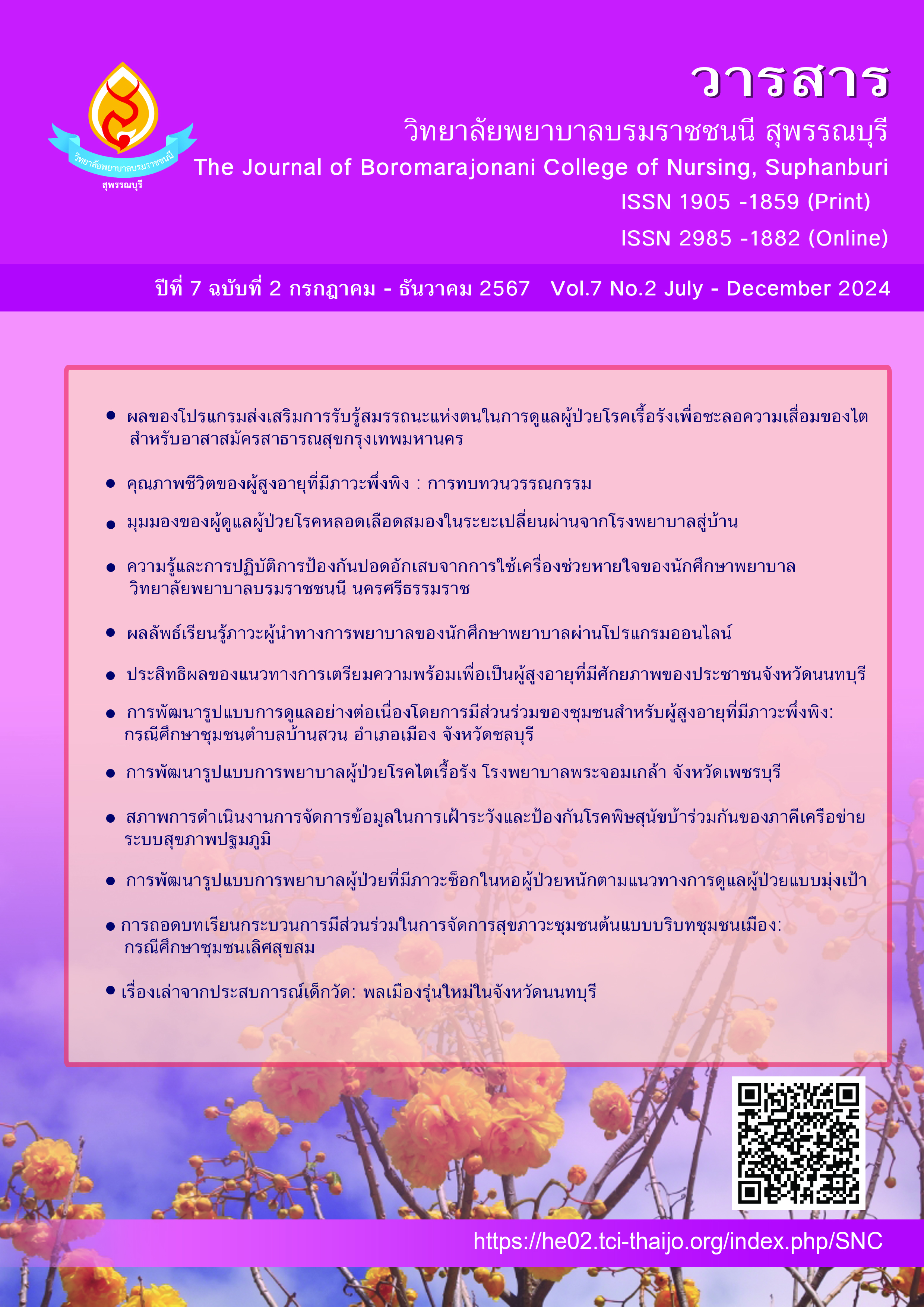
The Operational Status of Collaborative Data Management for Rabies Surveillance and Prevention among Primary Health Care Networks in Nonthaburi Province
Keywords:
Rabies, data management, primary healthcare network, primary healthcare systemAbstract
This qualitative research explored the operational status of collaborative data management for rabies surveillance and prevention among primary healthcare networks. The key informants comprised 40 participants, including nurses working in primary care units, livestock office officials, community leaders, and health volunteers involved in rabies management.The research instrument was a focus group discussion guide. Data were collected through focus group discussions and analyzed using content analysis to identify key themes. Data collection and triangulation ensured the accuracy and reliability of the research findings.
The findings revealed seven main themes regarding the operational status of data management for rabies surveillance and prevention in collaboration with primary healthcare network: 1) Data integration and communication among network partners; 2) Capacity building for personnel and communities; 3) Challenges and development approaches; 4) Management of stray animals; 5) Development of data collection and analysis systems; 6) Fostering cooperation and community participation; and 7) Resource and budget management.
The study suggests the need for research and development of a central database system that integrates data from all relevant agencies. This would facilitate data exchange, analysis, planning, and decision-making for more effective rabies prevention and control.
References
กรมควบคุมโรค. (2566). แนวทางการดำเนินงานป้องกันควบคุมโรคพิษสุนัขบ้าแห่งชาติ. กระทรวงสาธารณสุข.
กรมควบคุมโรค. (2567). กรมควบคุมโรคแนะ “เข้าพรรษาสุขใจ สุขภาพไทยแข็งแรง” เสริมภูมิคุ้มกัน ลดปัจจัยเสี่ยงโรค ตลอดช่วงเข้าพรรษา. ค้นคว้าจาก https://ddc.moph.go.th/brc/news.php?news=44654
กองโรคติดต่อทั่วไป กรมควบคุมโรค กระทรวงสาธารณสุข. (2565). คู่มือการสร้างและประเมินพื้นที่ปลอดโรคพิษสุนัขบ้า (พิมพ์ครั้งที่ 1). สำนักพิมพ์อักษรกราฟฟิคแอนด์ดีไซน์ กรุงเทพฯ.
กรมปศุสัตว์. (2566). รายงานประจำปี 2566. https://drive.google.com/file/d/1Nyw3Exx2onqxKrecvuo_kMWs-DHbpIxO/view
คณะกรรมการขับเคลื่อนการดำเนินโครงการสัตว์ปลอดโรค คนปลอดภัย จากโรคพิษสุนัขบ้า. (2560). แผนยุทธศาสตร์ โครงการสัตว์ปลอดโรค คนปลอดภัย จากโรคพิษสุนัขบ้า ตามพระปณิธานศาสตราจารย์ ดร.สมเด็จพระเจ้าลูกเธอเจ้าฟ้าจุฬาภรณวลัยลักษณ์ อัครราชกุมารี ปี 2560-2563.
https://pvlo-pre.dld.go.th/webnew/images/stories/report/rebies2566/301Yuttasart60-63.pdf
วิภาดา สุวรรณดี และคณะ. (2564). ผลของโปรแกรมการให้ความรู้เรื่องโรคพิษสุนัขบ้าต่อพฤติกรรมการป้องกันโรคของประชาชนในชุมชน. วารสารพยาบาลสาธารณสุข, 35(2), 78-92.
ศุภมาส พันธ์เชย. (2561). โรคพิษสุนัขบ้า. วารสารกระบี่เวชสาร, 1(2), 49-61.
สมชาย ใจดี และคณะ. (2565). ปัจจัยความสำเร็จในการบูรณาการการทำงานระหว่างหน่วยงานเพื่อควบคุมโรคพิษสุนัขบ้า: กรณีศึกษาจังหวัดนครราชสีมา. วารสารสาธารณสุขศาสตร์, 52(1), 45-58.
Burnard, P. (1991). A method of analyzing interview transcripts in qualitative research. Nurse
Education Today, 11(6), 461-466.
Cleaveland, S., Hampson, K., Haydon, D. T., Lembo, T., Townsend, S. E., & Meslin, F. X. (2022). The global elimination of dog-mediated human rabies: The time is now. The Lancet Global Health, 10(3), e392-e400.
Denzin, N. K., Lincoln, Y. S., MacLure, M., Otterstad, A. M., Torrance, H., Cannella, G. S., et al. (2018). Critical qualitative methodologies reconceptualization and emergent construction. International Review of Qualitative Research. doi.org/10.1525/irqr.2017.10.4.482
Hampson, K., Abela-Ridder, B., Bharti, O., Knopf, L., Léchenne, M., Mindekem, R., ... & Zinsstag, J. (2019). Modelling to inform prophylaxis regimens to prevent human rabies. Vaccine, 37, A166-A173.
Mahapatra, M., Sayalel, K., Msechu, J., Kinney, E., Tapia, E., Byarugaba, D. K., ... & Mazet, J. A. (2021). Smartphone-based surveillance system for early detection and control of animal diseases in low-resource settings. Frontiers in Veterinary Science, 8, 647-697.
United Against Rabies Collaboration. (2019). First annual progress report: Global Strategic Plan to End Human Deaths from Dog-mediated Rabies by 2030. https://iris.who.int/bitstream/handle/10665/328053/WHO-CDS-NTD-NZD-2019.04-eng.pdf?sequence=1
World Health Organization. (2022). Digital technology for disease surveillance and response. WHO Technical Report Series, No. 1035.
Zinsstag, J., Schelling, E., Crump, L., Whittaker, M., Tanner, M., & Stephen, C. (2020). One Health: The theory and practice of integrated health approaches. CABI.
Downloads
Published
Issue
Section
License
Copyright (c) 2024 Boromarajonani College of Nursing, Suphanburi

This work is licensed under a Creative Commons Attribution-NonCommercial-NoDerivatives 4.0 International License.
บทความที่ได้รับการตีพิมพ์เป็นลิขสิทธิ์ของวารสารวิทยาลัยพยาบาลบรมราชชนนี สุพรรณบุรี
ข้อความที่ปรากฏในบทความแต่ละเรื่องในวารสารวิชาการเล่มนี้เป็นความคิดเห็นส่วนตัวของผู้เขียนแต่ละท่านไม่เกี่ยวข้องกับวิทยาลัยพยาบาลบรมราชชนนี สุพรรณบุรี และคณาจารย์ท่านอื่นๆในวิทยาลัยฯ แต่อย่างใด ความรับผิดชอบองค์ประกอบทั้งหมดของบทความแต่ละเรื่องเป็นของผู้เขียนแต่ละท่าน หากมีความผิดพลาดใดๆ ผู้เขียนแต่ละท่านจะรับผิดชอบบทความของตนเองแต่ผู้เดียว


