
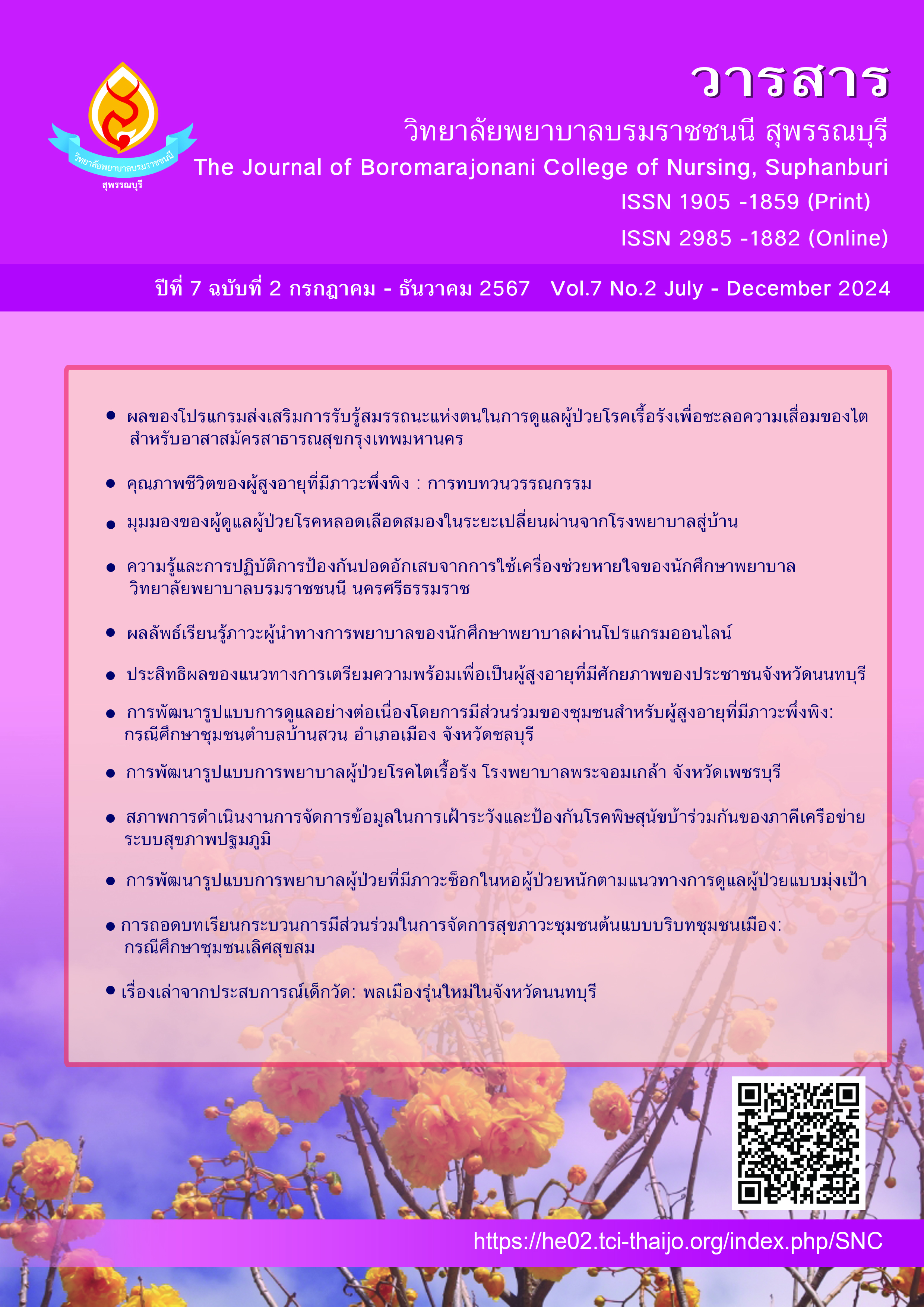
Development of a Nursing Care Model for Patients with Shock in the Intensive Care Unit Based on Early Goal Directed Therapy
Keywords:
Nursing model, shock, intensive care unit, early goal directed therapyAbstract
This developmental research aimed to create and assess the effectiveness of a Nursing Care Model for Patients with Shock in the intensive care unit (ICU). The sample included 30 professional nurses working in the ICU and 53 patients with shock admitted to the respiratory ICU between February and May 2024. The research instruments included a knowledge assessment form for nurses caring for patients with shock (reliability = 0.94), a nurse's perception of model benefits assessment form, and a patient outcome recording form (IOC = 0.87, reliability = 0.88). Data were analyzed using content analysis, frequency, percentage, mean, standard deviation, and paired t-test.
The research findings indicated that the Nursing Care Model for Patients with Shock in the Intensive care unit based on early goal directed therapy comprised three key components: 1) a support system for organizing the nursing model, including ICU staffing policies and team-based nursing guidelines; 2) a shock patient care process, incorporating nursing standards for shock management and the SHOCK Bundle; and 3) outcomes and continuous improvement, featuring quality assurance indicators for shock patient care services and a professional development plan to enhance the knowledge and skills of the nursing team. Following the intervention, nurses showed a statistically significant increase in knowledge regarding shock patient care (p < .05), and the mean score for the perceived benefit of Nursing Care Model for Patients with Shock was rated as very high. Patient care outcomes achieved a success rate of 77.36%, with a survival rate of 83.02%.
Suggestions from the research results: The targeted nursing care model for shock patients can be applied as a guideline for improving shock patient care.
References
กระทรวงสาธารณสุข. (2566). อัตราตายจากติดเชื้อ (Sepsis) https://healthkpi.moph.go.th/kpi/kpi- list/view/?id=43&utm_source
เกษา นาสวน, สมปอง ใจกล้า, และกันตินันท์ สอดสุข. (2567). การพัฒนารูปแบบการจัดบริการผู้ป่วยที่มีภาวะติดเชื้อในกระแสเลือด. วารสารอนามัยสิ่งแวดล้อมและสุขภาพชุมชน, 9(1), 397-407.
วิจิตรา กุสุมภ์. (2565). การพยาบาลผู้ป่วยภาวะวิกฤต: แบบองค์รวม (พิมพ์ครั้งที่ 7). นนทบุรี: พี.เค.เค. พริ้นติ้ง.วิภารัช
นงลักษณ์ บุญเยีย. (2558). ผลการพัฒนารูปแบบทีมการพยาบาลต่อคุณภาพการพยาบาลในผู้ป่วยหนักศัลยกรรมหัวใจและทรวงอก. วารสารวิชาการสาธารณสุข, 927–936.
นันทรัตน์ โกษาแสง. (2567). พัฒนารูปแบบการดูแลผู้ป่วยติดเชื้อในกระแสโลหิตและบันทึกด้วยโปรแกรม IPD Paperless หอผู้ป่วยใน โรงพยาบาลบึงโขงหลง จังหวัดบึงกาฬ. https://bkpho.moph.go.th/ssjweb/bkresearch/bkpho.moph.go.th
ประภาพรรณ สิงห์โต และทองเปลว ชมจันทร์. (2564). กระบวนการและผลลัพธ์ของการดูแลแบบมุ่งเป้าใน 6 ชั่วโมงแรกในผู้ป่วยที่มีภาวะติดเชื้อในกระแสเลือดชนิดรุนแรงและภาวะช็อคจากการติดเชื้อ. วารสารการพยาบาลและสุขภาพ สสอท, 3(2), 1-21.
มณีรัตน์ ทองดีพันธ์. (2562). ความสัมพันธ์ระหว่างภาระงานและการผสมผสานอัตรากำลังกับคุณภาพการพยาบาล. http://www.medi.co.th/hotnews11/nursing_1625473578NR124.pdf
ยุวดี เกตสัมพันธ์. (2556). Innovative Models of Nursing Care Delivery. https://www2.si.mahidol.ac.th/division/nursing/sins/download/meeting/sinsmeeting_ 2556_05.pdf
ระบบสารสนเทศ โรงพยาบาลเจ้าพระยายมราช. (2566). สถิติผู้ป่วย. โรงพยาบาลเจ้าพระยายมราช.
ศรีผาสุก พึ่งศรีเพ็ง. (2560). การปฏิบัติตามมาตรฐานทางการพยาบาลผู้ป่วยวิกฤต. วารสารกฎหมายสุขภาพและสาธารณสุข, 3(2), 180-192.
Bloom, J. E., Andrew, E., Dawson, L. P., Nehme, Z., Stephenson, M., Anderson, D., ... & Stub, D. (2022). Incidence and outcomes of nontraumatic shock in adults using emergency medical services in Victoria, Australia. JAMA Network Open, 5(1), e2145179-e2145179.
Huppmann, S. E. (2023). Surviving Shock: Nurse Driven Protocol for Application of Hemodynamic Monitoring Device.
Rhee, C., Jones, T. M., Hamad, Y., Pande, A., Varon, J., O’Brien, C., ... & Klompas, M. (2019). Prevalence, underlying causes, and preventability of sepsis-associated mortality in US acute care hospitals. JAMA network open, 2(2), e187571-e187571.
Rivers, E., Nguyen, B., Havstad, S., Ressler, J., Muzzin, A., Knoblich, B., Peterson, E., Tomlanovich, M., & Early Goal-Directed Therapy Collaborative Group. (2001). Early goal-directed therapy in the treatment of severe sepsis and septic shock. The New England Journal of Medicine, 345(19), 1368-1377. https://doi.org/10.1056/NEJMoa010307
Urden, L. D., Stacy, K. M., & Lough, M. E. (2017). Critical care nursing: Diagnosis and management (8th ed.). Elsevier
Downloads
Published
Issue
Section
License
Copyright (c) 2024 Boromarajonani College of Nursing, Suphanburi

This work is licensed under a Creative Commons Attribution-NonCommercial-NoDerivatives 4.0 International License.
บทความที่ได้รับการตีพิมพ์เป็นลิขสิทธิ์ของวารสารวิทยาลัยพยาบาลบรมราชชนนี สุพรรณบุรี
ข้อความที่ปรากฏในบทความแต่ละเรื่องในวารสารวิชาการเล่มนี้เป็นความคิดเห็นส่วนตัวของผู้เขียนแต่ละท่านไม่เกี่ยวข้องกับวิทยาลัยพยาบาลบรมราชชนนี สุพรรณบุรี และคณาจารย์ท่านอื่นๆในวิทยาลัยฯ แต่อย่างใด ความรับผิดชอบองค์ประกอบทั้งหมดของบทความแต่ละเรื่องเป็นของผู้เขียนแต่ละท่าน หากมีความผิดพลาดใดๆ ผู้เขียนแต่ละท่านจะรับผิดชอบบทความของตนเองแต่ผู้เดียว


