
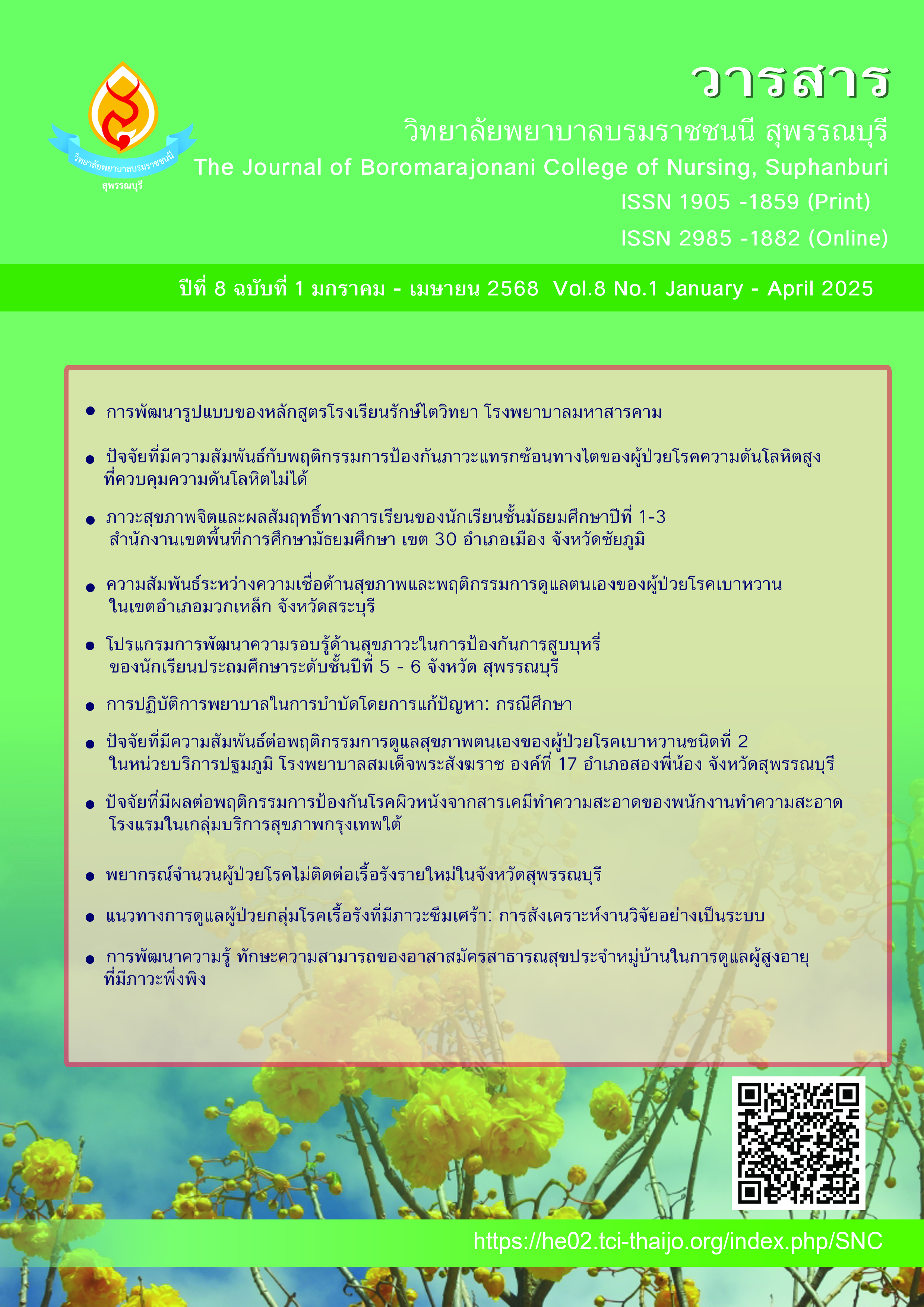
ปัจจัยที่มีความสัมพันธ์กับพฤติกรรมการป้องกันภาวะแทรกซ้อนทางไตของผู้ป่วยโรคความดันโลหิตสูง ที่ควบคุมความดันโลหิตไม่ได้
คำสำคัญ:
พฤติกรรมการป้องกันภาวะแทรกซ้อน, ภาวะแทรกซ้อนทางไต, ผู้ป่วยโรคความดันโลหิตสูงที่ควบคุมความดัน โลหิตไม่ได้บทคัดย่อ
การวิจัยครั้งนี้เป็นการวิจัยเชิงวิเคราะห์แบบภาคตัดขวาง (Cross-sectional Analytical Study) วัตถุประสงค์ เพื่อ ศึกษาระดับของพฤติกรรมการป้องกันการเกิดภาวะแทรกซ้อนทางไต และปัจจัยที่มีความสัมพันธ์กับพฤติกรรมการป้องกันภาวะแทรกซ้อนทางไตของผู้ป่วยโรคความดันโลหิตสูงที่ควบคุมความดันโลหิตไม่ได้ กลุ่มตัวอย่าง คือ ผู้ป่วยโรคความดันโลหิตสูงไม่สามารถควบคุมระดับความดันโลหิตได้ ที่มารับการรักษาที่โรงพยาบาลส่งเสริมสุขภาพตำบล เขตอำเภอบ้านลาด หรือโรงพยาบาลบ้านลาด จังหวัดเพชรบุรีระหว่างเดือนตุลาคม - เดือนธันวาคม 2567 จำนวน 360 คน คัดเลือกกลุ่มตัวอย่างแบบเจาะจง ตามเกณฑ์คุณสมบัติที่กำหนด เก็บรวบรวมข้อมูลโดยใช้แบบสอบถามที่ผ่านการตรวจสอบความเชื่อมั่นจากผู้ทรงคุณวุฒิ วิเคราะห์ข้อมูลโดยใช้สถิติเชิงพรรณนา ได้แก่ การแจกแจงความถี่ ร้อยละ ค่าเฉลี่ย ส่วนเบี่ยงเบนมาตรฐาน และสถิติเชิงอนุมาน ได้แก่ การวิเคราะห์การถดถอยพหุคูณ (Multiple regression analysis)
ผลการวิจัยพบว่า กลุ่มตัวอย่างมีระดับพฤติกรรมการป้องกันการเกิดภาวะแทรกซ้อนทางไต ด้านปัจจัยนำ ด้านปัจจัยเอื้อ ด้านปัจจัยเสริม และพฤติกรรมการป้องกันภาวะแทรกซ้อนทางไตของผู้ป่วยความดันโลหิตสูง อยู่ในระดับมาก ร้อยละ 80 ขึ้นไป และจากผลการวิเคราะห์ปัจจัยที่มีความสัมพันธ์กับพฤติกรรมการป้องกันภาวะแทรกซ้อนทางไตของผู้ป่วยโรคความดันโลหิตสูงที่ควบคุมความดันโลหิตไม่ได้ พบว่า เพศและอายุของผู้ป่วยไม่มีความสัมพันธ์อย่างมีนัยสำคัญกับพฤติกรรมการป้องกันภาวะแทรกซ้อนทางไต ในขณะที่สถานภาพสมรสมีความสัมพันธ์เชิงลบอย่างมีนัยสำคัญทางสถิติ (p < .001) รายได้เฉลี่ยต่อเดือนมีความสัมพันธ์เชิงบวกกับพฤติกรรมป้องกันภาวะแทรกซ้อนทางไต (p < .001) ในส่วนของปัจจัยสนับสนุนจากสิ่งแวดล้อม พบว่า ปัจจัยเอื้อมีความสัมพันธ์เชิงบวกอย่างมีนัยสำคัญ (p < .001) แสดงให้เห็นว่าการสนับสนุนจากครอบครัว ชุมชน และระบบบริการสุขภาพช่วยเสริมสร้างพฤติกรรมการป้องกันภาวะแทรกซ้อนของผู้ป่วย อย่างไรก็ตาม ปัจจัยนำและปัจจัยเสริมไม่มีความสัมพันธ์อย่างมีนัยสำคัญ
เอกสารอ้างอิง
บุญใจ ศรีสถิตนรากูร. (2553). ระเบียบวิธีการวิจัยทางพยาบาลศาสตร์. กรุงเทพฯ: ยูแอนด์ไอ อินเตอร์มีเดีย.
โรงพยาบาลส่งเสริมสุขภาพตำบลท่าช้าง. (2566). สถิติข้อมูลผู้ป่วยโรคความดันโลหิตสูง พ.ศ. 2564-2566. เพชรบุรี : โรงพยาบาลส่งเสริมสุขภาพตำบลท่าช้าง.
ระบบคลังข้อมูลด้านการแพทย์และสุขภาพ กระทรวงสาธารณสุข. (2567, 6 ตุลาคม). การใช้บริการสาธารณสุข. HDC. https://hdcservice.moph.go.th/hdc/main/index.php
วานิช สุขสถาน. (2561). ปัจจัยที่มีความสัมพันธ์กับพฤติกรรมสร้างเสริมสุขภาพของกลุ่มเสี่ยงโรคความดันโลหิตสูงภายใต้นโยบายหลักประกันสุขภาพถ้วนหน้า อำเภอเขมราฐ จังหวัดอุบลราชธานี. วารสารกฎหมายสุขภาพและสาธารณสุข, 4(3), 431-441.
สำนักงานสาธารณสุขจังหวัดเพชรบุรี. (2565). รายงานประจำปีเกี่ยวกับสถานการณ์สุขภาพของประชากรเพชรบุรี พ.ศ. 2563-2564. https://www.phetchaburihealth.go.th
สำนักงานสาธารณสุขอำเภอบ้านลาด. (2566). รายงานสถานการณ์ผู้ป่วยโรคความดันโลหิตสูงในอำเภอบ้านลาด ประจำปีงบประมาณ 2564-2566. https://www.banladhealth.go.th
อติพร อิงค์สาธิต และคณะ. (2567, 6 ตุลาคม). การศึกษาการดำเนินโรคและผลลัพธ์ทางคลินิกของโรคไตเรื้อรังในประชากร Thai SEEK Progression and outcomes of CKD in Thai SEEK Population. สถาบันวิจัยระบบสาธารณสุข. https://kb.hsri.or.th/dspace/bitstream/handle/11228/4768/hs2353.pdf
Bandura, A. (1977). Self-efficacy: Toward a unifying theory of behavioral change. Psychological Review, 84(2), 191-215. https://educational- innovation.sydney.edu.au/news/pdfs/Bandura%201977.pdf
Becker, M. H., & Maiman, L. A. (1975). Sociobehavioral determinants of compliance with health and medical care recommendations. Medical Care, 13(1), 10-24. https://www.jstor.org/stable/3763271
Best, J.W. (1977). Research in Education. (3rd ed). Englewood Cliffs, New Jersey: Prentice Hall, Inc.
Brown, K., Smith, L., & Garcia, P. (2020). Medication adherence and dietary management in hypertensive patients: The role of health care guidance. Journal of Hypertension Care, 28(3), 112-124.
Cohen, S., & Syme, S. L. (1985). Social support and health. Academic Press.
Cronbach, L. J. (1990). Essentials of psychological testing (5th ed.). New York: Harper Collins.
Green, L. W., & Kreuter, M. W. (1991). Health Promotion Planning: An Educational and Environmental Approach (2nd ed.). New York: McGraw-Hill.
Jones, L., & Taylor, M. (2019). Socio-economic factors and adherence to chronic disease management guidelines. Journal of Public Health Research, 45(3), 201-215.
Kadirvelu, A., Sadasivan, S., & Hui Ng, S. (2012). Social support in type II diabetes care: A case of too little, too late. Diabetes, Metabolic Syndrome and Obesity: Targets and Therapy, 5, 407-417. https//: doi.org/10.2147/DMSO.S37183
Kearney, P. M., Whelton, M., Reynolds, K., Muntner, P., Whelton, P. K., & He, J. (2005). Global burden of hypertension: Analysis of worldwide data. The Lancet, 365(9455), 217-223. https//:doi.org/10.1016/S0140-6736(05)17741-1
Likert, R. (1967). The Method of constructing and attitude scale. Attitude Theory and Measurement. New York: Wiley & Son.
Pender, N. J., Murdaugh, C. L., & Parsons, M. A. (2011). Health Promotion in nursing practice (6th ed.). NJ: Pearson Education LTD.
Rogers, R. W. (1983). Cognitive and physiological processes in fear appeals and attitude change: A revised theory of protection motivation. Social Psychophysiology, 153-176. https//:www.researchgate.net/publication/229068371
Rosenstock, M., Strecher, J., & Becker, H. (1988). Social leaning theory and the health belief model. Health Education Quarterly, 15(2). 175-183. https//:doi.org/10.1177/109019818801500203.
Smith, A., Brown, K., & Johnson, P. (2020). Family support and financial stability as determinants of health behaviors in chronic disease patients. Health Psychology Review, 38(2), 150-167.
Taylor, M., & Johnson, R. (2019). Barriers to physical activity among patients with chronic hypertension and kidney disease. Chronic Disease Prevention Journal, 45(2), 205-218.
Walker, S. N., Sechrist, K. R., & Pender, N. J. (1987). The health-promoting lifestyle profile: Development and psychometric characteristics. Nursing Research, 36(2), 76–81. https://doi.org/10.1097/00006199-198703000-00002
Wang, R., Lee, H., & Kim, J. (2021). Healthcare accessibility and preventive behaviors in patients with chronic kidney disease. International Journal of Nephrology, 55(4), 320-333.
World Health Organization (WHO). (2019). Hypertension prevalence and control rates. Global Health Observatory. https://www.who.int/news-room/fact-sheets/detail/hypertension
ดาวน์โหลด
เผยแพร่แล้ว
ฉบับ
ประเภทบทความ
สัญญาอนุญาต

อนุญาตภายใต้เงื่อนไข Creative Commons Attribution-NonCommercial-NoDerivatives 4.0 International License.
บทความที่ได้รับการตีพิมพ์เป็นลิขสิทธิ์ของวารสารวิทยาลัยพยาบาลบรมราชชนนี สุพรรณบุรี
ข้อความที่ปรากฏในบทความแต่ละเรื่องในวารสารวิชาการเล่มนี้เป็นความคิดเห็นส่วนตัวของผู้เขียนแต่ละท่านไม่เกี่ยวข้องกับวิทยาลัยพยาบาลบรมราชชนนี สุพรรณบุรี และคณาจารย์ท่านอื่นๆในวิทยาลัยฯ แต่อย่างใด ความรับผิดชอบองค์ประกอบทั้งหมดของบทความแต่ละเรื่องเป็นของผู้เขียนแต่ละท่าน หากมีความผิดพลาดใดๆ ผู้เขียนแต่ละท่านจะรับผิดชอบบทความของตนเองแต่ผู้เดียว


