
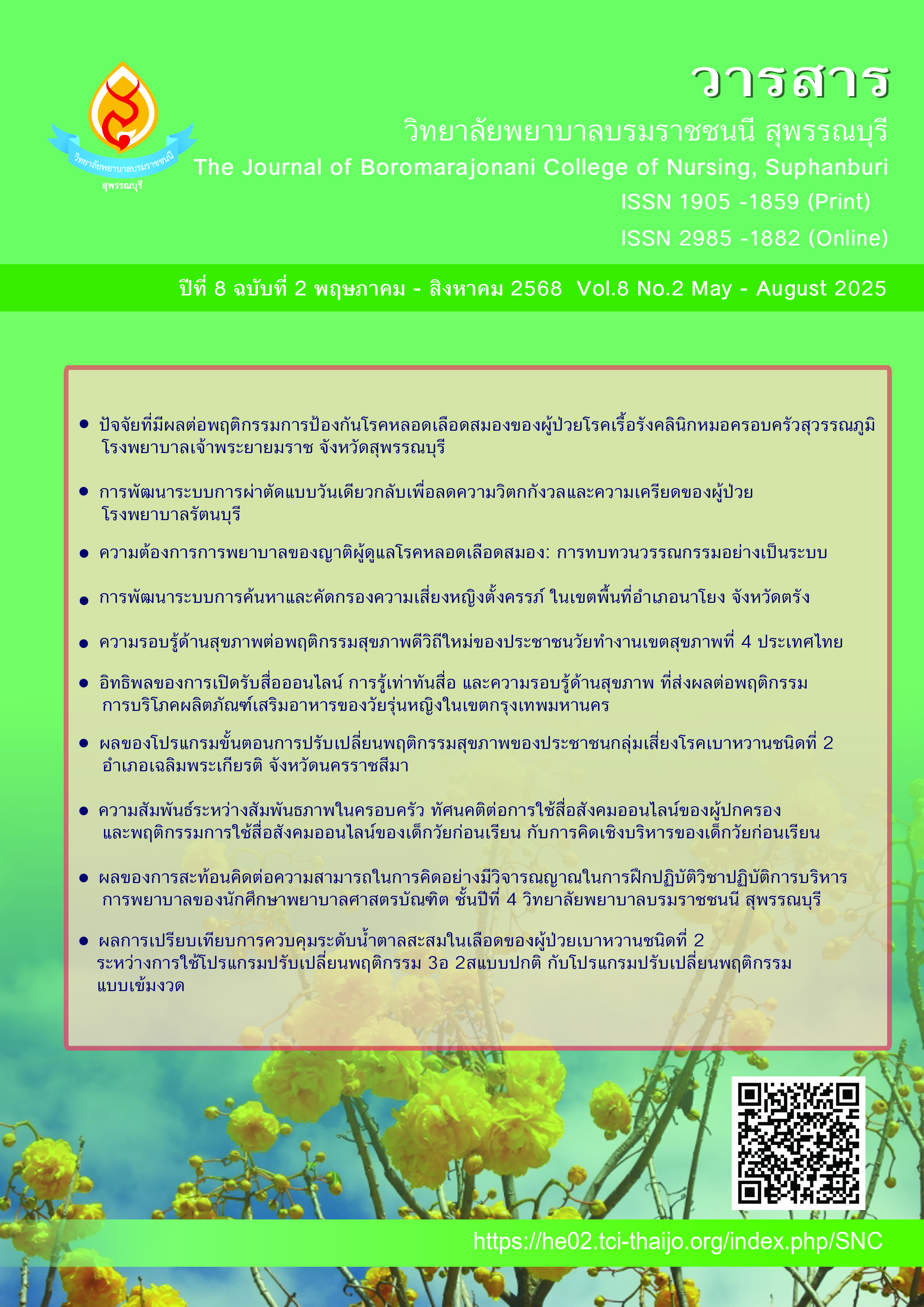
Effect of Reflective Thinking on Critical Thinking Ability in Nursing Administration Practicum of 4th Year Undergraduate Nursing Students Boromarajonani College of Nursing, Suphanburi
Keywords:
reflective thinking, critical thinking ability, undergraduate nursing studentsAbstract
This two-group pre-post test design experimental research aimed to compare the critical thinking ability of nursing students before and after teaching using reflective thinking. The sample group was fourth-year nursing students at Boromarajonani College of Nursing, Suphanburi, who were practicing the nursing administration practice course between November and December 2023.The sample size was determined using the G * Power program with a significance level of .05. The sample group consisted of 24 people per group, totaling 48 people. The sample group was selected by random drawing without replacement. The experimental group received reflections by recording reflections and verbal reflections from the researcher. The control group received regular teaching and learning. The research instruments were a written reflection record form created based on the Gibbs's Reflective Cycle concept and a critical thinking ability test. The Paired t-test was used to compare differences in critical thinking ability score among the experimental groups, and to compare critical thinking ability score scores between groups, the Mann-Whitney U test was used.
The results showed the mean critical thinking ability score of the experimental group increased statistically significantly (p < .01). The difference was statistically significant when comparing the mean critical thinking ability scores between the experimental and control groups (p < .05). The findings showed that verbal reflection combined with reflection writing during nursing practice helped develop students' critical thinking ability, learning through the process of reflective thinking, reviewing and reflecting on their own practice, leading to appropriate decision-making process in nursing practice for patient safety.
References
ดวงใจ เปลี่ยนบำรุง และปาริฉัตร อุทัยพันธ์. (2563). ผลของการจัดการเรียนการสอนโดยใช้การเรียนรู้แบบการ สะท้อนคิดเพื่อส่งเสริมความสามารถด้านการคิดวิจารณญาณของนักศึกษาพยาบาล วิทยาลัยพยาบาลบรมราชชนนี ยะลา.วารสารวิจัยและพัฒนาระบบสุขภาพ, 13(1), 83-93
นิซรีน เจ๊ะมามะ, นริสา จันทบุรี, มุสลินท์ โตะแปเราะ, นันทา กาเลี่ยง, และนัจญวา นิยมเดชา.ผลของการสอนโดยใช้สถานการณ์เสมือนจริงร่วมกับการเรียนรู้ผ่านแผนที่มโนทัศน์และการสะท้อนคิด ต่อความสามารถในการคิดอย่างมีวิจารณญาณของนักศึกษาพยาบาล มหาวิทยาลัยนราธิวาสราชนครินทร. วารสารเครือข่ายวิทยาลัยพยาบาลและการสาธารณสุขภาคใต้, 11(2), e268098.
ประไพ กิตติบุญถวัลย์, เกศแก้ว สอนดี, ผุสดี ก่อเจดีย์, และภูวสิทธิ์ สิงห์ประไพ. (2562). ผลการสะท้อนคิดต่อความสามารถในการคิดอย่างมีวิจารณญาณและการปฏิบัติการพยาบาลด้วยหัวใจความเป็นมนุษย์ของนักศึกษาพยาบาล. วารสารศึกษาศาสตร์ มหาวิทยาลัยศิลปกร, 17(2), 163-171.
รัตติกร เหมือนนาดอน, ยุพาภรณ์ ติรไพรวงศ์, เจียมใจ ศรีชัยรัตนกูล และสันติ ยุทธยง. (2562). การพัฒนาการ เรียนรู้ผ่านการสะท้อนคิด. วารสารวิจัยสุขภาพและการพยาบาล, 35(2), 13-25.
วรรณลี ยอดรักษ์และณัฏฐินี ชัวชมเกตุ. (2568). ผลการจัดการเรียนการสอนรูปแบบการเรียนรู้การสะท้อนคิดเพื่อส่งเสริมความสามารถในการคิดวิจารณญาณ นักศึกษาพยาบาล คณะพยาบาลศาสตร์ มหาวิทยาลัยทักษิณ. วารสารวิชาการสาธารณสุขชุมชน, 11(1), 205-216.
ศราวุธ เรืองสวัสดิ์. (2564). การจัดการเรียนการสอนของวิทยาลัยพยาบาลในสังกัดสถาบันพระบรมราชชนก ในช่วงการระบาดของเชื้อไวรัส COVID-19. วารสารวิจัยและนวัตกรรมทางสุขภาพ, 4(2), 101-114.
สมจิตต์ สินธุชัย, สุดาเดช พิทักษ์ศิริกุลและปิยะรัตน์ หยกสุริยันต์. (2561). การสะท้อนคิดการปฏิบัติในการศึกษาทางพยาบาลศาสตร์. วารสารพยาบาลทหารบก, 19 (2),15-23.
สภาการพยาบาล. (2553). สมรรถนะผู้ประกอบวิชาชีพการพยาบาลและการผดุงครรภ์. นนทบุรี:สภาการพยาบาล.
สุวิมล ขอผล, จินตวีร์พร แป้นแก้ว, ธณัชช์นรี สโรบล, เกศราภรณ์ ชูพันธ์, สุมิตรพร จอมจันทร์, และนิตยา บุญลือ. (2562). การพัฒนาทักษะการคิดอย่างมีวิจารณญาณโดยใช้การสะท้อนคิด. พยาบาลสาร, 46(1), 88-101.
อัจราวดี ศรียะศักดิ์, วารุณี เกตุอินทร์,วิโรจร์ ฉิ่งเล็ก, และสุวรรณี แสงอาทิตย์.(2562). ประสบการณ์เรียนรู้ของนักศึกษาพยาบาลผ่านการสะท้อนคิดกลังการฝึกปฏิบัติการพยาบาลเด็ก. วารสารมหาวิทยาลัยนราธิวาสราชนครินทร์, 11(1), 25-37.
Alfaro-LeFevre, R. (2019). Critical Thinking, Clinical Reasoning, and Clinical Judgment. Elsevier - Health Sciences Division.
Arslan, R., Gulveren, H., & Aydin, E. (2014). A research on critical thinking tendencies and factorsthat affect critical thinking of higher education students. International Journal of Business and Management, 9(5), 43.
Baker, C. R. (1996). Reflective Learning: A Teaching Strategy for Critical Thinking. Journal of Nursing Education, 35(1), 19-22. https://doi.org/doi:10.3928/0148-4834-19960101-06
Bijani, M., Mohammadi, F., Haghani, F., Yamani, N., & Karim, S. (2021). Development and psychometric evaluation of a reflection on clinical practice questionnaire for nursing students. BMC Nursing. 20, 185. https://doi.org/10.1186/s12912-021-00705-0
Bezanilla, M. J., Fernández-Nogueira, D., Poblete, M., & Galindo-Domínguez, H. (2019). Methodologies for teaching-learning critical thinking in higher education: The teacher’s view. Thinking skills and creativity, 33, 100584.
Carbogim, F. d. C., Barbosa, A. C. S., de Oliviera, L. B., de Sá Diaz, F. B. B., Toledo, L. V., Alves, K. R., . . . Püschel, V. A. d. A. (2018). Educational intervention to improve critical thinking for undergraduate nursing students: A randomized clinical trial. Nurse Education in Practice, 33, 121-126. https://doi.org/https://doi.org/10.1016/j.nepr.2018.10.001
Cargas, S., Williams, S., & Rosenberg, M. (2017). An approach to teaching critical thinking across disciplines using performance tasks with a common rubric. Thinking Skills and Creativity, 26, 24-37. https://doi.org/10.1016/j.tsc.2017.05.005
Colley, B. M., Bilics, A. R., & Lerch, C. M. (2012). Reflection: A Key Component to ThinkingCritically. The Canadian Journal for the Scholarship of Teaching and Learning, 3(1). https://doi.org/10.5206/cjsotl-rcacea.2012.1.2
Duron, R., Limbach, B., & Waugh, W. (2006). Critical thinking framework for any discipline. International Journal of Teaching and Learning in Higher Education, 17(2), 160-166.
Edwards S. (2017). Reflecting differently. New dimensions: reflection-before-action and reflection-beyond-action. International Practice Development Journal, 7(1), 1-14. https://doi.org/10.19043/ipdj.71.002
Facione, P. (2015). Critical Thinking: What It Is and Why It Counts. Insight Assessment.
Faul, F., Erdfelder, E., Lang, A.G., & Buchner, A. (2007). G*Power3: A flexible statistical power analysis program for the social, behavioral, and biomedical sciences. Behavior Research Methods, 39(2), 175-191.
Falcó-Pegueroles, A., Rodríguez-Martín, D., Ramos-Pozón, S., & Zuriguel-Pérez, E. (2021). Critical thinking in nursing clinical practice, education and research: From attitudes to virtue. Nursing philosophy: an international journal for healthcare professionals, 22(1), e12332. https://doi.org/10.1111/nup.12332
Fernandes, R., Willison, J., Boyle, C., & Muliasari, D. (2025). Teachers’ Perceptions of Critical Thinking Facilitation in English Language Classes in an Indonesian High School. Educational Studies, 61(1), 22–39. https://doi.org/10.1080/00131946.2025.2467904
Gibbs, G. (1998). Learning by Doing: A Guide to Teaching and Learning Methods. Oxford Brooks University, Oxford.
Golden, B. (2023). Enabling critical thinking development in higher education through the use of a structured planning tool. Irish Educational Studies, 42(4), 949–969. https://doi.org/10.1080/03323315.2023.2258497
Grohs, J. R., Kirk, G. R., Soledad, M. M., & Knight, D. B. (2018). Assessing systems thinking: A tool to measure complex reasoning through ill-structured problems. Thinking Skills and Creativity, 28, 110-130. https://doi.org/10.1016/j.tsc.2018.03.003
Hora, M. T., & Smolarek, B. B. (2018). Examining Faculty Reflective Practice: A Call for Critical Awareness and Institutional Support. The Journal of Higher Education, 89(4), 553–581. https://doi.org/10.1080/00221546.2018.1437663
Lopes Ribeiro, O. M. P., Trindade, L. L., Pinto Novo, A. F. M., da Rocha, C. G., Sousa, C. N., Cabral Teles, P. J. F., . . . Ventura-Silva, J. M. A. (2022). The COVID-19 Pandemic and Professional Nursing Practice in the Context of Hospitals. Healthcare (Basel), 10(2). https://doi.org/10.3390/healthcare10020326
Makhene A. (2017). Argumentation: A Methodology to Facilitate Critical Thinking. International journal of nursing education scholarship, 14(1), 20160030. https://doi.org/10.1515/ijnes-2016-0030
Martyn, J., Terwijn, R., Kek, M. Y., & Huijser, H. (2014). Exploring the relationships between teaching, approaches to learning and critical thinking in a problem-based learning foundation nursing course. Nurse education today, 34(5), 829–835. https://doi.org/10.1016/j.nedt.2013.04.023
Moeti, B., Mgawi, R. K., & Moalosi, W. T. S. (2017). Critical Thinking among Post-Graduate Diploma in Education Students in Higher Education: Reality or Fuss?. Journal of Education and Learning, 6(2), 13-24. http://dx.doi.org/10.5539/jel.v6n2p13.
Noblitt, L., Vance, D. E., & Smith, M. L. D. (2010). A comparison of case study and traditional teaching methods for improvement of oral communication and critical-thinking skills. Journal of College Science Teaching, 39(5), 26.
Nold, H. (2017). Using Critical Thinking Teaching Methods to Increase Student Success: An Action Research Project. International Journal of Teaching and Learning in Higher Education, 29(1), 17-32.
Orique, S. B., & McCarthy, M. A. (2015). Critical Thinking and the Use of Nontraditional Instructional Methodologies. The Journal of nursing education, 54(8), 455–459. https://doi.org/10.3928/01484834-20150717-06
Polit, D.F., & Beck, C.T. (2004). Nursing Research: Principles and Methods (7th Ed). Lippincott Williams & Wilkins, Philadelphia.
Rashid, S., & Qaisar, S. (2016). Developing Critical Thinking through Questioning Strategy among Fourth Grade Students. Bulletin of Education and Research, 38(2), 153-168.
Johns, C. (2000). Becoming a Reflective Practitioner. London: Blackwell Science.
Papathanasiou, I. V., Kleisiaris, C. F., Fradelos, E. C., Kakou, K., & Kourkouta, L. (2014). Critical thinking: the development of an essential skill for nursing students. Acta Informatica Medica, 22(4), 283-286. https://doi.org/10.5455/aim.2014.22.283-286
Sharples, J. M., Oxman, A. D., Mahtani, K. R., Chalmers, I., Oliver, S., Collins, K., Austvoll-Dahlgren, A., & Hoffmann, T. (2017). Critical thinking in healthcare and education. BMJ (Clinical research ed.), 357, j2234. https://doi.org/10.1136/bmj.j2234
Downloads
Published
Versions
- 2025-06-18 (2)
- 2025-05-26 (1)
Issue
Section
License

This work is licensed under a Creative Commons Attribution-NonCommercial-NoDerivatives 4.0 International License.
บทความที่ได้รับการตีพิมพ์เป็นลิขสิทธิ์ของวารสารวิทยาลัยพยาบาลบรมราชชนนี สุพรรณบุรี
ข้อความที่ปรากฏในบทความแต่ละเรื่องในวารสารวิชาการเล่มนี้เป็นความคิดเห็นส่วนตัวของผู้เขียนแต่ละท่านไม่เกี่ยวข้องกับวิทยาลัยพยาบาลบรมราชชนนี สุพรรณบุรี และคณาจารย์ท่านอื่นๆในวิทยาลัยฯ แต่อย่างใด ความรับผิดชอบองค์ประกอบทั้งหมดของบทความแต่ละเรื่องเป็นของผู้เขียนแต่ละท่าน หากมีความผิดพลาดใดๆ ผู้เขียนแต่ละท่านจะรับผิดชอบบทความของตนเองแต่ผู้เดียว


