
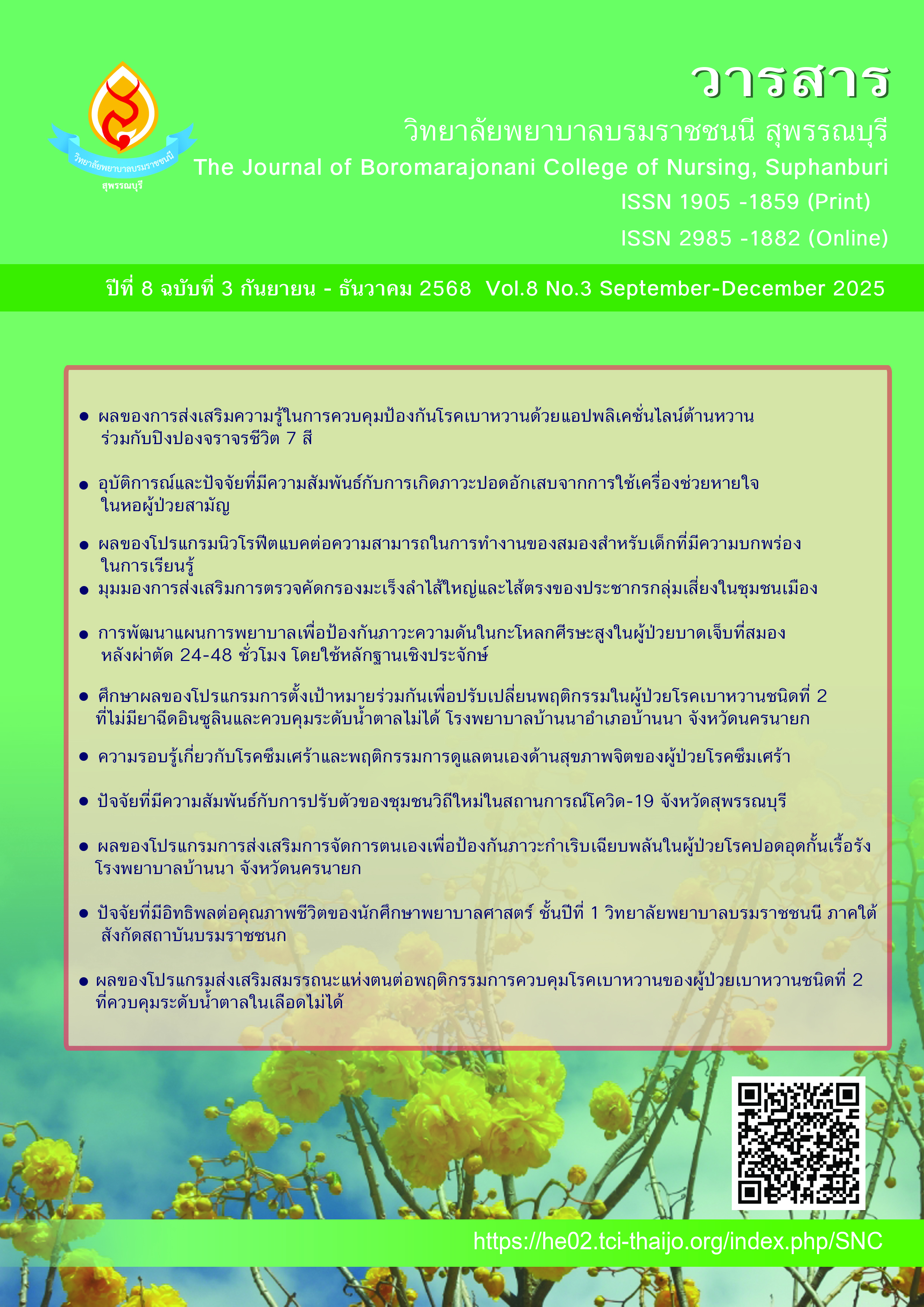
The study of the effects of the programme on adapting behavior in patients with type 2 diabetes without injections insulin at Ban Na Hospital, Ban Na District, Nakhon Nayok Province.
Keywords:
collaborative goal-setting, type 2 diabetes, Change behaviorAbstract
Type 2 diabetes is a major public health problem in Thailand. Ban Na Hospital has found that the number of diabetic patients with HbA1c≥10 who are not using insulin injections has tended to increase every year, resulting in complications and a reduced quality of life. This study aimed to examine the effect of a collaborative goal-setting program on knowledge, attitudes, self-care behaviors, and HbA1c levels in type 2 diabetes patients who do not use insulin and are unable to control their blood sugar levels. This research employed a quasi-experimental one-group pretest-posttest design. The sample consisted of 30 type 2 diabetes patients with HbA1c ≥ 10 who were not using insulin, selected through purposive sampling. The research instruments included a 9-item general information questionnaire, a 15-item diabetes knowledge scale, a 12-item self-care attitude scale, and a 12-item self-care behavior scale. All instruments were validated for content by experts and had a Cronbach’s alpha reliability coefficient of 0.75. Participants received the collaborative goal-setting program six times over 12 weeks. The program consisted of educational activities, behavior modification guidance, and self-selected goals communicated via LINE groups or direct telephone contact. Participants recorded their goals in a joint goal-setting booklet every two weeks, and HbA1c levels were measured at the end of the program. Data were analyzed using descriptive statistics and paired t-tests.
The results showed that after the program, participants had significantly higher self-care attitude scores (M=2.84, SD=0.16) and self-care behavior scores (M=2.45, SD=0.38) compared to before the program (attitude: M=2.49, SD=0.30; behavior: M=2.14, SD=0.42), with statistical significance at p < 0.01. However, the difference in diabetes knowledge scores was not statistically significant (p > 0.05). The mean HbA1c level after the program (M=8.40, SD=1.44) was significantly lower than before the program (M=9.96, SD=1.66), with statistical significance at p < 0.05.
Conclusion and Recommendations the collaborative goal-setting program is effective in improving self-care behavior and helping to control blood sugar levels in patients with poorly controlled type 2 diabetes. It is recommended that this program be implemented as part of the ongoing care for diabetic patients who struggle to manage their blood sugar levels.
References
กรมควบคุมโรค. (2567). โรคเบาหวาน ปรับเปลี่ยนพฤติกรรม ลดความเสี่ยง ควบคุมได้.
กรมควบคุมโรค. https://ddc.moph.go.th/brc/news.php?news=47609&deptcode=brc
กรมควบคุมโรค. (2566). สำนักงานป้องกันควบคุมโรคที่ 4 จังหวัดสระบุรีรายงานประจำปี 2566
[Annual Report 2023]. สำนักงานป้องกันควบคุมโรคที่ 4 จังหวัดสระบุรี. https://ddc.moph.go.th/odpc4/forecast_detail.php?publish=15401&deptcode=odpc4
กองโรคไม่ติดต่อ, & สำนักสื่อสารความเสี่ยงและพัฒนาพฤติกรรมสุขภาพ กรมควบคุมโรค. (2566). ข่าวประชาสัมพันธ์. https://ddc.moph.go.th/brc/news.php?news=38403&deptcode=brc&news_views
กฤตกร หมั่นสระเกษ, สุภาพร คำเมือง, & ณัฐธยาน์ ศรีสวัสดิ์. (2562). ผลของโปรแกรมการจัดการตนเองต่อการควบคุมระดับน้ำตาลในเลือดของผู้ป่วยโรคเบาหวานชนิดที่ 2 ที่ใช้อินซูลิน. วารสารพยาบาลทหารบก, 20(2), 145–153.
ชูศรี เมฆหมอก, จันทร์ฉาย ตระกูลดี, & สายฝน ม่วงคุ้ม. (2012). ผลการพยาบาลแบบตั้งเป้าหมายร่วมกันต่อพฤติกรรมการดูแลสุขภาพของผู้ป่วยเบาหวานที่มารับบริการโรงพยาบาลบ้านโป่ง จังหวัดราชบุรี. วารสารสภาการพยาบาล, 15(3), 78.
นริสา วงศ์พนารักษ์. (2556). การสื่อสารในการพยาบาลกับการสร้างสัมพันธภาพเพื่อการมีส่วนร่วมในการดูแลสุขภาพ. วารสารพยาบาลสงขลานครินทร์, 33(1), 80–91.
นริสา วงศ์พนารักษ์. (2556). การรับรู้ร่วมกันระหว่างพยาบาลและผู้รับบริการที่มีผลต่อการบรรลุเป้าหมายทางสุขภาพ. วารสารพยาบาลสงขลานครินทร์, 33(1), 24–36.
นิชาภา เหมือนภาค, ธิดารัตน์ มั่นเจริญ และศิรินารถ ศรีเอี่ยม. (2566). ความสัมพันธ์ระหว่างแรงจูงใจในการดูแลสุขภาพตนเองกับพฤติกรรมสุขภาพของผู้ป่วยเบาหวาน. วารสารสุขศึกษาและพฤติกรรมศาสตร์, 55(1), 25–34.
นิชาภา เหมือนภาค, พรทิพา กาญจนรัตน์ และพนิดา วงศ์ปราณีรัตน์. (2566). ความสัมพันธ์ระหว่างแรงจูงใจในการดูแลสุขภาพตนเองของผู้ป่วยเบาหวานชนิดที่ 2 กับพฤติกรรมการดูแลสุขภาพตนเอง. วารสารวิจัยสุขภาพและการพยาบาล, 39(1), 55–67.
ปิยนุช ภิญโญ, อัจฉรา ละอองทอง และชุติมา ชาญวิเศษ. (2564). การพัฒนาแนวทางสนับสนุนการจัดการตนเองของผู้ป่วยเบาหวานชนิดที่ 2 ในชุมชนกึ่งเมืองกึ่งชนบท. วารสารพยาบาลกระทรวงสาธารณสุข, 31(3), 12–24.
ปิยนุช ภิญโญ, ณัฐริกา พึ่งเกษม และอภิญญา วิจิตร. (2564). การพัฒนาแนวทางสนับสนุนการจัดการตนเองสำหรับผู้ป่วยเบาหวานชนิดที่ 2 ในชุมชนกึ่งเมืองกึ่งชนบท. วารสารพยาบาลทหารบก, 22(3), 267–276.
ศิริพร จิรวัฒน์กุล. (2552). ผลการพยาบาลแบบตั้งเป้าหมายร่วมกันต่อพฤติกรรมการดูแลสุขภาพของผู้ป่วยเบาหวาน. วารสารพยาบาลทหารบก, 10(3), 21–30.
ศูนย์เบาหวาน ศิริราช. (2560). แบบประเมินโครงการค่ายเบาหวานสำหรับผู้เป็นเบาหวานชนิดที่ 2 ประจำปี 2559–2560. https://www.si.mahidol.ac.th/th/division/diabetes/admin/download_files/2_44_1.pdf
สุกัญญา วัฒนะโชติ. (2553). การศึกษาพฤติกรรมการดูแลตนเองของผู้ป่วยเบาหวานชนิดที่ 2 ในเขตเทศบาลเมืองมหาสารคาม. วารสารโรงพยาบาลมหาสารคาม, 7(1), 23–34.
สุกัญญา วัฒนะโชติ. (2565). ความรู้ เจตคติ และการปฏิบัติตัวในการควบคุมโรคของผู้ป่วยเบาหวานโรงพยาบาลบ้านไร่ จังหวัดอุทัยธานี. วารสารโรงพยาบาลมหาสารคาม, 7(2), 2–7.
สุกฤตา ตะการีย์, ชวนพิศ อรุณรัตน์ และกัญญารัตน์ ชูวิเชียร. (2562). ผลของโปรแกรมการตั้งเป้าหมายร่วมกันต่อพฤติกรรมสุขภาพของผู้ป่วยเบาหวานชนิดที่ 2. วารสารพยาบาลศาสตร์, 37(2), 58–70.
สุกฤตา ตะการีย์, วรารัตน์ ชื่นตา และศิรินาถ ภัทรพิบูลย์. (2562). ผลของการตั้งเป้าหมายร่วมกันต่อพฤติกรรมสุขภาพของผู้ป่วยเบาหวานชนิดที่ 2. วารสารมหาวิทยาลัยนเรศวร: วิทยาศาสตร์สุขภาพ, 11(1), 47–55.
สำนักงานสาธารณสุขจังหวัดนครนายก. (2566). รายงานผลการดำเนินงาน: ร้อยละผู้ป่วยโรคเบาหวานที่ควบคุมระดับน้ำตาลในเลือดได้ดี. Health Data Center. https://nayok.moph.go.th/web/
สิริพิมพ์ ชูปาน, ทวีลักษณ์ วรรณฤทธิ์ และจินดารัตน์ ชัยอาจ. (2555). ผลของการพยาบาลตามทฤษฎีความสำเร็จตามจุดมุ่งหมายต่อพฤติกรรมควบคุมน้ำตาลในเลือดของผู้ป่วยเบาหวานชนิดที่ 2 [วิทยานิพนธ์พยาบาลศาสตรมหาบัณฑิต, มหาวิทยาลัยเชียงใหม่].
โรงพยาบาลบ้านนา. (2567). Health Data Center รายงานข้อมูลผู้ป่วยเบาหวาน พ.ศ. 2567.
American Diabetes Association. (2023). Standards of care in diabetes—2023. Diabetes Care, 46(Suppl. 1), S1–S291. https://doi.org/10.2337/dc23-Sint
Best, J. W. (1977). Research in education (3rd ed.). Prentice-Hall.
Bloom, B. S. (1979). Taxonomy of educational objectives: The classification of educational goals. Longman.
Bodenheimer, T., & Handley, M. A. (2009). Goal-setting for behavior change in primary care: An exploration and status report. Patient Education and Counseling, 76(2), 174–180. https://doi.org/10.1016/j.pec.2009.06.001
King, I. M. (1981). A theory for nursing: Systems, concepts, process. Wiley.
King, I. M. (2007). King's conceptual system, theory of goal attainment, and transaction process in the 21st century. Nursing Science Quarterly, 20(2), 109–111. https://doi.org/10.1177/0894318407299846
Lorig, K. R., & Holman, H. (2003). Self-management education: History, definition, outcomes, and mechanisms. Annals of Behavioral Medicine, 26(1), 1–7. https://doi.org/10.1207/S15324796ABM2601_01
Nunnally, J. C., & Bernstein, I. H. (1994). Psychometric theory (3rd ed.). McGraw-Hill.
Rovinelli, R. J., & Hambleton, R. K. (1977). On the use of content specialists in the assessment of criterion-referenced test item validity. Instructional Science, 6(2), 231–245. https://doi.org/10.1007/BF00116891
Downloads
Published
Issue
Section
License

This work is licensed under a Creative Commons Attribution-NonCommercial-NoDerivatives 4.0 International License.
บทความที่ได้รับการตีพิมพ์เป็นลิขสิทธิ์ของวารสารวิทยาลัยพยาบาลบรมราชชนนี สุพรรณบุรี
ข้อความที่ปรากฏในบทความแต่ละเรื่องในวารสารวิชาการเล่มนี้เป็นความคิดเห็นส่วนตัวของผู้เขียนแต่ละท่านไม่เกี่ยวข้องกับวิทยาลัยพยาบาลบรมราชชนนี สุพรรณบุรี และคณาจารย์ท่านอื่นๆในวิทยาลัยฯ แต่อย่างใด ความรับผิดชอบองค์ประกอบทั้งหมดของบทความแต่ละเรื่องเป็นของผู้เขียนแต่ละท่าน หากมีความผิดพลาดใดๆ ผู้เขียนแต่ละท่านจะรับผิดชอบบทความของตนเองแต่ผู้เดียว


