
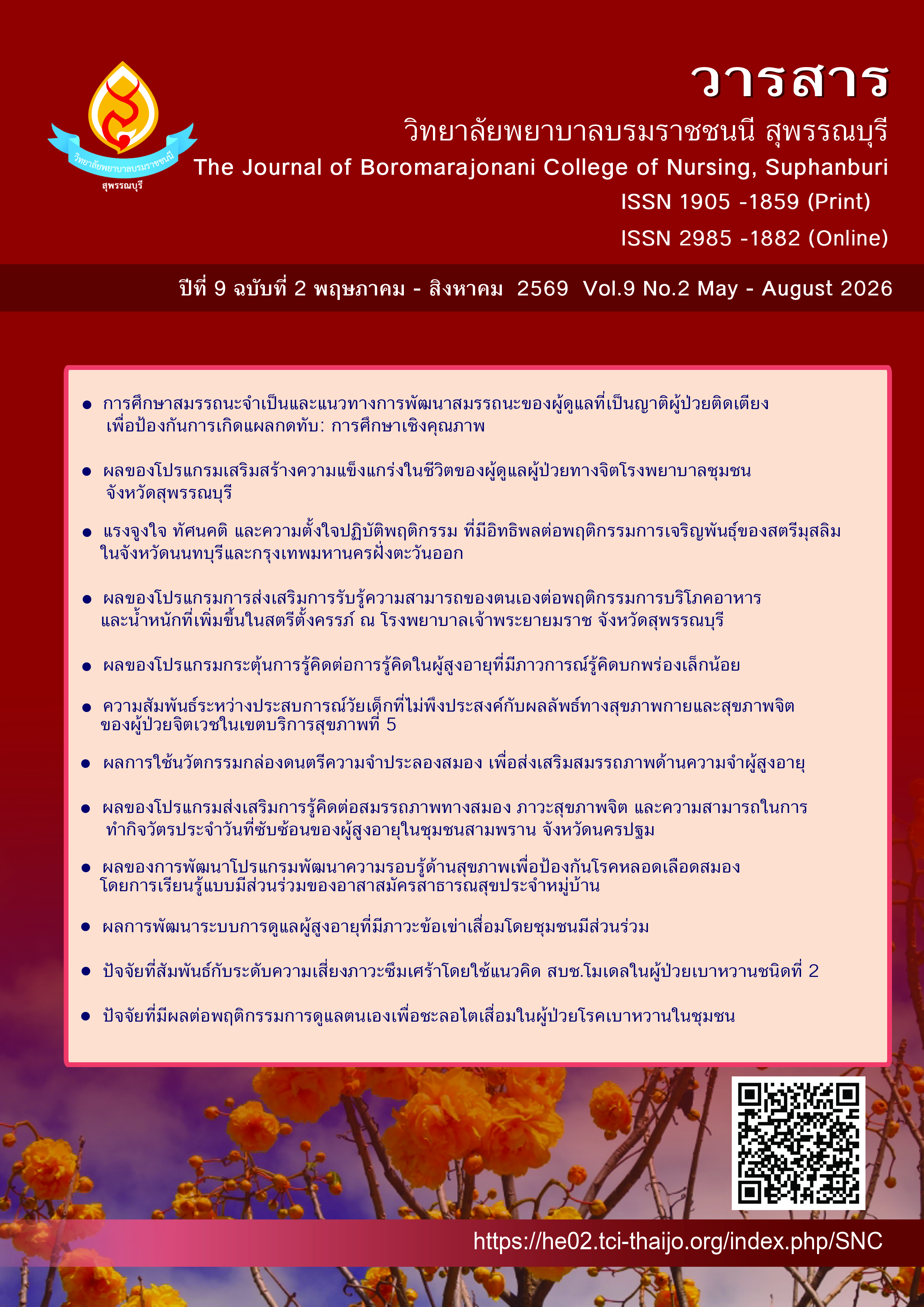
The Effect 0f The Resilience Enhancement Program for Caregivers of Psychiatric Patient at A Community Hospital Suphanburi Province
Keywords:
resilience quotient, caregivers of psychiatric patientAbstract
The purpose of this study was to examine the effects of a resilience enhancement program for caregivers of psychiatric patients at a community hospital in Suphanburi Province. This quasiexperimental study employed a two-group pretest–posttest design to measure resilience levels before, immediately after, and one month after the intervention. The sample consisted of 60 caregivers of psychiatric patients, who were randomly assigned to either the experimental group or the control group (n = 30 per group). Participants in the experimental group took part in a four-week Resilience Enhancement Program, while those in the control group received routine care. The program’s content and construct validity were verified by three experts, yielding an Index of Item–Objective Congruence (IOC) of 0.90, and its reliability, assessed using Cronbach’s alpha coefficient, was .85. The outcome was measured using the Resilience Quotient Scale developed by the Department of Mental Health. Data were analyzed using descriptive statistics, repeated-measures analysis of variance (ANOVA), and pairwise comparisons with Bonferroni correction.
The results showed that the mean score of Resilience Quotient at the post-test and 1-month follow-up were significantly different between the experimental and control groups (p < .001). Within the experimental group, mean Resilience Quotient scores before, immediately after, and one month after the intervention also differed significantly (p < .001). These findings suggest that the Resilience Enhancement Program can effectively strengthen caregivers’ mental resilience, enabling them to cope with challenges more creatively and effectively, thereby improving their overall quality of life.
References
กรมสุขภาพจิต กระทรวงสาธารณสุข. (2552). เปลี่ยนร้ายกลายเป็นดี พลังสุขภาพจิต RQ: Resilience Quotient. นนทบุรี: บริษัทดีน่าดูจำกัด.
กรมสุขภาพจิต กระทรวงสาธารณสุข. (2552). คู่มือการจัดกิจกรรมกำรสร้างพลังอึด ฮึด สู้ ในชุมชน. นนทบุรี: บียอนด์พับลิสชิ่งจำกัด.
กรมสุขภาพจิต. (2567). สถิติการให้บริการโรคจิตเวชที่สำคัญ. https://catalog.dmh.go.th/dataset/service-important.
กริณี สังข์ประคอง. (2562) ผลของโปรแกรมการเสริมสร้างพลังสุขภาพจิตต่อพลังสุขภาพจิตในผู้ดูแลผู้ป่วยโรคจิตเภทที่มีพฤติกรรมรุนแรง. วารสารวิจัยและนวัตกรรมทางสุขภาพ, 2(2), 1-20.
กำทร ดานา. (2564). การพัฒนาบทบาทการดูแลผู้ป่วยจิตเวช ของครอบครัวและภาคีเครือข่ายในชุมชน. วารสารวิชาการสาธารณสุข, 30(3), 404 -414.
ชาลินี สุวรรณยศ และ ดาราวรรณ ต๊ะปินตา. (2563). การลดความเครียดในผู้ดูแลผู้ป่วยสมองเสื่อม. วารสารจิตเวชและสุขภาพจิต, 34(2), 1-17.
ฐิติยาภรณ์ พิมวรรณ์ และ นิสิตา นาทประยุทธ. (2564). ปัจจัยที่สัมพันธ์กับความรู้สึกเป็นภาระของผู้ดูแลผู้ป่วยจิตเภท. สมาคมจิตแพทย์แห่งประเทศไทย, 66(2), 203-16.
ปัญญา ยืนยงตระกูล, พัชรินทร์ นินทจันทร์, โสภิณ แสงอ่อน, นันทิยา เอกอธิคมกิจ, ฐิติมา สงวนวิชัยกุล. (2566). ปัจจัยคัดสรรที่สัมพันธ์กับภาวะซึมเศร้าของผู้ดูแลผู้ป่วยจิตเภท. วารสารการพยาบาลจิตเวชและสุขภาพจิต, 37(2), 1-21.
ภาคิณี เดชชัยยศ ดวงใจ วัฒนสินธุ์ และ ภรภัทร เฮงอุดมทรัพย์. (2563). ปัจจัยที่มีผลต่อความผาสุกทางใจของผู้ดูแลผู้ป่วยจิตเภท. วารสารพยาบาลกระทรวงสาธารณสุข, 30(3), 170-181.
ไพจิตร พุทธรอด และมยุรี ลัคนาศิโรรัตน์ (2565).ผลของโปรแกรมการเสริมสร้างความเข้มแข็งทางใจต่อพลังสุขภาพจิต และภาวะซึมเศร้าในผูู้้ดูแลผู้ป่วยจิตเภท.วารสารการพยาบาลจิตเวชและสุขภาพจิต, 36(3), 1-13.
ไพบูลย์ ชาวสวนศรีเจริญ, กรรณิกา เรืองเดช ชาวสวนศรีเจริญ และ เสาวลักษณ์ คงสนิท. (2562). ประสิทธิผลของโปรแกรมการเสริมสร้างความแข็งแกร่งในชีวิตต่อความแข็งแกร่งในชีวิตการเห็นคุณค่าในตนเอง ความฉลาดทางอารมณ์และแรงจูงใจใฝ่สัมฤทธิ์ในการเรียนของนักศึกษาชั้นปีที่ 1 วิทยาลัยการสาธารณสุขสิรินธร จังหวัดตรัง. วารสารการพยาบาล การสาธารณสุขและการศึกษา, 20(2), 16-30.
วรเศรษฐ์ วัชรโรจนสกุล ชาลินี สุวรรณยศ และภัทราภรณ์ ภทรสกุล (2567). ผลของโปรแกรมส่งเสริมความแข็งแกร่งในชีวิตต่อความเครียด ของญาติผู้ดูแลผู้ที่มีภาวะสมองเสื่อม.วารสารวิจัยการพยาบาลและวิทยาศาสตร์สุขภาพ, 16(2), 1- 19.
วรงค์พร เจียรวัฒนาวิทย์. (2566). ภาวะซึมเศร้า วิตกกังวล และความเครียดในผู้ดูแลหลักของผู้ป่วยจิตเภทโรงพยาบาลนครปฐม. วารสารสุขภาพและสื่งแวดล้อมศึกษา, 8(1), 39 – 51.
วัชรีพร เกียงภา พัชรินทร์ นินทจันทร์โสภิณ แสงอ่อน และวิไล นาป่า. (2563). ปัจจัยคัดสรรที่มีความสัมพันธ์กับภาวะกดดดันด้านจิตใจของผู้ดูแลผู้ป่วยจิตเภท. วารสารการพยาบาลจิตเวชและสุขภาพจิต. 34(3), 77-101.
อมรรัตน์ ไก่แก้ว ดวงกมล ปิ่นเฉลียว และทิพย์ฆัมพร เกษโกมล. (2567). ผลของโปรแกรมเสริมสร้างพลังสุขภาพจิตร่วมกับแอปพลิเคชั่นไลน์ต่อความเข้มแข็งทางใจและภาวะกดดันด้านจิตใจ ของผู้ดูแลผู้ป่วยโรคจิตเภท. วารสารสุขภาพจิตแห่งประเทศไทย, 32(3), 202-12.
Cohen, J. (1992). Quantitative methods in psychology: A power primer. Psychological Bulletin, 112, 155-159.
Grotberg E. (1995). A guide to promoting resilience in children: strengthening the human spirit. The Hague:Bernard Van Leer Foundation.
Ryff CD, Keyes CLM. The structure of psychological well–being revisited. Journal of Personality and Social Psychology. 1995;69 (4): 719-27
Chen, X., Mao, Y., Kong, L., Li, G., Xin, M., Lou, F., et al. (2016). Resilience moderates the association between stigma and psycho-logical distress among family caregivers of patients with schizophrenia. Personality and Individual Differences, 96, 78-82.
Downloads
Published
Versions
- 2026-04-20 (2)
- 2026-03-11 (1)
Issue
Section
License

This work is licensed under a Creative Commons Attribution-NonCommercial-NoDerivatives 4.0 International License.
บทความที่ได้รับการตีพิมพ์เป็นลิขสิทธิ์ของวารสารวิทยาลัยพยาบาลบรมราชชนนี สุพรรณบุรี
ข้อความที่ปรากฏในบทความแต่ละเรื่องในวารสารวิชาการเล่มนี้เป็นความคิดเห็นส่วนตัวของผู้เขียนแต่ละท่านไม่เกี่ยวข้องกับวิทยาลัยพยาบาลบรมราชชนนี สุพรรณบุรี และคณาจารย์ท่านอื่นๆในวิทยาลัยฯ แต่อย่างใด ความรับผิดชอบองค์ประกอบทั้งหมดของบทความแต่ละเรื่องเป็นของผู้เขียนแต่ละท่าน หากมีความผิดพลาดใดๆ ผู้เขียนแต่ละท่านจะรับผิดชอบบทความของตนเองแต่ผู้เดียว


