
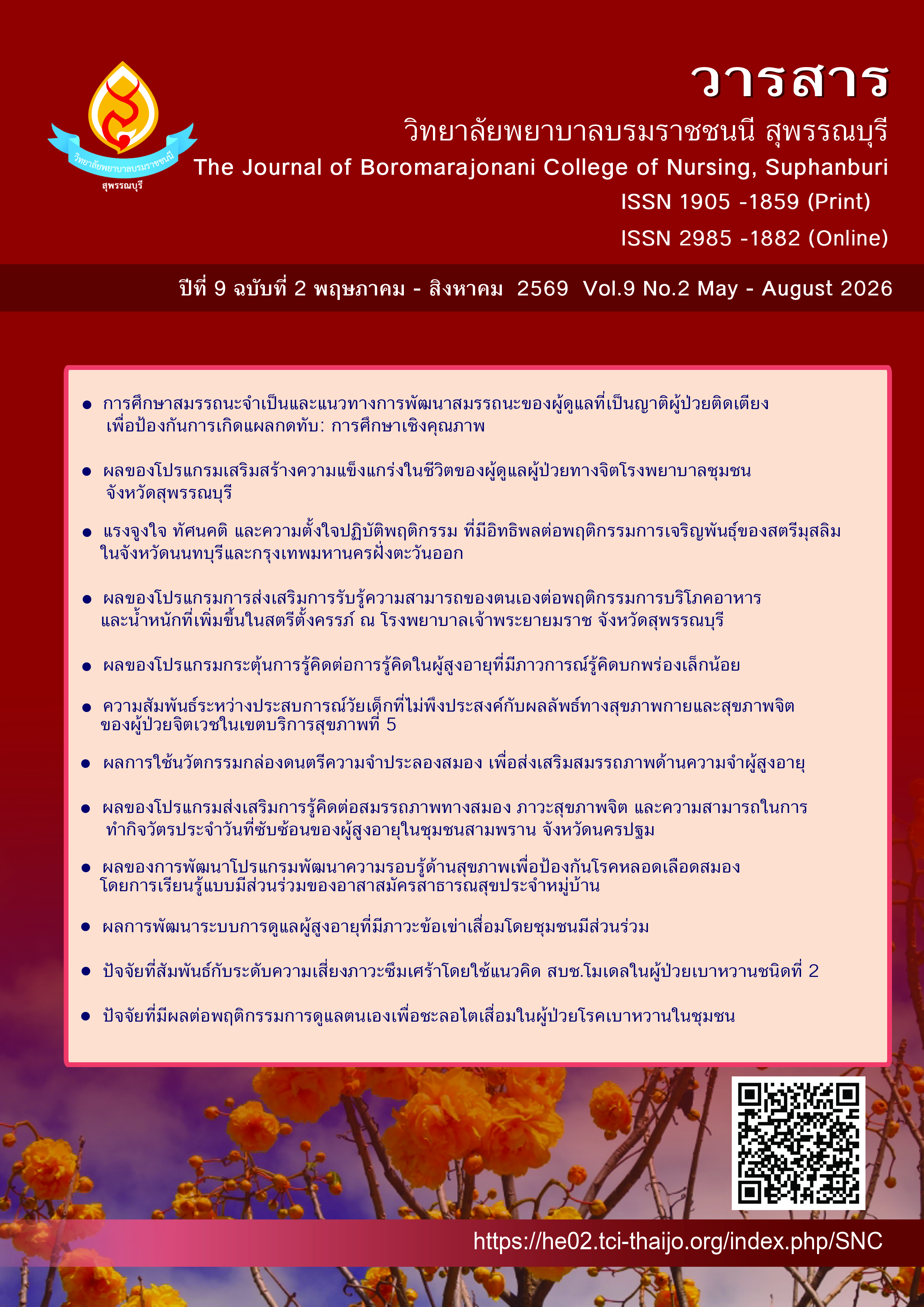
The Effects of Program Development a Health Literacy Development Program for Stroke PreventionThrough Participation Learning of Village Health Volunteers
Keywords:
Health literacy, Stroke, Stroke prevention behaviors, Village health volunteersAbstract
This quasi-experimental research aimed to evaluate the effectiveness of a health literacy development program for stroke prevention using participatory learning among Village Health Volunteers (VHVs). The program focused on enhancing health literacy skills and promoting stroke prevention behaviors. The study population consisted of VHVs in Mueang Suphan Buri District. The sample was selected via simple random sampling, with VHVs from Pho Phraya Sub-district Health Promoting Hospital forming the experimental group and VHVs from Pihan Daeng Sub-district Health Promoting Hospital serving as the comparison group. The sample size was determined using G*Power with an effect size of 0.80 at a .05 significance level, resulting in 30 participants per group. The intervention lasted 8 weeks.
The research instruments included: 1) A health literacy development program for community stroke prevention through participatory learning, comprising four skill areas: access, understanding, appraisal, and application; 2) A health literacy questionnaire for stroke prevention; and 3) A stroke prevention behavior questionnaire. The instruments were validated by experts with a Content Validity Index (CVI) of 1.00 for both, and Cronbach’s alpha coefficients of .92 and .92, respectively. Data were analyzed using descriptive statistics (frequency, percentage, mean, and standard deviation) and t-tests to compare mean scores of stroke prevention behaviors and health literacy within and between groups before and after the intervention.
The results revealed that after participating in the program, the experimental group had significantly higher mean scores for both health literacy and stroke prevention behaviors compared to their pre-intervention scores and higher than those of the comparison group at a .05 significance level.
Recommendations for future research include conducting follow-up assessments at 6 months or 1 year to evaluate the sustainability of health literacy and behavioral changes. Furthermore, the program should be adapted for other non-communicable diseases (NCDs). Utilizing a mixed-methods research approach is also suggested, as integrating quantitative and qualitative data would provide more comprehensive insights to further refine the program for target populations.
References
กระทรวงสาธารณสุข. (2563). สถิติผู้เสียชีวิตจากโรคหลอดเลือดสมองในประเทศไทย ปี พ.ศ. 2563
กระทรวงสาธารณสุข. (2566). ระบบคลังข้อมูลสุขภาพ.อัตราป่วยด้วยโรคหลอดเลือดสมอง.
กฤศภณ เทพอินทร์, และเสน่ห์ ขุนแก้ว. (2565). ความรอบรู้ด้านสุขภาพและพฤติกรรมสุขภาพของอาสาสมัครสาธารณสุขประจำหมู่บ้าน อำเภอฟากท่า จังหวัดอุตรดิตถ์.วารสารวิทยาลัยพยาบาลบรมราชชนนี อุตรดิตถ่, 14 (1), 206-218.
กษมา เชียงทอง. (2554). ความสัมพันธ์ระหว่างแบบแผนความเชื่อด้านสุขภาพ การรับรู้อาการเตือน และพฤติกรรมการจัดการโรคหลอดเลือดสมองในกลุ่มเสี่ยงโรคหลอดเลือดสมอง อำเภอดอยสะเก็ด จังหวัดเชียงใหม่. [วิทยานิพนธ์ปริญญาโทที่ไม่มีการตีพิมพ์]. มหาวิทยาลัยเชียงใหม่.
จรรยา คุณภาที. (2567). การพัฒนารูปแบบความรอบรู้ด้านสุขภาพและพฤติกรรมสุขภาพของอาสาสมัครสาธารณสุขประจำหมู่บ้าน (อสม.) ด้านโรคติดต่อและไม่ติดต่อในพื้นที่ตำบลบ้านม่วง อำเภอบ้านดุง จังหวัดอุดรธา นี. วารสารอนามัยสิ่งแวดล้อมและสุขภาพชุมชน, 9 (3), 1-10.
ชินตา เตชะวิจิตรจารุ. (2560). ความรอบรู้ทางสุขภาพ: กุญแจสำคัญสู่พฤติกรรมสุขภาพและผลลัพธ์สุขภาพที่ดี. วารสารพยาบาลทหารบก, 19 (พิเศษ), 1-11.
ณฐา เชียงปิ๋ว, วราภรณ์ บุญเชียง, และศิวพร อึ้งวัฒนา. (2561). ผลของการเรียนรู้แบบมีส่วนร่วมเกี่ยวกับการป้องกันโรคหลอดเลือดสมองต่อความรับรู้และการรับรู้สมรรถนะแห่งตนของอาสาสมัครสาธารณสุขประจำหมู่บ้าน. วารสารพยาบาล, 45 (1), 87-99
พรธิรา บุญฉวี. (2566). ผลของโปรแกรมการส่งเสริมความรอบรู้ด้านสุขภาพต่อพฤติกรรมการป้องกันโรคในผู้ที่เป็นโรคหลอด เลือดสมองระยะฟื้นฟูสภาพ [วิทยานิพนธ์ปริญญาโท, จุฬาลงกรณ์ มหาวิทยาลัย]. วารสารพยาบาล, 73(2), 51-60
เฟื่องฟ้า สีสวย. (2550). คุณภาพชีวิตของผู้ดูแลผู้ป่วยโรคหลอดเลือดสมอง โรงพยาบาลจุฬาลงกรณ์ [วิทยานิพนธ์ปริญญาโทที่ไม่มีการตีพิมพ์]. จุฬาลงกรณ์มหาวิทยาลัย.
รัตนพร สายตรีล, ปุญญพัฒน์ ไชยเมล์, และสมเกียรติยศ วรเดช. (2562). ความสามารถในการประกอบกิจวัตรประจำวันของผู้ป่วยโรคหลอดเลือดสมอง. วารสารวิชาการสาธารณสุขชุมชน, 5 (2), 1-13.
ราชวิทยาลัยอายุรแพทย์แห่งประเทศไทย.(2562). คนไทยป่วยตายด้วยโรคหลอดเลือดสมองสูงเป็นอันดับ 1. สืบค้นจาก https://www.registrationmaster.net/rcpt-people/content/4.
สถาบันประสาทวิทยา. (2559). แนวทางการพยาบาลผู้ป่วยโรคหลอดเลือดสมองสำหรับพยาบาลทั่วไป.
สมบัติ ทั่งทอง. (2567). การพัฒนารูปแบบการป้องกันโรคหลอดเลือดสมองในผู้สูงอายุโดยการมีส่วนร่วมของอาสาสมัครสาธารณสุขประจำหมู่บ้าน จังหวัดฉะเชิงเทรา. วารสารวิชาการป้องกันควบคุมโรค สคร.2พิษณุโลก, 11 (2), 1-16.
สมชาย โตวณะบุตร. (2558). โรคหลอดเลือดสมอง (Stroke). สืบค้นจาก https://www.hiso.or.th/hiso/picture/reportHealth/report/report8_5.pdf Berger et al., 1999 อ้างใน Freitas, Carruzzo, Tsiskaridze, Lobrinus & Bogousslavsky, 2001).
สุดา หันกลาง, สายสุนีย์ เลิศกะโทก, และสุลีกรณ์ ศิวะศานต์ (2568). ประสิทธิผลของโปรแกรมการเรียนรู้โดยใช้โครงงานเป็นฐานต่อความรอบรู้ด้านสุขภาพในอาสาสมัครสาธารณสุขประจำหมู่บ้าน . วารสาร Pacific Rim International Journal of Nurseing Research, 29 (3), 632-647.
อำนวย เนียมหมื่นไวย์. (2561). ประสิทธิผลของโปรแกรมการพัฒนาความรอบรู้ด้านสุขภาพและพฤติกรรมสุขภาพ 3 อ. 2ส. ของอาสาสมัครสาธารณสุขประจำหมู่บ้าน นักจัดการสุขภาพชุมชน อำเภอบ้านเหลื่อม จังหวัดนครราชสีมา. วารสารวิจัยและพัฒนาด้านสุขภาพสำนักงานสาธารณสุข จังหวัดนครราชสีมา, 4 (2), 1-15.
Migena Ymeraj, Fatjon Kotica, Giorgia Bozzolan, et al (2025). Health literacy in stroke disease: A systematic review. Journal of Vascular Nursing, 43 (1), 33-45.
Reetu Passi, Manmeet Kaur (2025) Participatory Action for Optimizing Health Literacy and Access to Manage Hypertension: Pre-post Evaluation in a Marginalized Community of India. Journals of Sage open, 15 (2), 20.
Dinesh Neupane, Craig S. Mclachlan , Rupesh Gautam, Shiva Raj Mishra, Michael Thorlund, Mette Schlutter, and Per Kallestrup. (2015). Literacy and motivation for the prevention and control of hypertension among female community health volunteers: a qualitative study from Nepal. Journals of Global Health Action, 8 (1), 1-8.
Kristine Sørensen, Stephan Van den Broucke, James Fullam, Gerardine Doyle, Jurgen Pelikan, and Zofia Slonska. (2012). Health literacy and public health: A systematic review and integration of definitions and models. Journals of BMC Public Health, 12 (80), 1-13.
Downloads
Published
Versions
- 2026-04-21 (3)
- 2026-04-21 (2)
- 2026-03-11 (1)
Issue
Section
License

This work is licensed under a Creative Commons Attribution-NonCommercial-NoDerivatives 4.0 International License.
บทความที่ได้รับการตีพิมพ์เป็นลิขสิทธิ์ของวารสารวิทยาลัยพยาบาลบรมราชชนนี สุพรรณบุรี
ข้อความที่ปรากฏในบทความแต่ละเรื่องในวารสารวิชาการเล่มนี้เป็นความคิดเห็นส่วนตัวของผู้เขียนแต่ละท่านไม่เกี่ยวข้องกับวิทยาลัยพยาบาลบรมราชชนนี สุพรรณบุรี และคณาจารย์ท่านอื่นๆในวิทยาลัยฯ แต่อย่างใด ความรับผิดชอบองค์ประกอบทั้งหมดของบทความแต่ละเรื่องเป็นของผู้เขียนแต่ละท่าน หากมีความผิดพลาดใดๆ ผู้เขียนแต่ละท่านจะรับผิดชอบบทความของตนเองแต่ผู้เดียว


