
Preceding Cutaneous Manifestation as an Early Identification of Multiple Endocrine Neoplasia Type 1 Syndrome: A Case Report
Keywords:
Multiple Endocrine Neoplasia Type 1, Collagenoma, Neuroendocrine Tumor, Pituitary Neoplasm, Primary HyperparathyroidismAbstract
Background: Multiple Endocrine Neoplasia type 1 (MEN1) syndrome is a rare genetic disorder associated with the development of tumors in various endocrine glands. Cutaneous manifestations, such as angiofibromas and collagenomas, can be early indicators of the syndrome.
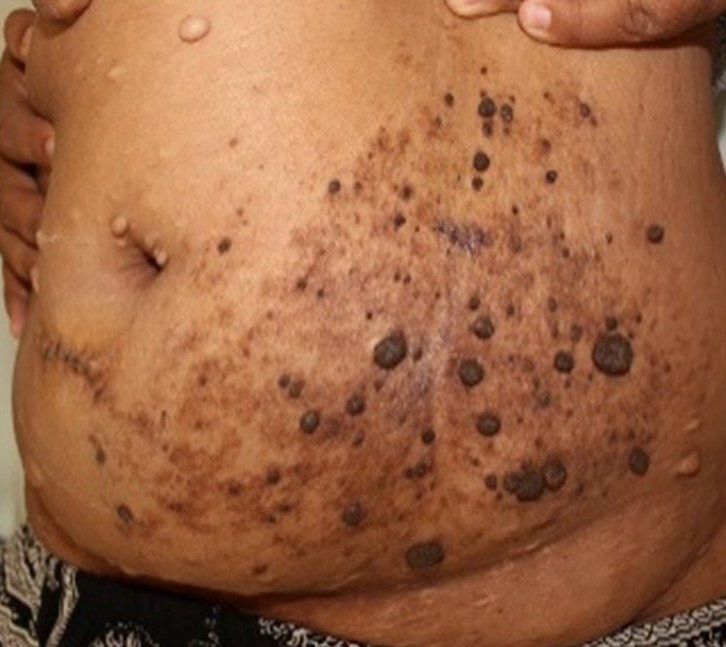
Case Report: A female patient with a history of progressive headache, rhinorrhea, secondary amenorrhea, and spontaneous galactorrhea was diagnosed with invasive pituitary adenoma. Over the past 10 years, she developed multiple skin-colored and brownish nodules, similar to those seen in her relatives, which were histologically consistent with collagenomas. Additional investigations revealed primary hyperparathyroidism. These combined clinical features led to the diagnosis of MEN1 syndrome. Notably, her mother had collagenomas more than 20 years prior and was subsequently diagnosed with a thyroid mass and invasive prolactinoma. Pathogenic variants of the MEN1 gene were identified in the patient, her mother, and her sister. Genetic counseling, as well as biochemical and radiological surveillance, was recommended for the patient and her affected family members.
Conclusion: Collagenoma is a crucial clue for early diagnosis of MEN1 syndrome. Detection of multiple collagenomas should prompt investigations for MEN1-related endocrine and non-endocrine tumors
References
Richards S, Aziz N, Bale S, et al. Standards and guidelines for the interpretation of sequence variants: a joint consensus recommendation of the American College of Medical Genetics and Genomics and the Association for Molecular Pathology. Genet Med 2015;17:405-23.
Kamilaris CD, Stratakis CA. Multiple endocrine neoplasia type 1 (MEN1): an update and the significance of early genetic and clinical diagnosis. Front Endocrinol (Lausanne) 2019;10:339.
Băicoianu-Nițescu LC, Gheorghe AM, Carsote M, Dumitrascu MC, Sandru F. Approach of multiple endocrine neoplasia type 1 (MEN1) syndrome–related skin tumors. Diagnostics (Basel) 2022;12:2768.
Asgharian B, Turner ML, Gibril F, Entsuah LK, Serrano J, Jensen RT. Cutaneous tumors in patients with multiple endocrine neoplasm type 1 (MEN1) and gastrinomas: prospective study of frequency and development of criteria with high sensitivity and specificity for MEN1. J Clin Endocrinol Metab 2004;89:5328-36.
Xia Y, Darling TN. Rapidly growing collagenomas in multiple endocrine neoplasia type I. J Am Acad Dermatol 2007;56:877-80.
Darling TN, Skarulis MC, Steinberg SM, Marx SJ, Spiegel AM, Turner M. Multiple facial angiofibromas and collagenomas in patients with multiple endocrine neoplasia type 1. Arch Dermatol 1997;133:853-7.
Balogh K, Rácz K, Patócs A, Hunyady L. Menin and its interacting proteins: elucidation of menin function. Trends Endocrinol Metab 2006;17:357-64.
Chung YJ, Hwang S, Jeong JJ, Song SY, Kim SH, Rhee Y. Genetic and epigenetic analysis in Korean patients with multiple endocrine neoplasia type 1. Endocrinol Metab (Seoul) 2014;29:270-9.
Choi JH, Kim HI, Kang SM, et al. A case of a calcitonin-secreting pancreatic endocrine tumor in a patient with multiple endocrine neoplasia type 1. Korean J Med 2012;83:817-22.
Jeong YJ, Oh HK, Bong JG. Multiple endocrine neoplasia type 1 associated with breast cancer: a case report and review of the literature. Oncol Lett 2014;8:230-4.
Downloads
Published
How to Cite
Issue
Section
License
Copyright (c) 2025 Thai Journal of Dermatology

This work is licensed under a Creative Commons Attribution-NonCommercial-NoDerivatives 4.0 International License.
เนื้อหาและข้อมูลในบทความที่ลงตีพิมพ์ในวารสารโรคผิวหนัง ถือเป็นข้อคิดเห็นและความรับผิดชอบของผู้เขียนบทความโดยตรงซึ่งกองบรรณาธิการวารสาร ไม่จำเป็นต้องเห็นด้วย หรือร่วมรับผิดชอบใดๆ
บทความ ข้อมูล เนื้อหา รูปภาพ ฯลฯ ที่ได้รับการตีพิมพ์ในวารสารโรคผิวหนัง ถือเป็นลิขสิทธิ์ของวารสารฯ หากบุคคลหรือหน่วยงานใดต้องการนำทั้งหมดหรือส่วนหนึ่งส่วนใดไปเผยแพร่ต่อหรือเพื่อกระทำการใดๆ จะต้องได้รับอนุญาตเป็นลายลักอักษรจากบรรณาธิการวารสารโรคผิวหนังก่อนเท่านั้น

