
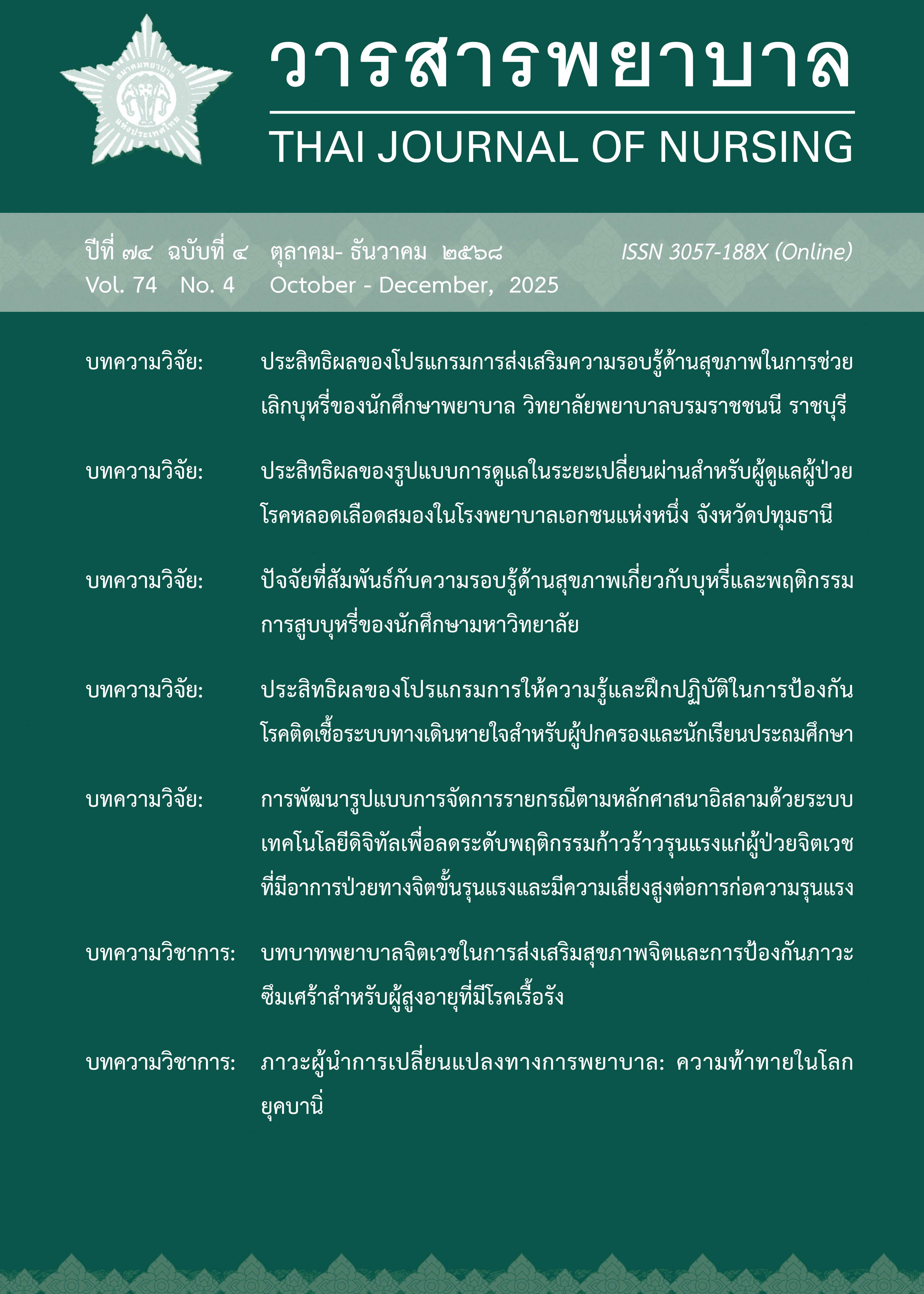
ํThe effectiveness of health literacy promotion program on smoking cessation among nursing students at Boromarajonani College of Nursing, Ratchaburi
Article Sidebar
Main Article Content
Abstract
This quasi-experimental research aimed to study the health literacy on smoking cessation among nursing students at Boromarajonani College of Nursing, Ratchaburi, and to compare health literacy on smoking cessation of nursing students before and after participating in the health literacy promotion program on smoking cessation. The sample of 66 nursing students at Boromarajonani College of Nursing, Ratchaburi, was purposively selected. The research instruments were the health literacy on smoking cessation questionnaire and the health literacy promotion program on smoking cessation. Data were analyzed by descriptive statistics, and t-test. The results of the research revealed as follows. 1) Before participating in the health literacy promotion program on smoking cessation, the health literacy on smoking cessation of nursing students was at a moderate level. 2) After participating in the health literacy promotion program on smoking cessation, the mean score of health literacy on smoking cessation of nursing students was significantly higher than before participating in the health literacy promotion program on smoking cessation at p < .05.
Article Details

This work is licensed under a Creative Commons Attribution-NonCommercial-NoDerivatives 4.0 International License.
References
กระทรวงสาธารณสุข กรมอนามัย. (2560). กรอบแนวคิดการส่งเสริมความรอบรู้ด้านสุขภาพ: Health literacy framework. สำนักโรคไม่ติดต่อ.
ประกิต วาทีสาธกกิจ. (2559). พิษภัยบุหรี่และการควบคุมยาสูบ. มูลนิธิรณรงค์เพื่อการไม่สูบบุหรี่.
มหาวิทยาลัยนเรศวร วิจัยและวิชาการด้านการควบคุมยาสูบภาคเหนือ. (2562). รายงานสถานการณ์การบริโภคยาสูบของประเทศไทย พ.ศ. 2562. สินทวีกิจ พริ้นติ้ง.
สุรีรัตน์ จันทรสาขา, ชลลดา ศรีสวัสดิ์, และวิไลวรรณ ยืนยง. (2561). ความรู้ ทัศนคติ และทักษะในการช่วยเลิกบุหรี่ของนักศึกษาพยาบาล. วารสารพยาบาลศาสตร์ มหาวิทยาลัยเชียงใหม่, 45(2), 42–55.
Bock, B. C., Becker, B. M., Niaura, R. S., Partridge, R., Fava, J. L., & Trask, P. (2013). Smoking cessation among participants in an internet-based intervention: Results from a randomized controlled trial. Journal of Medical Internet Research, 15(1), Article e12. https://doi.org/10.2196/jmir.2235
Hong, K. J., Park, N. L., Heo, S. Y., Jung, S. H., Lee, Y. B., & Hwang, J. H. (2021). Effect of e-health literacy on COVID-19 infection-preventive behaviors of undergraduate students majoring in healthcare. Healthcare (Basel, Switzerland), 9(5), 573. https://doi.org/10.3390/healthcare9050573
Ishikawa, H., & Kiuchi, T. (2010). Health literacy and health communication. Biopsychosocial Medicine, 4(1), 18. https://doi.org/10.1186/1751-0759-4-18
Lee, E. H., & Shin, S. R. (2025). Development and evaluation of virtual simulation for smoking cessation counseling education program for nursing students. BMC Nursing, 24, 512.
https://doi.org/10.1186/s12912-025-03141-6
Liu, C., Wang, D., Liu, C., Jiang, J., Wang, X., Chen, H., Ju, X., & Zhang, X. (2020). What is the meaning of health literacy? A systematic review and qualitative synthesis. Family Medicine and Community Health, 8(2), Article e000351. https://doi.org/10.1136/fmch-2020-000351
Marissa, B. R., Flor, L. S., Mullany, E. C., Gupta, V., Hay, S. I., & Gakidou, E. (2021). Spatial, temporal, and demographic patterns in prevalence of smoking tobacco use and initiation among young people in 204 countries and territories. The Lancet Public Health, 6(7), e472–e481.
Nutbeam, D. (2000). Health literacy as a public health goal: A challenge for contemporary health Education and communication strategies into the 21st century. Health Promotion International, 15(3), 259–267. https://doi.org/10.1093/heapro/15.3.259
Sarna, L., Bialous, S. A., Chan, S. S. C., Hollen, P., O’Connell, K. A., & Ganz, P. A. (2014). Tobacco use and cessation in nursing students: Cross-country survey results. Nursing Outlook, 62(5), 351–359.
Thornberry, A., Garcia, T. J., Peck, J., & Sefcik, E. (2020). Occupational health nurses’ self‑efficacy in smoking cessation interventions: An integrative review. Workplace Health & Safety, 68(9), 441–449. https://doi.org/10.1177/2165079920925106
World Health Organization, (2019). More than 100 reasons to quit tobacco. https://www.who.int/news-room/spotlight/more-than-100-reasons-to-quit
Zhang, L., Long Huang, X., Ye Luo, T., Jiang, L., Xue Jiang, M., & Yan Chen, H. (2021). Impact of tobacco cessation education on behaviors of nursing undergraduates in helping smokers to quit smoking. Tobacco Induced Diseases, 19(1), 58. https://doi.org/10.18332/tid/13902
