
Testing of validity and reliability of the Medication Adherence Report Scale (MARS) in post-kidney transplantation patients
Article Sidebar
Main Article Content
Abstract
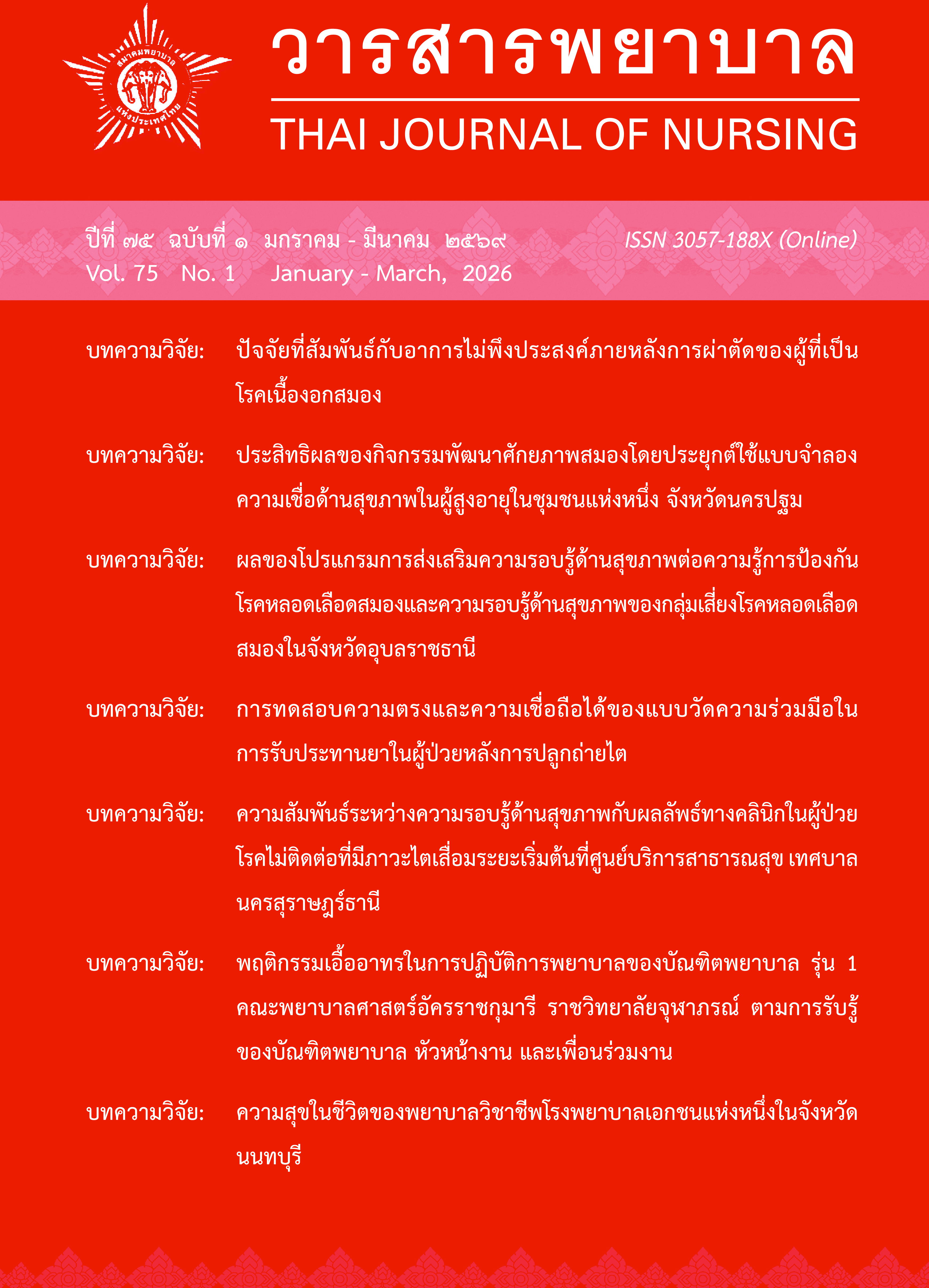
This cross-sectional study aimed to assess the validity and reliability of the Medication Adherence Report Scale (MARS) in post kidney transplantation patients. The Thai version of the MARS was developed through forward-backward translation techniques. The scale was then reviewed by five experts for content validity. A total of 100 post kidney transplantation patients after 6 months, aged 18 years or above were recruited. Data analysis was conducted using descriptive statistics and exploratory factor analysis was used to examine its construct validity. Results showed that content validity index of the Thai version of the MARS was 0.80. Exploratory factor analysis revealed that communalities were between 0.52 and 0.95. Factor loading of items were between 0.72 and 0.97. The Cronbach’s alpha coefficient was 0.772, which was acceptable.
Article Details

This work is licensed under a Creative Commons Attribution-NonCommercial-NoDerivatives 4.0 International License.
References
อุวรรณ โศภิตสกล, วรรณภา ประไพพานิช, และวันทนา มณีศรีวงศ์กูล. (2561). ปัจจัยที่มีความสัมพันธ์กับการรับประทานยาอย่างต่อเนื่องสมํ่าเสมอในผู้ป่วยหลังปลูกถ่ายไต. วารสารวิจัยและนวัตกรรมทางการพยาบาล, 24(3), 328–344.
Al-Qerem, W., Al Bawab, A. Q., Abusara, O., Alkhatib, N., & Horne, R. (2022). Validation of the arabic version of medication adherence report scale questionnaire and beliefs about medication specific questionnaire: A factor analysis study. PLoS One, 17(4), Article e0266606. https://doi.org/10.1371/journal.pone.0266606
Alsanosi, S. M., Aldajani, A. Q., Gheliwi, H. A., Alotibi, M. M., Bokhari, G. S., Almatrafi, O. A., Alqawlaq, A. K., Abujamai, J. Z., Shaikhomer, M., Alhindi, Y. Z., & Alshanberi, A. M. (2025). Knowledge, attitudes, and perceptions of chronic patients in Saudi Arabia regarding the use of artificial intelligence to improve medication adherence. Patient Preference and Adherence, 19, 1781-1792. https://doi.org/10.2147/PPA.S519427
Boateng, G. O., Neilands, T. B., Frongillo, E. A., Melgar-Quiñonez, H. R., & Young, S. L. (2018). Best practices for developing and validating scales for health, social, and behavioral research: A primer. Frontiers in Public Health, 6, Article 149. https://doi.org/10.3389/fpubh.2018.00149
Brislin, R. W. (1970). Back-translation for cross-cultural research. Journal of Cross-Cultural Psychology, 1, 185-216. https://doi.org/10.1177/135910457000100301
Chan, A. H. Y., Horne, R., Hankins, M., & Chisari, C. (2020). The medication adherence report scale: A measurement tool for eliciting patients' reports of nonadherence. British Journal of Clinical Pharmacology, 86(7), 1281–1288. https://doi.org/10.1111/bcp.14193
Derejie, M. N., Dereje, E. N., Alemu, D. M., Tesfay, Y. G., Hunduma, F., & Temie, N. M. (2024). Medication non-adherence and its associated factors among kidney transplant patients in a large teaching hospital in Ethiopia. BMC Nephrology, 25(1), 187. https://doi.org/10.1186/s12882-024-03620-z
Griva, K., Davenport, A., Harrison, M., & Newman, S. P. (2012). Non-adherence to immunosuppressive medications in kidney transplantation: Intent vs. forgetfulness and clinical markers of medication intake. Annals of Behavioral Medicine, 44(1), 85–93. https://doi.org/10.1007/s12160-012-9359-4
Hair, J. F., Black, W. C., Babin, B. J., & Anderson, R. E. (2010). Multivariate data analysis: A global perspective (7th ed.). Pearson Education.
Horne, R., & Weinman, J. (2002). Self-regulation and self-management in asthma: Exploring the role of illness perceptions and treatment beliefs in explaining non-adherence to preventer medication. Psychology & Health, 17(1), 17–32. https://doi.org/10.1080/08870440290001502
Kaiser, H. F. (1974). An index of factorial simplicity. Psychometrika, 39(1), 31–36. https://doi.org/10.1007/BF02291575
Polit, D. F., & Hungler, B. P. (2013). Essentials of nursing research: Methods, appraisal, and utilization (8th ed.). Lippincott Williams & Wilkins.
Tsapepas, D., Langone, A., Chan, L., Wiland, A., McCague, K., & Chisholm-Burns, M. (2014). A longitudinal assessment of adherence with immunosuppressive therapy following kidney transplantation from the Mycophenolic Acid Observational Renal Transplant (MORE) study. Annals of Transplantation, 19, 174–181. https://doi.org/10.12659/AOT.890216
Weng, L. C., Yang, Y. C., Huang, H. L., Chiang, Y. J., & Tsai, Y. H. (2017). Factors that determine self-reported immunosuppressant adherence in kidney transplant recipients: A correlational study. Journal of Advanced Nursing, 73(1), 228–239. https://doi.org/10.1111/jan.13106
World Health Organization. (2003). Adherence to long-term therapies: Evidence for action. https://apps.who.int/iris/handle/10665/42682
