
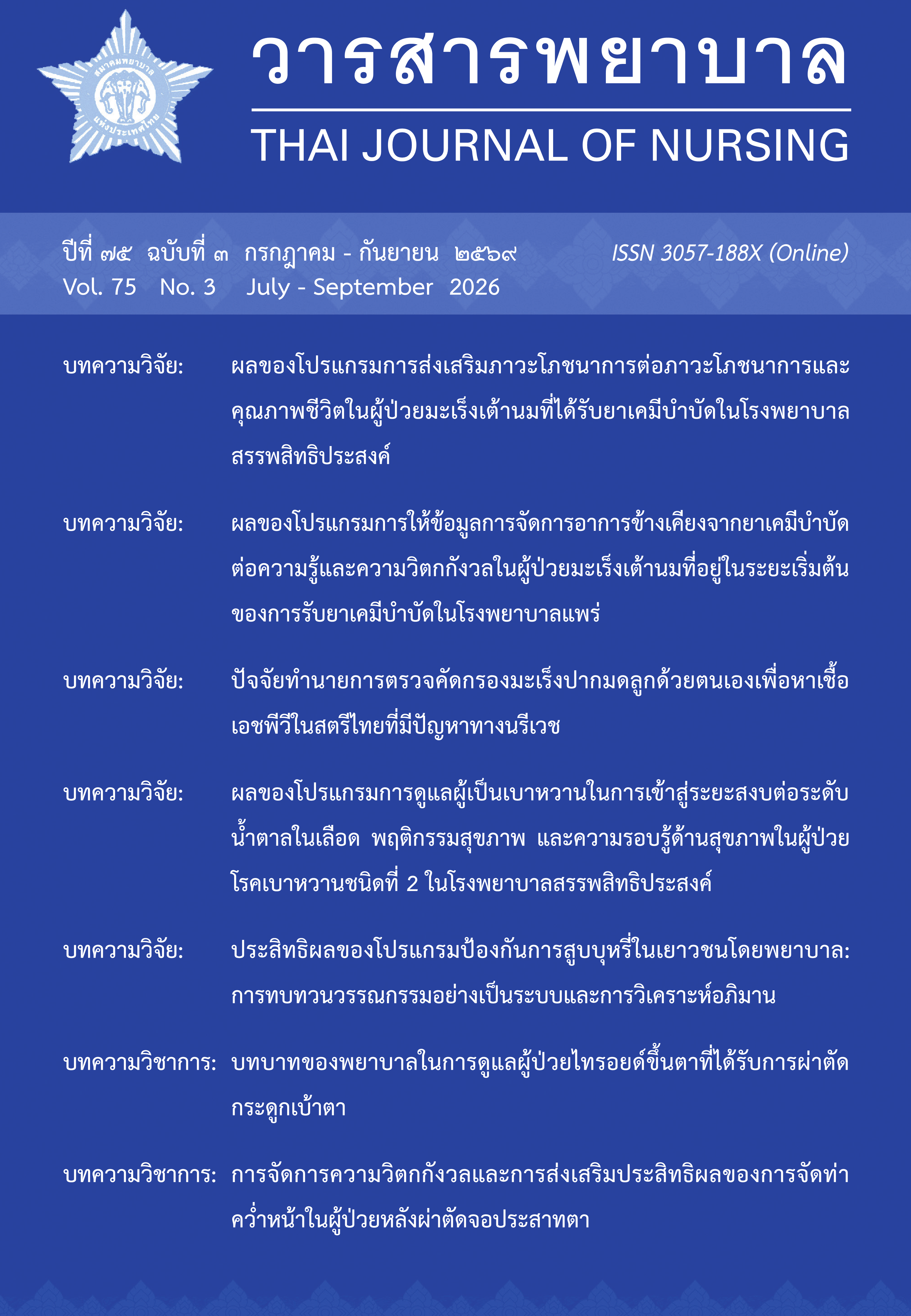
Predictive factors of cervical cancer screening via HPV self-sampling among Thai women with Gynecological problems
Article Sidebar
Main Article Content
Abstract
This descriptive cross-sectional design aimed to examine knowledge, attitudes, practices, and predictive factors of cervical cancer screening via HPV self-sampling among Thai women with Gynecological problems. A total of 304 Thai women with gynecological problems were recruited using purposive sampling. They were attending gynecology clinics at tertiary hospitals in Bangkok. The research instruments included questionnaires assessing knowledge, attitudes, practice and gynecological health factors. Data were analyzed using descriptive statistics and multiple regression analysis. The results showed that the mean knowledge score was 14.41 (SD = 3.76), indicating some limitations in understanding detailed aspects of HPV infection and screening methods. The mean attitude score was 25.62 (SD = 3.39), with concerns identified regarding confidence in self-sampling procedures, accuracy of test results, and potential contamination. The mean practice score was 6.01 (SD = 3.75). Only 8.88% of participants had previously performed HPV self-sampling, while 63.49% expressed intention to do so in the future. The predictors of HPV self-sampling behavior were knowledge (Beta = .354), history of HPV infection (Beta = .127), attitudes (Beta = .119), and history of cervical cancer screening (Beta = .118), collectively explaining 27% of the variance (p < .001).
Article Details

This work is licensed under a Creative Commons Attribution-NonCommercial-NoDerivatives 4.0 International License.
References
สถาบันมะเร็งแห่งชาติ. (2568). ทะเบียนมะเร็งระดับโรงพยาบาล พ.ศ. 2566 (Hospital-Based Cancer Registry 2023).
https://nci.go.th/files/cancer_stat/1771317685_file.pdf
Bogale, A. L., Teklehaymanot, T., Ali, J. H., Kassie, G. M., Medhin, G., Baye, A. Y., & Shiferaw, A. Y. (2022). Comparison of self-collected versus clinician collected cervicovaginal specimens for detection of high-risk human papillomavirus among HIV infected women in Ethiopia. BMC Women's Health, 22(1), 360. https://doi.org/10.1186/s12905-022-01944-2
Cohen, J. (1988). Statistical power analysis for the behavioral sciences (2nd ed.). Lawrence Erlbaum Associates.
Ferlay, J., Ervik, M., Lam, F., Laversanne, M., Colombet, M., & Mery, L. (2024). Global cancer observatory: Cancer Today. International Agency for Research on Cancer.
https://gco.iarc.who.int/media/globocan/factsheets/cancers/23-cervix-uteri-fact-sheet.pdf
Kositamongkol, C., Kanchanasurakit, S., Mepramoon, E., Talungchit, P., Chaopotong, P., Kengkla, K., Chaisathaphol, T., Saokaew, S., & Phisalprapa, P. (2023). Cost-utility and budget impact analyses of cervical cancer screening using self-collected samples for HPV DNA testing in Thailand. BMC Public Health, 23(1), 2413.
https://doi.org/10.1186/s12889-023-17358-0
Kittisiam, T., Tangjitgamol, S., Chaowawanit, W., Khunnarong, J., Srijaipracharoen, S., Thavaramara, T., & Pataradool, K. (2016). Knowledge and attitudes of Bangkok metropolitan women towards HPV and self-sampled HPV testing. Asian Pacific Journal of Cancer Prevention, 17(5), 2445–2451.
Ma’som, M., Bhoo-Pathy, N., Nasir, N. H., Bellinson, J., Subramaniam, S., Ma, Y., Yap, S.-H., Goh, P.-P., Gravitt, P., & Woo, Y. L. (2016). Attitudes and factors affecting acceptability of self-administered cervicovaginal sampling for human papillomavirus (HPV) genotyping as an alternative to Pap testing among multiethnic Malaysian women. BMJ Open, 6(8), Article e011022.
https://doi.org/10.1136/bmjopen-2015-011022
Nishimura, H., Yeh, P. T., Oguntade, H., Kennedy, C. E., & Narasimhan, M. (2021). HPV self-sampling for cervical cancer screening: A systematic review of values and preferences. BMJ Global Health, 6(5), Article e003743. https://doi.org/10.1136/bmjgh-2020-003743
Ploysawang, P., Rojanamatin, J., Prapakorn, S., Jamsri, P., Pangmuang, P., Seeda, K., & Sangrajrang, S. (2021). National cervical cancer screening in Thailand. Asian Pacific Journal of Cancer Prevention, 22(1), 25-30. https://doi.org/10.31557/apjcp.2021.22.1.25
Rogers, E. M. (1983). Diffusion of innovations (3rd ed.). Free Press.
Shao, J., Ke, H., Jiang, C., Sun, H., Han, H., Zhu, J., Chen, L., Wang, Y., Gu, J., & Duan, Y. (2024). Knowledge, attitudes, and practices of human papillomavirus and self-sampling among adult women: A cross-sectional study. Frontiers in Public Health, 12, Article 1377343. https://doi.org/10.3389/fpubh.2024.1377343
Smith, L. W., Khurshed, F., van Niekerk, D. J., Krajden, M., Greene, S. B., Hobbs, S., Coldman, A. J., Franco, E. L., & Ogilvie, G. S. (2014). Women’s intentions to self-collect samples for human papillomavirus testing in an organized cervical cancer screening program. BMC Public Health, 14(1), 1060. https://doi.org/10.1186/1471-2458-14-1060
Sukkasame, P., Jareemit, N., Punyashthira, A., Inthasorn, P., Chantawong, N., Suwannarurk, K., Pariyawateekul, P., Tangjitgamol, S., & Thai Gynecologic Cancer Society Research Group. (2024). Attitude toward human papillomavirus self-sampling and associated factors among Thai women undergoing colposcopy. Obstetrics & Gynecology Science, 7(3), 286–295. https://doi.org/10.5468/ogs.23293
Suwantaroj, J., Sripan, P., Kallawicha, K., Tso, J., Singweratham, N., & Siewchaisakul, P. (2025). The utilization of human papillomavirus testing for cervical cancer screening in Thailand: A comparison of screening with and without self-sampling samples. Asian Pacific Journal of Cancer Prevention, 26(9), 3469–3475. https://doi.org/10.31557/apjcp.2025.26.9.3469
Tiiti, T. A., Aluko, O., & Barrett, C. (2025). Knowledge of human papillomavirus and self-sampling, including vaccination practices among female students in Free State, South Africa. Cancer Causes Control, 36(12), 1705–1717. https://doi.org/10.1007/s10552-025-02049-5
Waller, J., Waite, F., & Marlow, L. (2024). Awareness and knowledge about HPV and primary HPV screening among women in Great Britain: An online population-based survey. Journal of Medical Screening, 31(2), 91–98. https://doi.org/10.1177/09691413231205965
World Health Organization. (2025). Eradicating cervical cancer in Thailand: A journey of hope and progress.
