
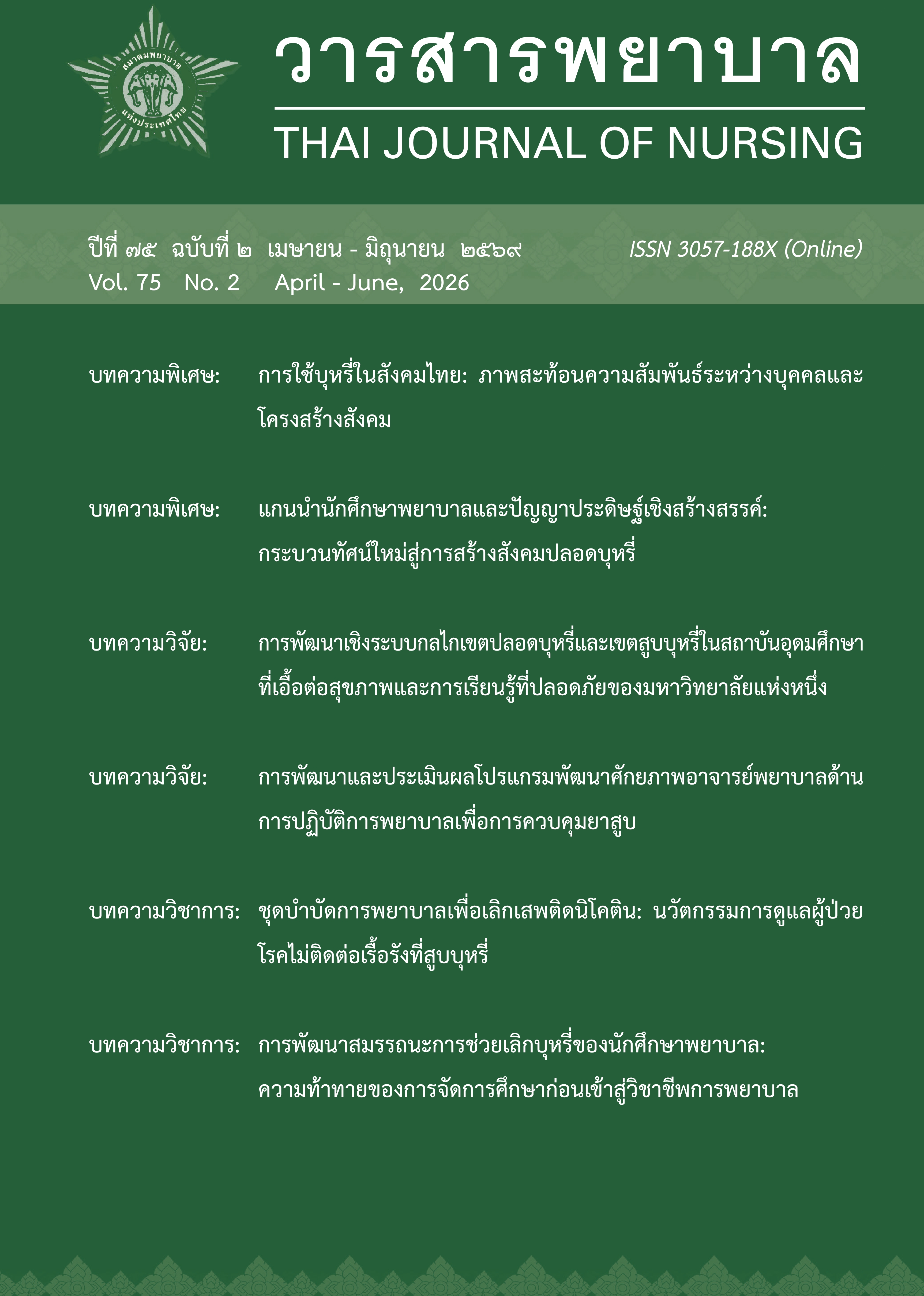
Tobacco use in Thai society: A reflection of the relationship between individuals and social structures
Article Sidebar
Main Article Content
Abstract
The situation of tobacco consumption in Thai society through an integrated perspective, linking socio-cultural contexts, toxicological components, and life-stage health impacts. The study identifies four evolutionary eras: traditional (social tool), industrial (mass commodity), control (public policy), and innovation (e-cigarettes). Toxicologically, combustible cigarettes contain over 5,000 chemicals, including tobacco-specific nitrosamines (TSNAs) and heavy metals that cause DNA damage. While e-cigarettes reduce certain toxins, they trigger epigenetic changes and accelerated biological lung aging. Life-stage analysis shows that early initiation (ages 6–17) significantly increases mortality risk and impairs organ development. In adulthood, tobacco use drives cardiovascular diseases, while in the elderly, it is linked to cognitive decline and oral health issues. The synthesis reveals that smoking is not merely a biological addiction but an outcome of interactions between individuals and social structures that shape consumption norms. The study concludes that future tobacco control measures must shift from a purely health-centric focus toward understanding the social dynamics and marketing of novel tobacco products. Developing such responsive policies is essential for creating sustainable control frameworks and protecting the health of the Thai population effectively.
Article Details

This work is licensed under a Creative Commons Attribution-NonCommercial-NoDerivatives 4.0 International License.
References
การยาสูบแห่งประเทศไทย. (2562). ประวัติการก่อตั้งและวิวัฒนาการการยาสูบ. https://www.thaitobacco.or.th
กรมสรรพสามิต. (2565). ความรู้เกี่ยวกับยาสูบและผลิตภัณฑ์ยาสูบในประเทศไทย. กระทรวงการคลัง. https://www.excise.go.th
กรมควบคุมโรค. (2567). สื่อประชาสัมพันธ์เนื่องในวันงดสูบบุหรี่โลก ประจำปี 2567. กระทรวงสาธารณสุข.
มูลนิธิรณรงค์เพื่อการไม่สูบบุหรี่. (2563). สถานการณ์การควบคุมยาสูบของประเทศไทยและมาตรการคุ้มครองสุขภาพจากควันบุหรี่. มูลนิธิรณรงค์เพื่อการไม่สูบบุหรี่.
สำนักงานกองทุนสนับสนุนการสร้างเสริมสุขภาพ. (2566). สถานการณ์บุหรี่ไฟฟ้าและผลกระทบต่อเด็กและเยาวชนไทย. สำนักงานกองทุนสนับสนุนการสร้างเสริมสุขภาพ.
Brandt, A. M. (2007). The cigarette century: The rise, fall, and deadly persistence of the product that defined America. Basic Books.
Cook, D. K., Lalonde, G., Oldham, M. J., Wang, J., Bates, A., Ullah, S., Sulaiman, C., Carter, K., Jongsma, C., Dull, G., & Gillman, I. G. (2024). A practical framework for novel electronic
nicotine delivery system evaluation: Chemical and toxicological characterization of JUUL2 aerosol and comparison with reference cigarettes. Toxics, 12(1), 41.
https://doi.org/10.3390/toxics12010041
Gately, I. (2001). Tobacco: A cultural history of how an exotic plant seduced civilization. Grove Press.
Goodman, J. (2005). Tobacco in history: The cultures of dependence. Routledge.
Jee, Y., Jung, K. J., Back, J. H., Lee, S. M., & Lee, S. H. (2020). Trajectory of smoking and early bladder cancer risk among Korean young adult men. Cancer Causes & Control, 31, 943-949. https://doi.org/10.1007/s10552-020-01335-8
Khan, A., Richardson, C., McElroy, J. P., Singh, A., Weng, D. Y., Kamel, S., Reisinger, S. A., Wewers, M. D., Shields, P. G., & Song, M. A. (2025). Associations of volatile organic compounds with accelerated epigenetic aging in the lungs of smokers and electronic cigarette users. Science of the Total Environment, 986, Article 179792. https://doi.org/10.1016/j.scitotenv.2025.179792
Liu, X., Sun, J., Zhao, M., Bovet, P., & Xi, B. (2023). Cigarette smoking in childhood and risk of all-cause and cause-specific mortality in adulthood. Frontiers in Public Health, 11, Article
https://doi.org/10.3389/fpubh.2023.1051597
Luu, M. N., Han, M., Bui, T. T., Tran, P. T. T., Lim, M. K., & Oh, J. K. (2022). Smoking trajectory and cancer risk: A population-based cohort study. Tobacco Induced Diseases, 20, 71.
https://doi.org/10.18332/tid/152137
Matsuo, R., Ago, T., Kiyuna, F., Sato, N., Nakamura, K., Kuroda, J., Wakisaka, Y., Kitazono, T., & Fukuoka Stroke Registry Investigators. (2020). Smoking status and functional outcomes after acute ischemic stroke. Stroke, 51(3), 846–852.
https://doi.org/10.1161/STROKEAHA.119.027230
Norton, M. (2008). Sacred gifts, profane pleasures: A history of tobacco and chocolate in the Atlantic world. Cornell University Press.
Parmar, M. P., Kaur, M., Bhavanam, S., Mulaka, G. S. R., Ishfaq, L., Vempati, R., C, M. F., Kandepi, H. V., R, R. E., Sahu, S., & Davalgi, S. (2023). A systematic review of the effects of smoking on the cardiovascular system and general health. Cureus, 15(4), Article e38073. https://doi.org/10.7759/cureus.38073
Proctor, R. N. (2011). Golden holocaust: Origins of the cigarette catastrophe and the case for abolition. University of California Press.
Reinstadler, S. J., Eitel, C., Fuernau, G., de Waha, S., Desch, S., Mende, M., Metzler, B., Schuler, G., Thiele, H., & Eitel, I. (2017). Association of smoking with myocardial injury and clinical outcome in patients undergoing mechanical reperfusion for ST-elevation myocardial infarction. European Heart Journal–Cardiovascular Imaging, 18(1), 39–45.
https://doi.org/10.1093/ehjci/jew030
Song, W., Wang, W., Dou, L. Y., Wang, Y., Xu, Y., Chen, L. F., & Yan, X. W. (2015). The implication of cigarette smoking and cessation on macrophage cholesterol efflux in coronary artery disease patients. Journal of Lipid Research, 56(3), 682-691. https://doi.org/10.1194/jlr.P055491
