
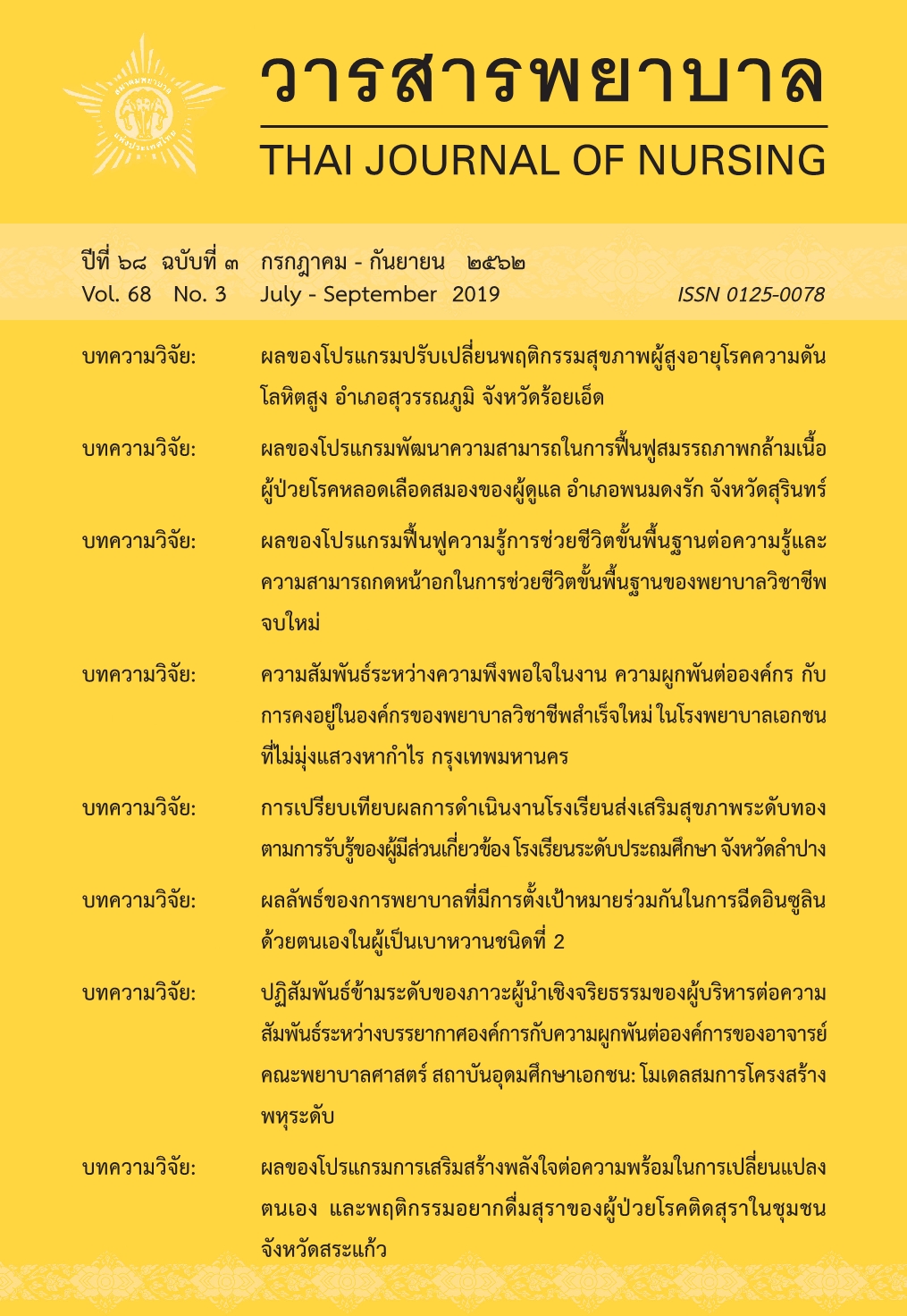
Effectiveness of basic life support retraining program on knowledge and chest compression performance in basic life support among new registered nurses
Article Sidebar
Main Article Content
Abstract
This quasi-experimental research aimed at investigating knowledge on basic life support ofnew registered nurses after one year and comparing knowledge and chest compression performance of basic life support [BLS] of new registered nurses in the pamphlet and BLS training video group and those in the pamphlet and instructor-led BLS training group. Data were collected from 40 subjects using the basic life support knowledge scale and the chest compression performance. Data analysis was conducted using descriptive statistics, Chi-square test, and t-test. The findings revealed that after one year, the scores of BLS of new registered nurses reduced with statistical significance (p < .001). After undergoing retraining in two groups, their knowledge increased with statistical significance (p < .001). The subjects in the pamphlet and BLS training video group, their knowledge was significantly lower than that of the subjects in the pamphlet and instructor-led BLS training group (p < .05). The overall chest compression performance of both groups were not different, but the chest compression rate in the pamphlet and BLS training video group was considered too fast compared to the pamphlet and instructor-led BLS training group (p < .001).
Article Details
References
จาก http://bps.moph.go.th/new_bps/sites/default/files/health_strategy2559.pdf
ทิศนา แขมมณี. (2547). ศาสตร์การสอน (พิมพ์ครั้งที่ 3). กรุงเทพมหานคร: ด่านสุทธาการพิมพ์.
อุรา แสงเงิน, สุพัตรา อุปนิสากร, และทิพมาส ชิณวงศ์. (2555). ปัจจัยที่มีความสัมพันธ์กับความรู้และทักษะในการช่วยฟื้นคืนชีพของพยาบาลโรงพยาบาลสงขลานครินทร์. วารสารพยาบาลสงขลานครินทร์, 32(1), 1-10.
Benjamin, E. J., Virani, S. S., Callaway, C. W., Chamberlain, A. M., Chang, A. R., Cheng, S., . . . Muntner, P. ( 2018). Heart disease and stroke statistics 2018 Update: A report from the American Heart Association. Circulation. 137(12), e67-e492. doi: 10.1161/CIR.0000000000000558
Ackermann, A. D. (2009). Investigation of learning outcomes for the acquisition and retention of CPR knowledge and skills learned with the use of high-fidelity simulation. Clinical Simulation in Nursing, 5(6), e213-e222.
Bloom, B. S. (1956). Taxonomy of education objectives, the classification of educational goals handbook I:
Cognitive domain. New York: David Mckay.
Bukiran, A., Erdur, B., Ozen, M., & Bozkurt, A. I. (2014). Retention of nurses' knowledge after basic life support and advanced cardiac life support training at immediate, 6-month, and 12-month post -training intervals: A longitudinal study of nurses in Turkey. Journal of Emergency Nursing, 40(2), 146-152.
Hamilton, R. (2005). Nurses' knowledge and skill retention following cardiopulmonary resuscitation
training: A review of the literature. Journal of Advanced Nursing, 51(3), 288-297.
Kardong-Edgren, S. E., Oermann, M. H., Odom-Maryon, T., & Ha, Y. (2010). Comparison of two instructional modalities for nursing student CPR skill acquisition. Resuscitation, 81(8), 1019-1024.
Kern, K. B., Sanders, A. B., Raife, J., Milander, M. M., Otto, C. W., & Ewy, G. A. (1992). A study of chest compression rates during cardiopulmonary resuscitation in humans: The importance of rate-directed chest compressions. Archives of Internal Medicine, 152(1), 145-149.
Madden, C. (2006). Undergraduate nursing students' acquisition and retention of CPR knowledge and skills. Nurse Education Today, 26(3), 218-227.
Mpotos, N., Yde, L., Calle, P., Deschepper, E., Valcke, M., Peersman, W., . . . Monsieurs, K. (2013).
Retraining basic life support skills using video, voice feedback or both: A randomised controlled trial. Resuscitation, 84(1), 72-77.
Nishiyama, C., Iwami, T., Murakami, Y., Kitamura, T., Okamoto, Y., Marukawa, S., . . . Kawamura, T. (2015). Effectiveness of simplified 15-min refresher BLS training program: A randomized controlled trial. Resuscitation, 90, 56-60.
Partiprajak, S., & Thongpo, P. (2016). Retention of basic life support knowledge, self-efficacy and chest compression performance in Thai undergraduate nursing students. Nurse Education in Practice, 16(1), 235-241.
Roh, Y. S., & Issenberg, S. B. (2014). Association of cardiopulmonary resuscitation psychomotor skills with knowledge and self-efficacy in nursing students. International Journal of Nursing Practice, 20(6), 674-679.
Vandeveer, M. & Norton, B. (2005). From teaching to learning: Theoretical foundation. In D. M. Billings & J. A. Halstead (Eds.). Teaching in nursing: A guide for faculty (2nd ed., pp. 240-241). St. Louis: Elsevier-Saunders.
Xanthos, T., Akrivopoulou, A., Pantazopoulos, I., Aroni, F., Datsis, A., & Iacovidou, N. (2012). Evaluation of nurses' theoretical knowledge in basic life support: A study in a district Greek hospital. International Emergency Nursing, 20(1), 28-32.
