
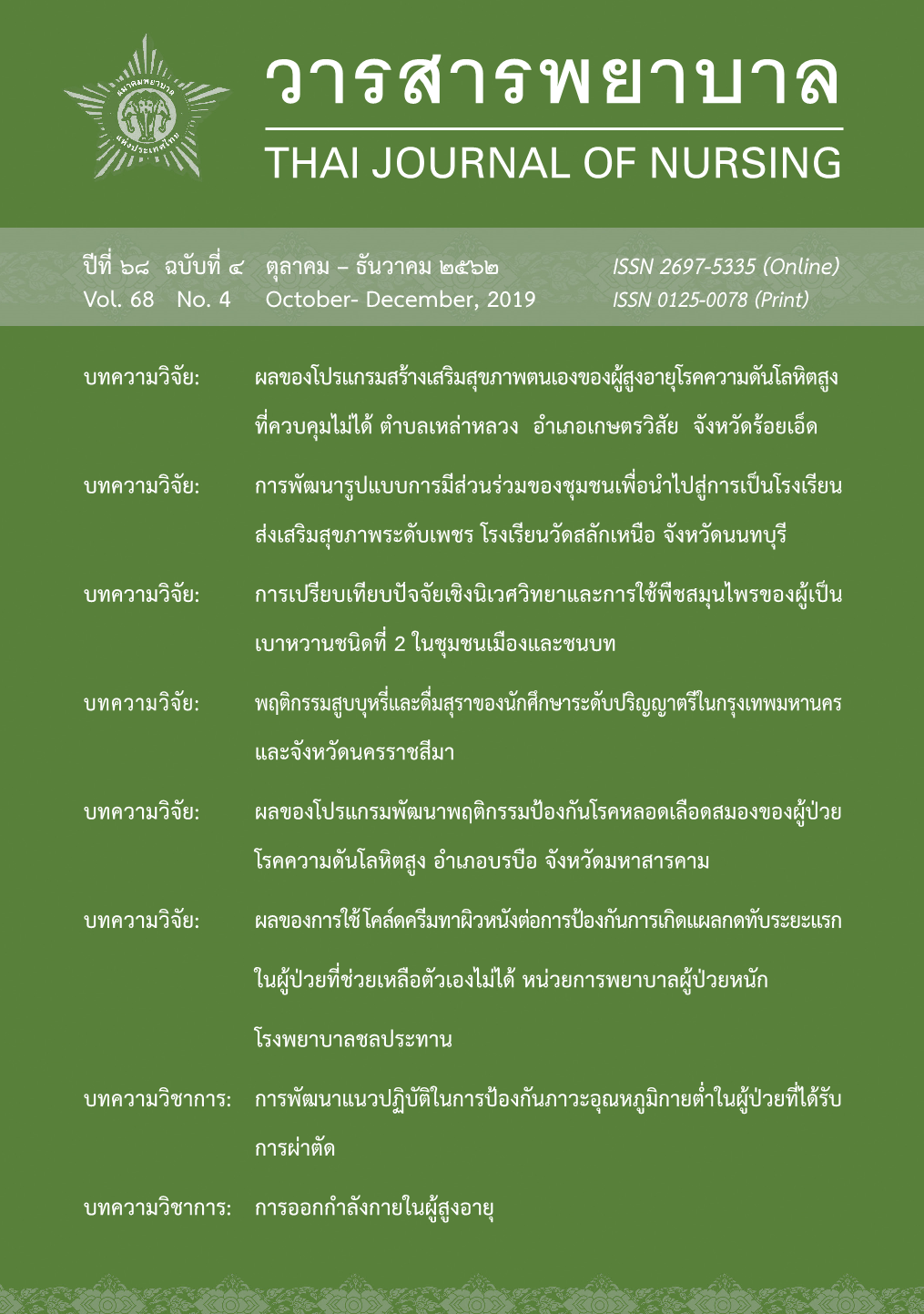
การออกกำลังกายในผู้สูงอายุ
Article Sidebar
Main Article Content
บทคัดย่อ
การออกกำลังกายมีประโยชน์ต่อผู้สูงอายุมากควรทำให้เป็นกิจวัตรประจำวัน การออกกำลังกายในผู้สูงอายุมี 4 แบบ ได้แก่ แบบเพิ่มความอดทนหรือแอโรบิก แบบช่วยการทรงตัว แบบเพิ่มความแข็งแรงของ กล้ามเนื้อและแบบยืดหยุ่น การออกกำลังกายแบบเพิ่มความอดทนหรือแบบแอโรบิกจะกระตุ้นการเต้นของหัวใจและการหายใจ การเดินเป็นวิธีที่ดีที่สุดสำหรับการออกกำลังกายแบบแอโรบิกในผู้สูงอายุ การออกกำลังกายเพื่อช่วยทรงตัว สามารถป้องกันการหกล้มได้ การออกกำลังกายแบบเพิ่มความแข็งแรงของกล้ามเนื้อ จะทำให้กล้ามเนื้อแข็งแรง เช่น การยกน้ำหนัก การออกกำลังกายแบบยืดหยุ่นช่วยให้ร่างกายทำกิจกรรมต่าง ๆได้ตามปกติ ช่วยการเคลื่อนไหวของข้อ เช่น การเต้นรำ โยคะ การยืดกล้ามเนื้อเฉพาะกลุ่ม เป็นต้น
Article Details
เอกสารอ้างอิง
ปิยะภัทร เดชพระธรรม. (2558). การออกกำลังกายในผู้สูงอายุ. ใน ประเสริฐ อัสสันตชัย. (บก.).
ปัญหาสุขภาพที่พบบ่อยในผู้สูงอายุและการป้องกัน (หน้า 399 – 422). กรุงเทพมหานคร: ยูเนียนครีเอชั่น.
วิไล คุปต์นิรัติกุล. (2561). การออกกำลังกายในผู้สูงอายุ. สืบค้นเมื่อ 15 ธันวาคม 2561, จาก https://www.
rehabmed.or.th/ main/wp. Content/ update// 2014/ 03/ exercise 1. Doc
เสก อักษรานุเคราะห์. (2553). การออกกำลังกายในผู้สูงอายุ. ใน อรรณณพ ใจสำราญ, สมพล สงวนรังศิริกุล,
อดิศร ภัทราดูลย์, สุกัญญา ชัยกิตติศิลป และ อารีรัตน์ สุพุทธิธาดา. (บก.). สังคมสูงวัยเปี่ยมสุขด้วยวิถีสุขภาพและสิ่ง
แวดล้อม (หน้า 37 - 68). กรุงเทพมหานคร: คอนเซ็พท์ เมดิคัส.
American College of Sports Medicine. (2011). Position stand: Quantity and quality of exercise
for developing and maintaining cardio – respiratory, musculoskeletal and neuromotor fitness
in apparently healthy adults: Guidance for prescribing exercise. Medicine and Science in
Sports and Exercise, 43(7), 1334 – 1359.
Carter, N. D., Kunnus, P., & Khan, K. M. (2001). Exercise in the prevention of falls in older people:
A systematic literature review examining the rational and the evidence. Sports Medicine, 31(6),
– 438.
Frontera, W. R., & Bigard, X. (2002). The benefits of strength training in the elderly. Science and
Sports, 17, 109 – 116.
Haber, D. (2013). Health promotion and aging practical: Applications for health professionals(6th.ed.).
New York, NY: Springer Publishing.
Miller, C. (2009). Nursing for wellness in older adults (5th.ed.). Philadelphia: Lippincott Williams
& Wilkins.
Nay, R., Garratt, S., & Fetherstonhaugh, D. (2014). Older people: Issues and innovations in care.
New York: Elsevier.
Saxon, S. V., Etten, M. J., & Perkins, E. A. (2015). Physical change and aging: A guide for helping
professions (6th.ed.). New York, NY: Springer Publishing.
Wolf, S. L., Barnhart , H. X., Kutner, N. G., McNeely, E., Coogler, C., & Xu, T. (1996 ). Reducing frailty
and falls in older persons: An investigation of Tai Chi and computerized balance training. Journal
of the American Geriatric Society, 44, 489 – 497.
