
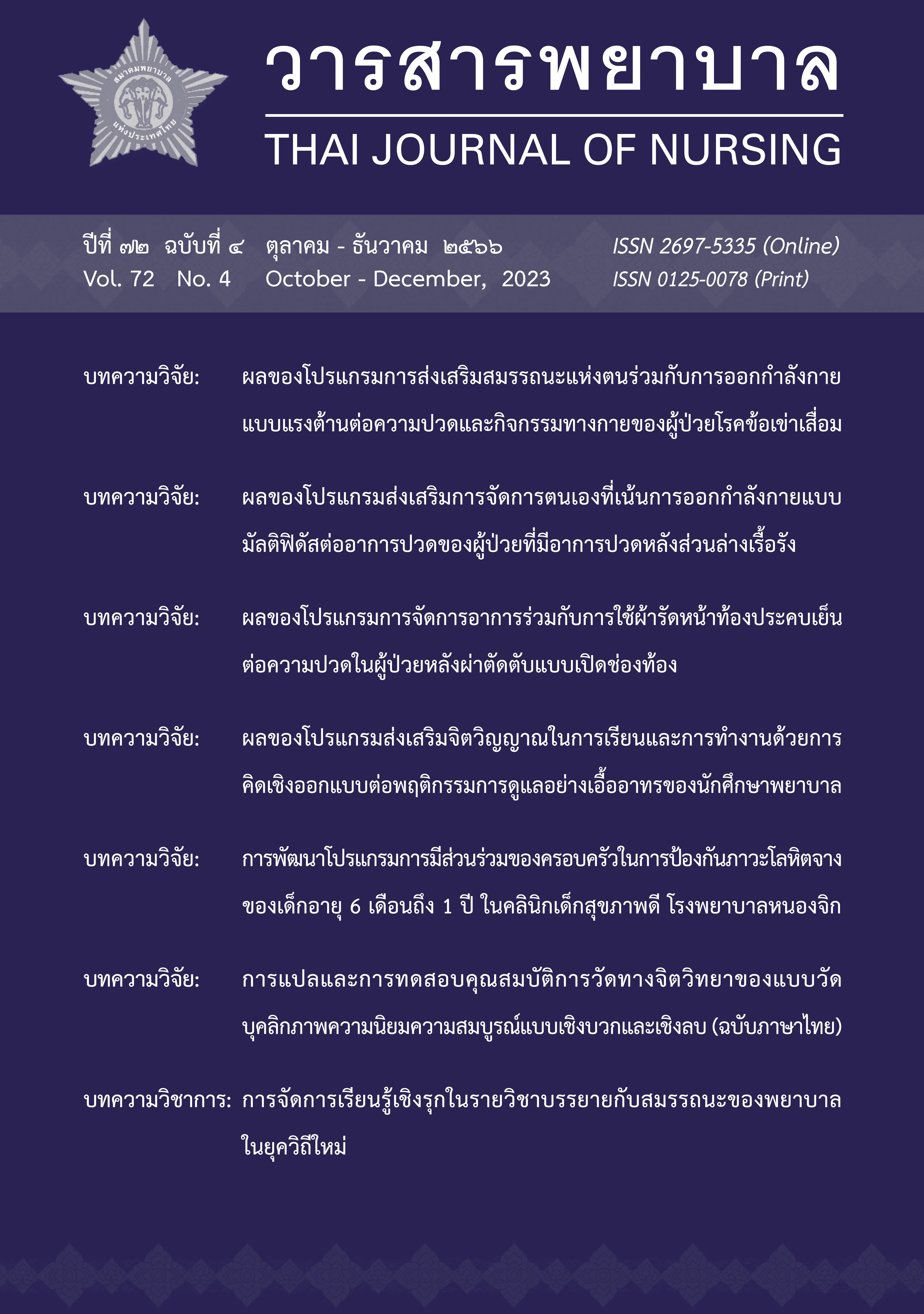
การแปลและการทดสอบคุณสมบัติการวัดทางจิตวิทยาของแบบวัดบุคลิกภาพความนิยมความสมบูรณ์แบบเชิงบวกและเชิงลบ (ฉบับภาษาไทย)
Article Sidebar
Main Article Content
บทคัดย่อ
การวิจัยนี้มีจุดมุ่งหมายเพื่อแปลและทดสอบคุณสมบัติการวัดทางจิตวิทยาของแบบวัดบุคลิกภาพความนิยมความสมบูรณ์แบบเชิงบวกและเชิงลบ (ฉบับภาษาไทย) ขั้นตอนการวิจัยมี 2 ระยะ คือ ระยะที่ 1 การแปลและตรวจสอบความตรงตามเนื้อหาเชิงวัฒนธรรมโดยแปลแบบไปข้างหน้าและแปลย้อนกลับ ประยุกต์ใช้ร่วมกับกระบวนการแปลและการปรับด้านวัฒนธรรม และทดลองใช้ และระยะที่ 2 การหาความเที่ยงของแบบวัด ผลการวิจัยได้แบบวัดบุคลิกภาพความนิยมความสมบูรณ์แบบเชิงบวกและเชิงลบ ฉบับภาษาไทย ที่มีค่าดัชนีความตรงตามเนื้อหาเชิงวัฒนธรรม เท่ากับ 1.00 และมีค่าสัมประสิทธิ์แอลฟ่าของครอนบาคทั้งฉบับ เท่ากับ 0.943 โดยแบบวัดบุคลิกภาพความนิยมความสมบูรณ์แบบเชิงบวกมีค่าสัมประสิทธิ์แอลฟ่าของครอนบาคเท่ากับ 0.925 ส่วนแบบวัดบุคลิกภาพความนิยมความสมบูรณ์แบบเชิงลบมีค่าสัมประสิทธิ์แอลฟ่าของครอนบาค เท่ากับ 0.914
Article Details

อนุญาตภายใต้เงื่อนไข Creative Commons Attribution-NonCommercial-NoDerivatives 4.0 International License.
เอกสารอ้างอิง
จิดาภา ดวงทิพย์. (2562). ปัจจัยพยากรณ์ความผาสุกทางจิตใจของพยาบาลวิชาชีพ โรงพยาบาลเอกชนในจังหวัดเชียงใหม่ [วิทยานิพนธ์ปริญญามหาบัณฑิต ไม่ได้ตีพิมพ์]. มหาวิทยาลัยเชียงใหม่.
นันทกา สวัสดิพานิช และสุจิตรา เทียนสวัสดิ์. (2554). การแปลเครื่องมือเพื่อใช้ในงานวิจัยข้ามวัฒนธรรม: เทคนิคและประเด็นที่ต้องพิจารณา. วารสารสภาการพยาบาล, 26(1), 19-28.
Akour, M., & AL-Omari, H. (2013). Empirical investigation of the stability of IRT item-parameters estimation. International Online Journal of Educational Sciences, 5(2), 291-301.
Asgari, A., & Kramer, J. M. (2008). Construct validity and factor structure of Persian occupational self-assessment. Occupational Therapy in Health Care, 22(1), 2-3.
Beaton, D. E., Bombardier, C., Guillemin, F., & Ferraz, M. B. (2000). Guidelines for the process of cross-cultural adaptation of self-report measures. Spine, 25(24), 3186-3191.
Besharat, M. A. (2005). Evaluating psychometric properties of Farsi version of the positive and negative perfectionism scale. Psychological Reports, 97(1), 33-42.
Besharat, M. A. (2009). Reliability and factor validity of a Farsi version of the positive and negative perfectionism scale. Psychological Reports, 105(1), 99-110.
Brislin, R. W. (1970). Back-translation for cross-cultural research. Journal of Cross-cultural Psychology, 1(3), 185-216.
Egan, S., Piek, J., Dyck, M., & Kane, R. (2011). The reliability and validity of the positive and negative perfectionism scale. Clinical Psychologist, 15(3), 121-132.
Egan, S., Piek, J., Dyck, M., & Kane, R. (2011). The reliability and validity of the positive and negative perfectionism scale. Clinical Psychologist, 15(3), 121–132. https://doi.org/10.1111/j.1742-9552.2011.00029.x
Haase, A. M., Prapavessis, H., & Owens, R. G. (2002). Perfectionism, social physique anxiety and disordered eating: A comparison of male and female elite athletes. Psychology of Sport and Exercise, 3(3), 209-222.
Kundi, Y. M., Hollet-Haudebert, S., & Peterson, J. (2022). Career adaptability, job crafting and subjective career success: the moderating roles of lone wolf personality and positive perfectionism. Personnel Review, 51(3), 945-965. doi:10.1108/PR-04-2020-0260
Lord, F. M., & Novick, M. R. (1968). Statistical theories of mental test scores. Addison-Wesley.
Melrose, S. (2011). Perfectionism and depression: Vulnerabilities nurses need to understand. Nursing Research and Practice, 2011, Article 858497. https://doi.org/10.1155/2011/858497
Ocampo, A. C. G., Wang, L., Kiazad, K., Restubog, S. L. D., & Ashkanasy, N. M. (2020). The relentless pursuit of perfectionism: A review of perfectionism in the workplace and an agenda for future research. Journal of Organizational Behavior, 41(2), 144-168. https://doi.org/10.1002/job.2400
Rovinelli, R. J., & Hambleton, R. K. (1976). On the use of content specialists in the assessment of criterion-referenced test item validity. Dutch Journal for Educational Research, 2, 49–60.
Şahin, A., & Anıl, D. (2017). The effects of test length and sample size on item parameters in item response theory. Educational Sciences: Theory & Practice, 17(1),321-335.
Terry-Short, L. A., Owens, R. G., Slade, P. D., & Dewey, M. E. (1995). Positive and negative perfectionism. Personality and Individual Differences, 18(5), 663-668.
https://doi.org/10.1016/0191-8869(94)00192-UGet rights and content
Yusoff, M. S. B. (2019). ABC of content validation and content validity index calculation. Education in Medicine Journal, 11(2), 49-54.
Zhou, X., Wu, S., Zhu, H., & Cai, T. (2016). Reliability and validity of the positive and negative perfectionism scale among Chinese college students. Social Behavior and Personality an International Journal, 44(5), 727-736.
