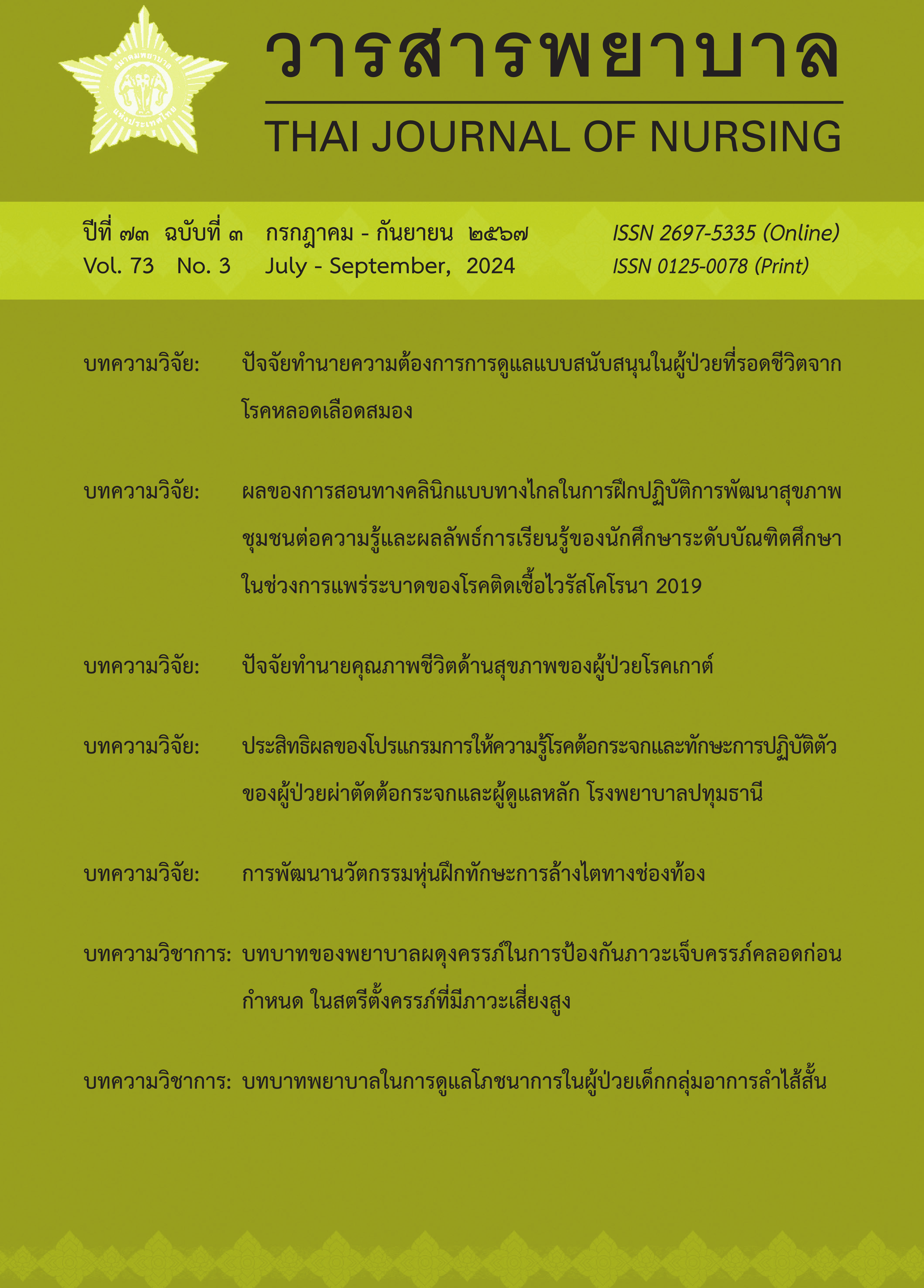
ปัจจัยทํานายความต้องการการดูแลแบบสนับสนุนในผู้ป่วยที่รอดชีวิตจากโรคหลอดเลือดสมอง
Article Sidebar
Main Article Content
บทคัดย่อ
การวิจัยสหสัมพันธ์เชิงทำนาย เพื่อศึกษาปัจจัยทำนายความต้องการการดูแลแบบสนับสนุนในผู้ป่วยที่รอดชีวิตจากโรคหลอดเลือดสมอง เลือกกลุ่มตัวอย่างแบบเจาะจง จำนวน 114 คน ตามเกณฑ์ที่กำหนด เครื่องมือวิจัย ได้แก่ 1) แบบสอบถามข้อมูลส่วนบุคคล 2) แบบสอบถามความต้องการการดูแลแบบสนับสนุน 3) แบบสอบถามภาวะโรคร่วม 4) แบบสอบถามระดับความพิการ 5) แบบสอบถามภาวะซึมเศร้าและความวิตกกังวล และ 6) แบบสอบถามความเหนื่อยล้า มีค่าดัชนีความตรงตามเนื้อหาระหว่าง 0.88 – 1.00 มีค่าสัมประสิทธิ์ความเที่ยงเท่ากับ 0.87, 0.89, 0.78, 0.88 และ 0.97 ตามลำดับ วิเคราะห์ข้อมูลด้วยสถิติพรรณนา และวิเคราะห์การถดถอยพหุแบบขั้นตอน ผลการวิจัยพบว่า ปัจจัยที่ทำนายความต้องการการดูแลแบบสนับสนุนของผู้ป่วยที่รอดชีวิตจากโรคหลอดเลือดสมอง ได้แก่ ระดับความพิการ (Beta = 0.447) ภาวะโรคร่วม (Beta = 0.310) ภาวะซึมเศร้าและความวิตกกังวล (Beta = 0.251) และ ความเหนื่อยล้า (Beta = 0.155) โดยสามารถร่วมทำนายความต้องการการดูแลแบบสนับสนุนของผู้ป่วยที่รอดชีวิตจากโรคหลอดเลือดสมอง ได้ร้อยละ 78.1 อย่างมีนัยสำคัญทางสถิติที่ระดับ .05
Article Details

อนุญาตภายใต้เงื่อนไข Creative Commons Attribution-NonCommercial-NoDerivatives 4.0 International License.
เอกสารอ้างอิง
กระทรวงสาธารณสุข กองยุทธศาสตร์และแผนงาน. (2566). สถิติสาธารณสุข 2566. https://ddc.moph.go.th/brc/news.php? news=37914& deptcode brc&news_views=4675
ธนา นิลชัยโกวิทย์, มาโนช หล่อตระกูล, และ อุมาภรณ์ ไพศาลสุทธิเดช. (2539). การพัฒนาแบบสอบถาม hospital anxiety and depression scale ฉบับภาษาไทยในผู้ป่วยโรคมะเร็ง. วารสารสมาคมจิตแพทย์แห่งประเทศไทย, 41(1), 18-30.
ปชาณัฏฐ์ นันไทยทวีกุล, เพ็ญนภา แดงด้อมยุทธ, ปัทมา พีระพันธ์, จารุณี ลาบามา, และ เพ็ญโพยม สาคร. (2564). ความต้องการของผู้ป่วยโรคหลอดเลือดหัวใจ. วารสารพยาบาลทหารบก, 22(2), 169-177.
พรชัย จูลเมตต์. (2565). การพยาบาลผู้สูงอายุโรคหลอดเลือดสมอง. วนิดาการพิมพ์.
ศรารินทร์ พิทธยะพงษ์. (2561). สถานการณ์ ปัญหา และ อุปสรรคการดูแลผู้ป่วยหลังการเกิดโรคหลอดเลือดสมองระยะเปลี่ยนผ่านจากโรงพยาบาลสู่บ้าน. วารสารพยาบาลสภากาชาดไทย, 11(2), 26-39.
สถาบันประสาทวิทยา. (2558). แนวทางการพยาบาลผู้ป่วยโรคหลอดเลือดสมองสำหรับพยาบาลทั่วไป. ธนาเพรส.
สถาบันรับรองคุณภาพสถานพยาบาล (องค์การมหาชน) และสมาคมโรคหลอดเลือดสมองไทย. (2558). เกณฑ์ประเมินและรับรองศูนย์โรคหลอดเลือดสมองมาตรฐาน. สถาบันรับรองคุณภาพสถานพยาบาล (องค์การมหาชน).
สมศักดิ์ เทียมเก่า. (2564). สถานการณ์โรคหลอดเลือดสมอง. วารสารประสาทวิทยาแห่งประเทศไทย, 37(4), 54-60.
อวยพร สวัสดี. (2557). ปัจจัยคัดสรรที่สัมพันธ์กับความเหนื่อยล้าในผู้ป่วยโรคหลอดเลือดสมอง [วิทยานิพนธ์ปริญญามหาบัณฑิต ไม่ได้ตีพิมพ์]. จุฬาลงกรณ์มหาวิทยาลัย.
Adunwatanasiri, P., Sindhu, S., Wanitkun, N., & Viwatwongkasem, C. (2021). A causal relationship of home care services on the quality of life among survivors of stroke in Thailand. Walailak Journal of Science and Technology (WJST), 18(5), Article 9049. https://doi.org/10.48048/wjst.2021.9049
Bonevski, B., Sanson-Fisher, R., Girgis, A., Bourton, L., Cook, P., & Boyes, A. (2000). Evaluation of an instrument to assess the needs of patients with cancer. American Cancer Society, 88(1), 217-225. https://doi.org/10.1002/(sici)1097-0142(20000101)88:1<217::aid-cncr29>3.0.co;2-y
Elf, M., Eriksson, G., Johansson, S., von Koch, L., & Ytterberg, C. (2016). Self-reported fatigue and associated factors six years after stroke. PloS One, 11(8), Article e0161942. https://doi.org/10.1371/journal.pone.0161942
Feigin, V. L., Brainin, M., Norrving, B., Martins, S., Sacco, R. L., Hacke, W., Fisher, M., Pandian, J., & Lindsay, P. (2022). World Stroke Organization (WSO): Global stroke fact sheet 2022. International Journal of Stroke: official Journal of the International Stroke Society, 17(1), 18–29. https://doi.org/10.1177/17474930211065917
Fitch, M. I. (2008). Supportive care framework. Canadian Oncology Nursing Journal = Revue canadienne de nursing oncologique, 18(1), 6–24. https://doi.org/10.5737/1181912x181614
Heiberg, G., Røe, C., Friborg, O., Pedersen, S. G., Holm Stabel, H., Nielsen, J. F., & Anke, A. (2021). Factors associated with met and unmet rehabilitation needs after stroke: A multicentre cohort study in Denmark and Norway. Journal of Rehabilitation Medicine, 53(6), Article jrm00203. https://doi.org/10.2340/16501977-2828
Intamas, U., Rawiworrakul, T., Amnatsatsue, K., Nanthamongkolchai, S., & Palmer, M. H. (2021). Care of stroke survivors in community: A case study of rural Thai community. Journal of Health Research, 35(1), 77-87.
Olaiya, M. T., Cadilhac, D. A., Kim, J., Nelson, M. R., Srikanth, V. K., Andrew, N. E., Bladin, C. F., Gerraty, R. P., Fitzgerald, S. M., Phan, T., Frayne, J., Thrift, A. G., & STANDFIRM (Shared Team Approach Between Nurses and Doctors for Improved Risk Factor Management) Investigators. (2017). Long-term unmet needs and associated factors in stroke or TIA survivors: An observational study. Neurology, 89(1), 68 -75. https://doi.org/10.1212/WNL.0000000000004063
Polit, D. F., & Beck, C. T. (2021). Nursing research: Generating and assessing evidence for nursing practice (11th ed.). Wolters Kluwer.
Rancic, N. K., Mandic, M. N., Kocic, B. N., Veljkovic, D. R., Kocic, I. D., & Otasevic, S. A. (2020). Health-related quality of life in stroke survivors in relation to the type of inpatient rehabilitation in Serbia. Medicina (Kaunas, Lithuania), 56(12), Article 666. https://doi.org/10.3390/medicina56120666
Tamrat, E. G., Gufue, Z. H., Getachew, S., Yifru, Y. M., & Gizaw, M. (2022). Factors associated with the longer-term unmet supportive care needs of stroke survivors in Ethiopia: A multicentre cross-sectional study. BMJ Open, 12(1), Article e053579. https://doi.org/10.1136/bmjopen-2021-053579
Ullberg, T., Zia, E., Petersson, J., & Norrving, B. (2016). Perceived unmet rehabilitation needs 1 year after stroke: An observational study from the Swedish stroke register. Stroke, 47(2), 539–541. https://doi.org/10.1161/STROKEAHA.115.011670
Utriyaprasit, K. (2001). The relationship between recovery symptoms and functional outcomes in Thai CABG patients (Publication No.3034639) [Doctoral dissertation. Case Western Reserve University]. ProQuest Dissertations and Theses Global.
Zawawi, N. S. M., Aziz, N. A., Fisher, R., Ahmad, K., & Walker, M. F. (2020). The unmet needs of stroke survivors and stroke caregivers: A systematic narrative review. Journal of Stroke and Cerebrovascular Diseases: the official Journal of National Stroke Association, 29(8), Article 104875. https://doi.org/10.1016/j.jstrokecerebrovasdis.2020.104875
