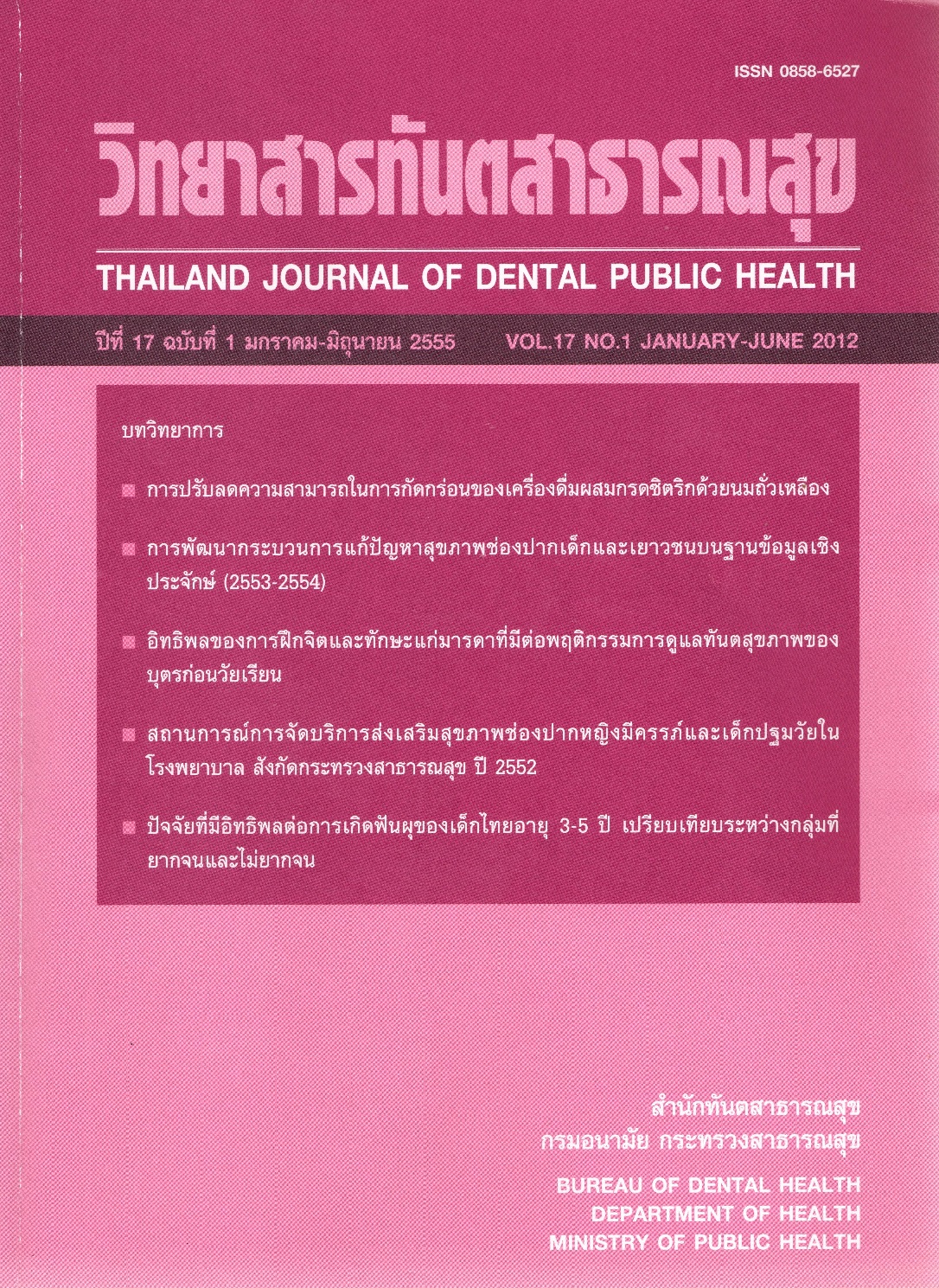
Modification of erosive potential of citric acid containing drinks by soy milk.
Article Sidebar
Main Article Content
Abstract
Previous studies revealed that citric acid containing drinks were erosive and a study showed that addition of cow’s milk to erosive beverages was capable to lesson enamel dissolution because high calcium content in milk probably enhanced remineralization of enamel. Since soy milk, containing high amount of calcium, nutritious like cow’s milk but more available and less expensive in Thailand, the objective of this study to demonstrate the effect of soy milk on the reduction of erosive potential of citric acid containing drinks available in Bangkok. The experiment was performed by collecting 5 citric acid containing drinks, 3 samples per each drink. Soy milk, prepared from 100 % dried soy milk powder (20 g in 100 ml water), was added to obtain 3, 5, 10, 20, 30, 40, and 50% soy milk containing drinks. Before and after soy milk addition, pH was measured by pH electrode, buffer capacity was determined by titration with 0.1 M NaOH and erosive potential was calculated from the amount of phosphate dissolved after shaking 50 mg synthetic apatite in 5 ml citric acid containing drinks for 10 min. The differences between all variables were analyzed by Wilcoxon Signed Ranks test (p<0.05). The results showed that after addition of 20, 30, 40, and 50% of soy milk, the pH of all drinks significantly increased (p<0.05).The buffer capacity and the phosphate dissolution of all drinks significant decreased only at 20,30,40, and 50% of soy milk , (p<0.05). From these data, it was summarized that addition of 20% to 50 % soy milk could lessen the erosive potential of citric acid containing drinks.
Downloads
Article Details
References
2. Hughes JA, West NX, Parker DM, van den Braak MH, Addy M. Effects of pH and concentration of citric, malic and lactic acids on enamel, in vitro. J Dent. 2000 ;28:147-52.
3. West NX, Hughes JA. and Addy M. The effect of pH on the erosion of dentine and enamel by dietary acids in vitro. J Oral Rehabil. 2001 ;28:860-4
4. Hannig C, Hamkens A, Becker K, Attin R, Attin T. Erosive effects of different acids on bovine enamel: release of calcium and phosphate in vitro. Arch Oral Biol. 2005 ;50:541-52 .
5. พรศรี ปฏิมานุเกษม และ ยุทธนา ปัญญางาม. ความสามารถในการกัดกร่อนผงอะพาไทท์สังเคราะห์ของเครื่องดื่มผสมกรดซิตริกที่มีจำหน่ายในประเทศไทย. ว ทันต สธ 2553; 15: 28-35.
6. Barbour ME., Parker DM., Allen GC. and Jandt KD. Human enamel dissolution in citric acid as a function of pH in the range 2.30< or = pH< or = 6.30--a nanoindentation study. Eur J Oral Sci. 2003;11:258-62
7. Jensdottir T., Bardow A. Holbrook P. Properties and modification of soft drinks in relation to their erosive potential in vitro. J Dent. 2005;33:569-75.
8. Magalhães AC., Moraes SM., Rios D, Buzalaf MA. Effect of ion supplementation of a commercial soft drink on tooth enamel erosion. Food Addit Contam Part A Chem Anal Control Expo Risk Assess. 2009;26:152-6.
9. Kato MT., Maria AG., Vaz LGM,Italiani FM., Sales-Peres SHC., Buzalaf MAR.Effect of iron supplementation on the erosive potential of carbonated or decarbonated beverage. J Appl Oral Sci. 2007;15:61-4.
10. Syed J, Chadwick RG. A laboratory investigation of consumer addition of UHT milk to lessen the erosive potential of fizzy drinks. Br Dent J. 2009;206:E6.
11. Larsen MJ, Nyvad B. Enamel erosion by some soft drinks and orange juices relative to their pH, buffering effect and contents of calcium phosphate. Caries Res. 1999;33(1):81-7.
12. Grobler, S.R., Jenkins, G.N., Kotze, D. The effects of the composition and method of drinking of soft drinks on plaque pH. Br Dent J. 1985; 158(8):293-6.
13. Lussi A, Jaeggi T, Jaeggi-Schärer S. Prediction of the erosive potential of some beverages. Caries Res.1995; 29(5):349-54.
14. Cairns AM, Watson M, Creanor SL, Foye RH. The pH and titratable acidity of a range of diluting drinks and their potential effect on dental erosion. J Dent.2002; 30(7-8):313-7
15. Phelan J, Rees J. The erosive potential of herbal teas. J Dent. 2003; 31(4):241-6.
16. ยุทธนา ปัญญางาม, พรศรี ปฏิมานุเกษม คุณสมบัติในการกัดกร่อนเคลือบฟันและปริมาณฟลูออไรด์ในน้ำผลไม้ธรรมชาติชนิดพร้อมดื่มที่มีจำหน่ายในกรุงเทพมหานคร. ว ทันต สธ 2551;13:90-6.
17. Jensdottir T, Bardow A, Holbrook P. Properties and modification of soft drinks in relation to their erosive potential in vitro. J Dent.2005; 33(7):569-75.
18. คุณค่าทางโภชนาการของอาหารไทย กองโภชนาการ กรมอนามัย available from http://nutrition.anamai.moph.go.th/FoodTable/Html/frame.html
19. Torell P. Iron and dental caries. Swed Dent J.1988; 12(3):113-24.
