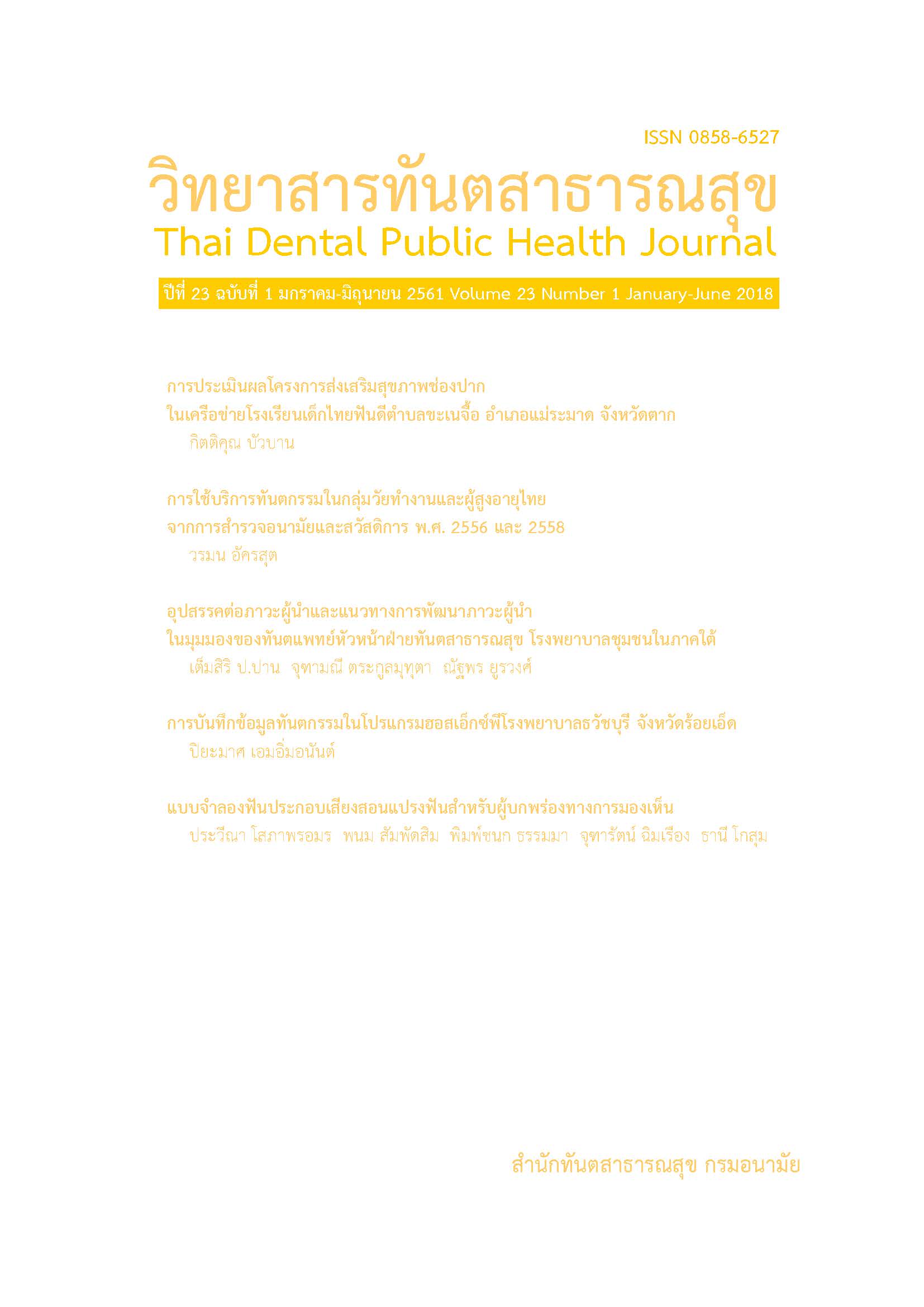
อุปสรรคต่อภาวะผู้นำและแนวทางการพัฒนาภาวะผู้นำ ในมุมมองของทันตแพทย์หัวหน้าฝ่ายทันตสาธารณสุข โรงพยาบาลชุมชนในภาคใต้
Article Sidebar
Main Article Content
บทคัดย่อ
การวิเคราะห์แบบตัดขวางนี้ต้องการศึกษาปัญหาอุปสรรคและแนวทางพัฒนาภาวะผู้นำของทันตแพทย์หัวหน้าฝ่ายทันตสาธารณสุขทุกคนในโรงพยาบาลชุมชนภาคใต้จำนวน 134 คน เก็บข้อมูลระหว่างพฤศจิกายน 2559 ถึงกุมภาพันธ์ 2560 ด้วยการส่งแบบสอบถามทางไปรษณีย์ให้กลุ่มตัวอย่างเขียนตอบด้วยตนเองและส่งกลับ แบบสอบถามประกอบด้วยข้อมูลส่วนบุคคลและคำถามปลายเปิดด้านปัญหาอุปสรรคและแนวทางการพัฒนาภาวะผู้นำ วิเคราะห์ข้อมูลเชิงปริมาณด้วยสถิติเชิงพรรณนา ไคสแควร์ และฟิชเชอร์เอ็กแซกเทสต์ กำหนดระดับนัยสำคัญทางสถิติที่ 0.05 ส่วนข้อมูลเชิงคุณภาพใช้การจำแนก จัดกลุ่ม และวิเคราะห์เนื้อหาโดยผู้วิจัย 2 คน มีอัตราตอบกลับร้อยละ 76.9 อุปสรรคต่อภาวะผู้นำได้แก่ ปัญหาด้านคุณลักษณะส่วนบุคคล ผู้ร่วมงาน องค์การ และอื่นๆ ร้อยละ 74.8, 17.5, 9.7 และ 3.9 ตามลำดับ พบความสัมพันธ์อย่างมีนัยสำคัญทางสถิติระหว่างระดับการศึกษาสูงสุดกับอุปสรรคด้านคุณลักษณะส่วนบุคคล ส่วนอุปสรรคด้านองค์การสัมพันธ์กับตำแหน่งปัจจุบันและระยะเวลาเป็นหัวหน้าฝ่ายอย่างมีนัยสำคัญ ด้านการพัฒนาภาวะผู้นำ มีข้อเสนอให้ใช้แนวทางพัฒนาตนเองในสัดส่วนมากที่สุด (ร้อยละ 34.0) รองลงมาเป็นการเข้าอบรมด้านภาวะผู้นำ การบริหาร และทักษะอื่นๆ (ร้อยละ 30.1) การแลกเปลี่ยนเรียนรู้จากทันตแพทย์หัวหน้าฝ่ายด้วยกันและผู้มีประสบการณ์หรือผู้นำที่ประสบความสำเร็จ (ร้อยละ 14.6) และการเสริมทักษะภาวะผู้นำในหลักสูตรปริญญาตรี (ร้อยละ 9.7) พบความสัมพันธ์อย่างมีนัยสำคัญทางสถิติระหว่างระดับการศึกษาสูงสุดกับการเสนอให้เสริมทักษะภาวะผู้นำในหลักสูตรทันตแพทยศาสตรบัณฑิต ส่วนการเสนอให้พัฒนาภาวะผู้นำในแนวทางอื่นนั้นสัมพันธ์กับตำแหน่งปัจจุบันและระยะเวลาที่เป็นหัวหน้าฝ่ายอย่างมีนัยสำคัญ
Downloads
Article Details

อนุญาตภายใต้เงื่อนไข Creative Commons Attribution-NonCommercial-NoDerivatives 4.0 International License.
เอกสารอ้างอิง
2. Strategy and Planning Division. Details of 20-year strategic indicators of the Ministry of Public Health for fiscal year 2018. [online] 20 July 2018 [cited 2018 July 24]; Available from: URL: http://www.bps.moph.go.th/new_bps/ node /91
3. Thongpasaknow W, Rakjareon S. Role and responsibilities in oral public health and guideline in oral public health of primary health care sysytem. In Wongkongkathep S, Rakjareon S, Jitjamsai K, (eds). Oral public health guideline for oral health personel in primary health care system. Bangkok: Dental Health Bureau, Department of Health; 2009. p. 9-18. (in Thai)
4. Bureau of Dental Health. The 7th national oral health survey 2012 of Thailand. Bangkok: Department of Health; 2013. (in Thai)
5. Timofe MP, Ungureanu MI, Cetean A, Mocean F, Albu S. Leadership practices and percep-tions in oral healthcare: a scoping review. Oral Health Dent Manag 2017; 16(1):1-7.
6. Spano-Szekely L, Quinn Griffin MT, Clavelle J, Fitzpatrick JJ. Emotional Intelligence and Transformational Leadership in Nurse Mana-gers. J Nurs Adm 2016; 46(2):101-8.
7. Echevarria IM, Patterson BJ, Krouse A. Predic-tors of transformational leadership of nurse managers. J Nurs Manag 2017; 25(3):167-75.
8. Pillai R, Meindl JR. Context and charisma: A "meso" level examination of the relationship of organic structure, collectivism, and crisis to charismatic leadership. J Manag 1998; 24(5):643-71.
9. Pawar BS. Central conceptual issues in trans-formational leadership research. Leadership Org Dev J 2003; 24(7):397–406.
10. Wright BE, Pandey SK. Transformational leadership in the public sector: Does struc-ture matter?. J Public Adm Res 2010; 20(1): 75–89.
11. Walter F, Bruch H. Structural impacts on the occurrence and effectiveness of transforma-tional leadership: An empirical study at the organizational level of analysis. Leadersh Q 2010; 21(5): 765–82.
12. Nielsen K, Cleal B. Under which conditions do middle managers exhibit transformational leadership behaviors? An experience sam-pling method study on the predictors of transformational leadership behaviors. Leadersh Q 2011; 22(2):344–52.
13. Forest AE, Taichman RS, Inglehart MR. Dentists' leadership-related perceptions, values, experiences and behavior. J Am Dent Assoc 2013; 144(12):1397-405.
14. Brocklehurst P, Nomura M, Ozaki T, Ferguson J, Matsuda R. Cultural differences in clinical leadership: a qualitative study comparing the attitudes of general dental practitioners from Greater Manchester and Tokyo. Br Dent J 2013; 215(10):E19.
15. Morison S, McMullan C. Preparing for the future: challenges and opportunities for management and leadership skills. Br Dent J 2013; 214(1):1-5.
16. Brocklehurst P, Ferguson J, Taylor N, Tickle M. What is clinical leadership and why might it be important in dentistry?. Br Dent J 2013; 214(5):243–6.
