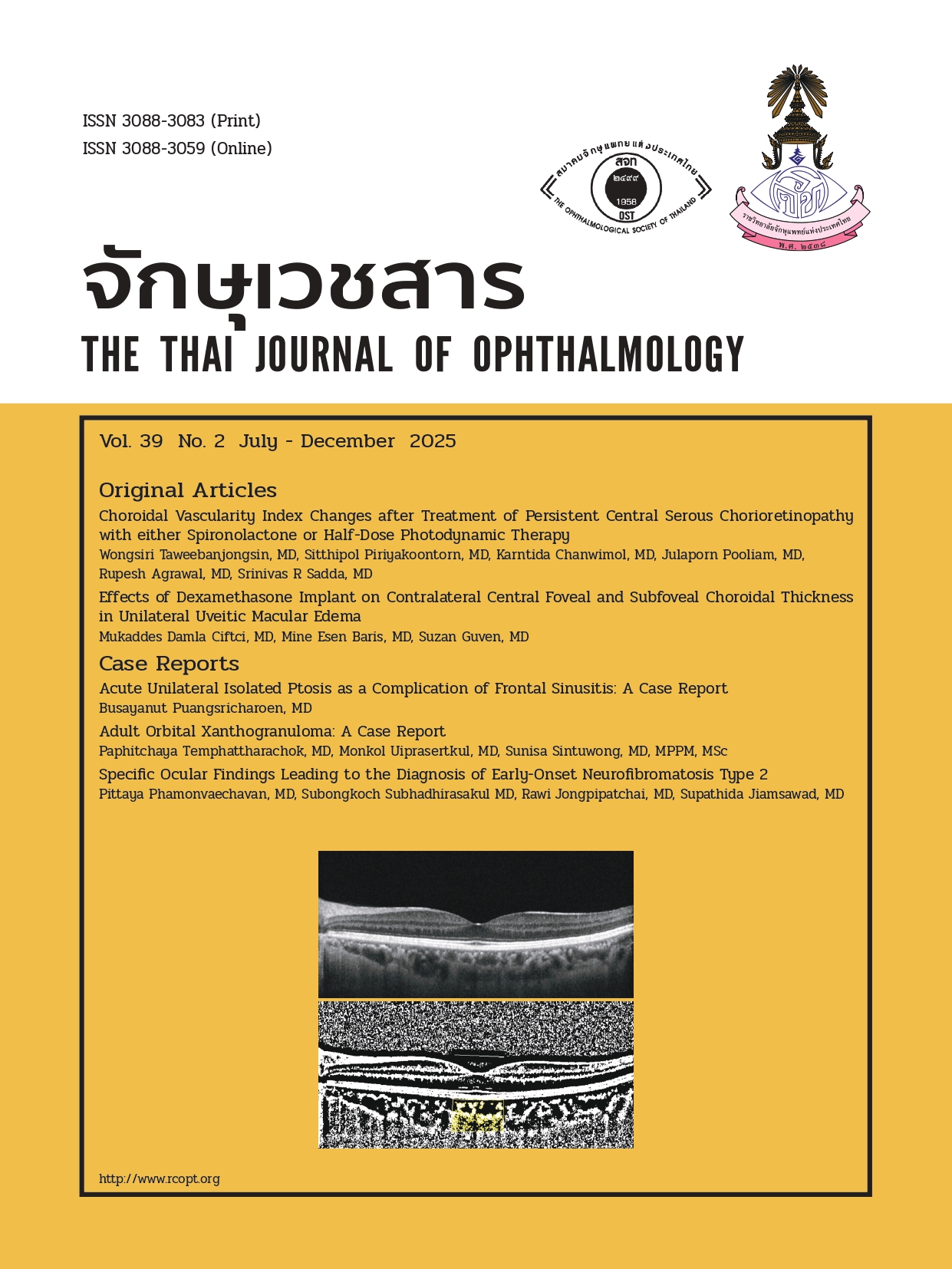
Choroidal Vascularity Index Changes after Treatment of Persistent Central Serous Chorioretinopathy with either Spironolactone or Half-Dose Photodynamic Therapy
Keywords:
central serous chorioretinopathy (CSC), choroidal vascularity index (CVI), choroidal thickness (CT), choroidal vasculature, spironolactone, half-dosed photodynamic therapyAbstract
Purpose: To evaluate choroidal vascularity index (CVI) changes after treatment with either spironolactone or half-dose photodynamic therapy (PDT).
Design: Retrospective study
Methods: We enrolled 34 patients with subretinal fluid accumulation persisting for more than 3 months due to central serous chorioretinopathy (CSC); 16 patients were treated with spironolactone and 18 with PDT. We reviewed the central OCT-B scans at baseline and 1 and 3 months after treatment. We defined the CVI as the percent of vascular/luminal pixels over the total number of pixels and compared the results between the treatment groups.
Results: The baseline CVIs were 60.33% in the spironolactone treatment group and 60.51% in the PDT group. After treatment, the CVI remained similar in the spironolactone group, but it increased significantly one month (63.35%) and three months (63.56%, R = 0.004, 0.001) after the PDT. The total and luminal choroidal areas were both decreased after PDT, but only the stromal area was significantly decreased at one and three months (R = 0.001and P < 0.001, respectively). By month three, the subfoveal choroidal thickness (SFCT) had decreased by 30.32 µm (R = 0.013) in the PDT group and by 18.88 µm (R = 0.195) in the spironolactone group.
Conclusion: After CSC treatment, the choroid remained virtually unchanged following the spironolactone therapy, whereas the choroidal thickness was significantly reduced and the CVI increased following PDT. These anatomic changes in the choroid following PDT may explain why the effects of PDT are more durable and potent than those of spironolactone for CSC.
References
Warrow DJ, Hoang QV, Freund KB. Pachychoroid pigment epitheliopathy. Retina 2013;33:1659-1672.
Gallego-Pinazo R, Dolzo-Marco R, Gómez-Ulla MS, Freund KB. Pachychoroid disease of macula. Retina. Med Hypo Discov Innov Ophthalmol 2014;3.
Phasukkijwatana N, Freund KB, Dolzo-Marco R, et al. Peripapillary pachychoroid syndrome. Retina 2017;0:1-16.
Cheung CMG, Lee WK, Koizumi H, Dansingani K, Lai TYY, Freund KB. Pachychoroid disease. Eye 2019;33:14-33.
Nicholson B, Noble J, Forooghian F, Meyerle C. Central serous chorioretinopathy: update on pathophysiology and treatment. Surv Ophthal 2013;58:103-126.
Prünte C, Flammer J. Choroidal capillary and venous congestion in central serous chorioretinopathy. Am J Ophthalmol 1996;121:26-34.
Daruich A, Matet A, Dirani A, Bousquet E, Zhao M, Farman N, Jaisser F, Behar-Cohen F. Central serous chorioretinopathy: recent findings and new physiopathology hypothesis. Retin Eye Res 2015;48:82-118.
Spaide RF, Hall L, Haas A, Campeas L, Yannuzzi LA, Fisher YL, Guyer DR, Slakter JS, Sorenson JA, Orlock DA. Indocyanine green videoangiography of older patients with central serous chorioretinopathy. Retina 1996;16:203-213.
Hayashi K, Hasegawa Y, Tokoro T. Indocyanine green angiography of central serous chorioretinopathy. Int Ophthalmol 1986;9:37-41.
Guyer DR, Yanuzzi LA, Slakter JS, Sorenson JA, Ho A, Orlock D. Digital indocyanine green angiography of central serous chorioretinopathy. Arch Ophthalmol 1994;112:1057-1062.
Tittl MK, Spaide RF, Wong D, Pilotto E, Yannuzzi LA, Fisher YL, Freund B, Guyer DR, Slakter JS, Sorenson JA. Systemic findings associated with central serous chorioretinopathy. Am J Ophthalmol 1999;128:63-68.
Haimovici R, Gragoudas ES, Duker JS, Sjaarda RN, Eliott D. Central serous chorioretinopathy associated with inhaled or intranasal corticosteroids. Ophthalmology 1997;104:1653-1660.
Iida T, Spaide RF, Negrao SG, Carvalho CA, Yannuzzi LA. Central serous chorioretinopathy after epidural corticosteroid injection. Am J Ophthalmol 2001;132:423-425.
Hurvitz AP, Hodapp KL, Jadgchew J, Solomon DJ, Stolldorf HS, Provencher MT. Central serous chorioretinopathy resulting in altered vision and color perception after glenohumeral corticosteroid injection. Orthopedics 2009;32.
Ezra N, Taban M, Behroozan D. Central serous chorioretinopathy associated with topical corticosteroids in a patient with psoriasis. J Drugs Dermatol 2011;10:918-921.
McGraw AP, Bagley J, Chen WS, Galayda C, Nickerson H, Armani A, Caprio M, Carmeliet P, Jaffe IZ. Aldosterone increases early atherosclerosis and promotes plaque inflammation through a placental growth factor-dependent mechanism. J Am Heart Assoc 2013;2:e000018.
Zhao M, Célérier I, Bousquet E et al. Mineralocorticoid receptor is involved in rat and human ocular chorioretinopathy. J Clin Invest 2012;122:2672-2679.
Herold TR, Prause K, Wolf A, Mayer WJ, Ulbig MW. Spironolactone in treatment of central serous chorioretinopathy – a case series. Graefes Arch Clin Exp Ophthalmol 2014;252:1985-1991.
Ghadiali Q, Jung JJ, Yu S, Patel SN, Yannuzzi LA. Central serous chorioretinopathy treated with mineralocorticoid antagonists: a one-year pilot study. Retina 2016;36:611-618.
Bousquet E, Beydoun T, Rothschild PR, et al. Spironolactone for nonresolving central serous chorioretinopathy: a randomized controlled crossover study. Retina 2015;35:2505-2515.
Daruich A, Matet A, Dirani A, Gallice M, Nicholson L, Sivaprasad S, Behar-Cohen F. Oral mineralocorticoid receptor antagonists: real-life experience in clinical subtypes of nonresolving central serous chorioretinopathy with chronic epitheliopathy. Trans Vis Sci Tech 2016;5:2.
Herold TR, Rist K, Priglinger SG, Ulbig MW, Wolf A. Long-term results and recurrence rates after spironolactone treatment in non-resolving central serous chorio-retinopathy (CSCR). Graefes Arch Clin Exp Ophthalmol 2017;255:221-229.
Lee JH, Lee SC, Kim H, Lee CS. Comparison of short-term efficacy between oral spironolactone treatment and photodynamic therapy for the treatment of nonresolving central serous chorioretinopathy. Retina 2017;0:1-7.
Sun X, Shuai Yuanlu, Fang Wangyi. Jia Li, Weizhong Ge, Songtao Yuan, Qinghuai Liu. Spironolactone versus observation in the treatment of acute central serous chorioretinopathy. Br J Ophthalmol 2018;102:1060-1065.
Lotery A, Sivaprasad S, O’Connell A, et al. Eplerenone for chronic central serous chorioretinopathy in patients with active, previous untreated disease for more than 4 months(VICI): a randomized, double-blind, placebo-controlled trial. Lancet 2020;395:294-303.
Nicolò M, Zoli D, Musolino M, Traverso CE. Association between the efficacy of half-dose photodynamic therapy with indocyanine green angiography and optical coherence tomography findings in the treatment of central serous chorioretinopathy. Am J Ophthalmol 2012;153:474-480.e1.
Ober MD, Yannuzzi LA, Do DV, Spaide RF, Bressler NM, Jampol LM, Angelilli A, Eandi CM, Lyon AT. Photodynamic therapy for focal retinal pigment epithelial leaks secondary to central serous chorioretinopathy. Ophthalmology 2005;112:2088-2094.
Sakalar YB, Keklikci U, Unlu K, Alakus MF, Kara IH. Effects of photodynamic therapy with verteporfin for the treatment of chronic central serous chorioretinpathy: an uncontrolled, open-label, observation study. Curr Ther Res Clin Exp 2010;71:173-185.
Chan WM, Lam DS, Lai TY, Tam BS, Liu DT, Chan CK. Choroidal vascular remodeling in central serous chorioretinopathy after indocyanine green guided photodynamic therapy with verteporfin: a novel treatment at a primary disease level. Br J Ophthalmol 2003;87:1453-1458.
Schimidt-Erfurth U, Laqua H, Schlötzer-Schrehard U, Viestenz A, Naumann GO. Histopathological changes following photodynamic therapy in human eyes. Arch Ophthalmol 2002;120:835-844.
Izumi T, Koizumi H, Maruko I, Takahashi Y, Sonoda S, Sakamoto T, Iida T. Structural analyses of choroidal after half-dose verteporfin photodynamic therapy for central serous chorioretinopathy. Br J Ophthalmol 2016;0:1-5.
Maruko I, Iida T, Sugano Y, Ojima A, Ogasawara M, Spaide RF. Subfoveal choroidal thickness after treatment of central serous chorioretinopathy. Ophthalmology 2010;117:1792-1799.
Agrawal R, Gupta P, Tan K-A, Cheung CMG, Wong TY, Cheng C-Y. Choroidal vascularity index as a measure of vascular status of the choroid: measurements in healthy eyes from a population-based study. Sci Rep 2016;6:21090.
Agrawal R, Chhablani J, Tan K-A, Shah S, Sarviya C, Banker A. Choroidal vascularity index in central serous chorioretinopathy. Retina 2016;0:1-6.
Agrawal R, Salman M, Tan K-A, Karampelas M, Sim DA, Keane PA, Pavesio C. Choroidal vascularity index (CVI) – A novel optical coherence tomography parameter for monitoring patients with panuveitis? PLOS ONE 2016;11:e0146344. doi:10.1371/journal.pone.0146344.
Agrawal R, Li LKH, Nakhate V, Khandelwal N, Mahendradas P. Choroidal vascularity index in Vogt-Koyanaki-Harada disease progression. Trans Vis Sci Tech 2016;5:7. doi:10.1167/tvst.5.4.7.
Koh LHL, Agrawal R, Khandelwal N, Sai Charan LS, Chhablani J. Choroidal vascular changes in age-related macular degeneration. Acta Ophthalmol 2017;95:e597-e601.
Wei X, Ting DSW, Ng YW, Khandelwal N, Agrawal R, Cheung CMG. Choroidal vascularity index A novel optical coherence tomography based parameter in patients with exudative age-related macular degeneration. Retina 2016;0:1-6.
Velaga SB, Nittala MG, Vupparaboina KK, Jana S, Chhablani J, Haines J, Pericak-Vance MA, Stambolian D, Sadda SR. Choroidal vascularity index and choroidal thickness in eyes with reticular pseudodrusen. Retina 2019;00:1-6.
Kinoshita T, Mitamura Y, Mori T, Akaiwa K, Semba K, Egawa M, Mori J, Sonoda S, Sakamoto T. Changes in choroidal structures in eyes with chronic central serous chorioretinopathy after half-dose photodynamic therapy. PLOS ONE 2016;11:e0163104. doi:10.1371/journal.pone.0163104.
Fatemeh Bazvand, Hassan Asadigandomani, Alireza Nezameslami, Reza Sadeghi, Mahdi Soleymanzadeh, Alireza Khodabande and Hamid Riazi-Esfahani. Short term choroidal microvascular changes following photodynamic therapy in chronic central serous chorioretinopathy. Photodiagnosis Photodyn Ther. 2023 Dec:44:103807. doi: 10.1016/j.pdpdt.2023.103807. Epub 2023 Sep 20.
Sonoda S, Sakamoto T, Kuroiwa N, Arimura N, Kawano H, Yoshihara N, Yamashita T, Uchino E, Kinoshita T, Mitamura Y. Structiral changes of inner and outer choroid in central serous chorioretinopathy determined by optical coherence tomography. PLOS ONE 2016;11:e0157190. doi:10.1371/journal.pone.0157190.
Downloads
Published
Issue
Section
License
Copyright (c) 2025 The THAI Journal of OPHTHALMOLOGY

This work is licensed under a Creative Commons Attribution-NonCommercial-NoDerivatives 4.0 International License.
The Thai Journal of Ophthalmology (TJO) is a peer-reviewed, scientific journal published biannually for the Royal College of Ophthalmologists of Thailand. The objectives of the journal is to provide up to date scientific knowledge in the field of ophthalmology, provide ophthalmologists with continuing education, promote cooperation, and sharing of opinion among readers.
The copyright of the published article belongs to the Thai Journal of Ophthalmology. However the content, ideas and the opinions in the article are from the author(s). The editorial board does not have to agree with the authors’ ideas and opinions.
The authors or readers may contact the editorial board via email at admin@rcopt.org.

