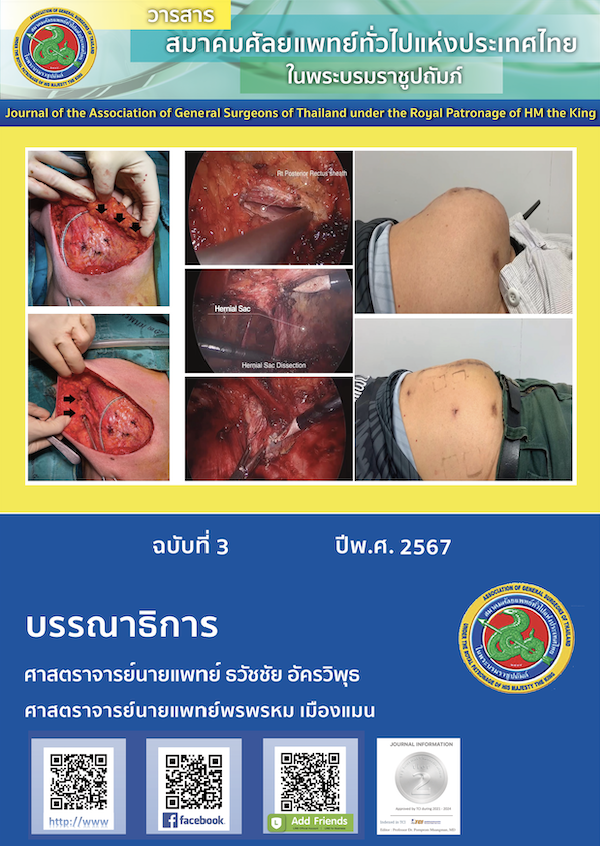
The extended-view totally extraperitoneal (eTEP) approach for Ventral hernia: Short-term results from a single center
Keywords:
ventral hernia, eTEPAbstract
Background
The eTEP technique is a popular approach in abdominal wall hernia surgery in recent years. This study aims to present the results of applying minimally invasive treatment with the laparoscopic eTEP approach for abdominal wall hernias.
Methods
This study is a retrospective review of 21 patients who underwent laparoscopic eTEP for primary abdominal wall hernias and incisional hernias between July 2022 and February 2024 (median follow up of 6.5 months)
Result
A total of 21 patients underwent the laparoscopic eTEP approach. 6 patients (28.5%) had primary hernias and 15 patients (71.4%) had incisional hernias. The mean hospital stay was 3.8 days. There were two cases of recurrence after discharge.
Conclusion
The laparoscopic eTEP approach provides advantages such as less postoperative pain, shorter hospital stays, early return to work, and fewer surgical complications. However, the laparoscopic eTEP technique has a long operative time and requires advanced laparoscopic suturing skills
References
Bittner R, Bingener-Casey J, Dietz U, Fabian M, Ferzli GS, Fortelny RH, et al. Guidelines for laparoscopic treatment of ventral and incisional abdominal wall hernias (International Endohernia Society (IEHS)—Part 1. Surgical Endoscopy 2014;28:2-29.
Belyansky I, Daes J, Radu VG, Balasubramanian R, Reza Zahiri H, Weltz AS, et al. A novel approach using the enhanced-view totally extraperitoneal (eTEP) technique for laparoscopic retromuscular hernia repair. Surg Endosc 2018;32:1525-32.
Daes J, Belyansky I. Anatomical Considerations and Tips for Laparoscopic and Robotic-Assisted Enhanced-View Totally Extraperitoneal Rives-Stoppa Repair for Midline Hernia. Journal of the American College of Surgeons 2021;233:e1-e11.
Baig SJ, Priya P. Extended totally extraperitoneal repair (eTEP) for ventral hernias: Short-term results from a single centre. J Minim Access Surg 2019;15:198-203.
Walming S, Angenete E, Block M, Bock D, Gessler B, Haglind E. Retrospective review of risk factors for surgical wound dehiscence and incisional hernia. BMC Surg 2017;17:19.
Peterman DE, Warren JA. Ventral Hernia Management in Obese Patients. Surg Clin North Am 2021;101:307-21.
Sanders DL, Pawlak MM, Simons MP, Aufenacker T, Balla A, Berger C, et al. Midline incisional hernia guidelines: the European Hernia Society. Br J Surg 2023;110:1732-68.