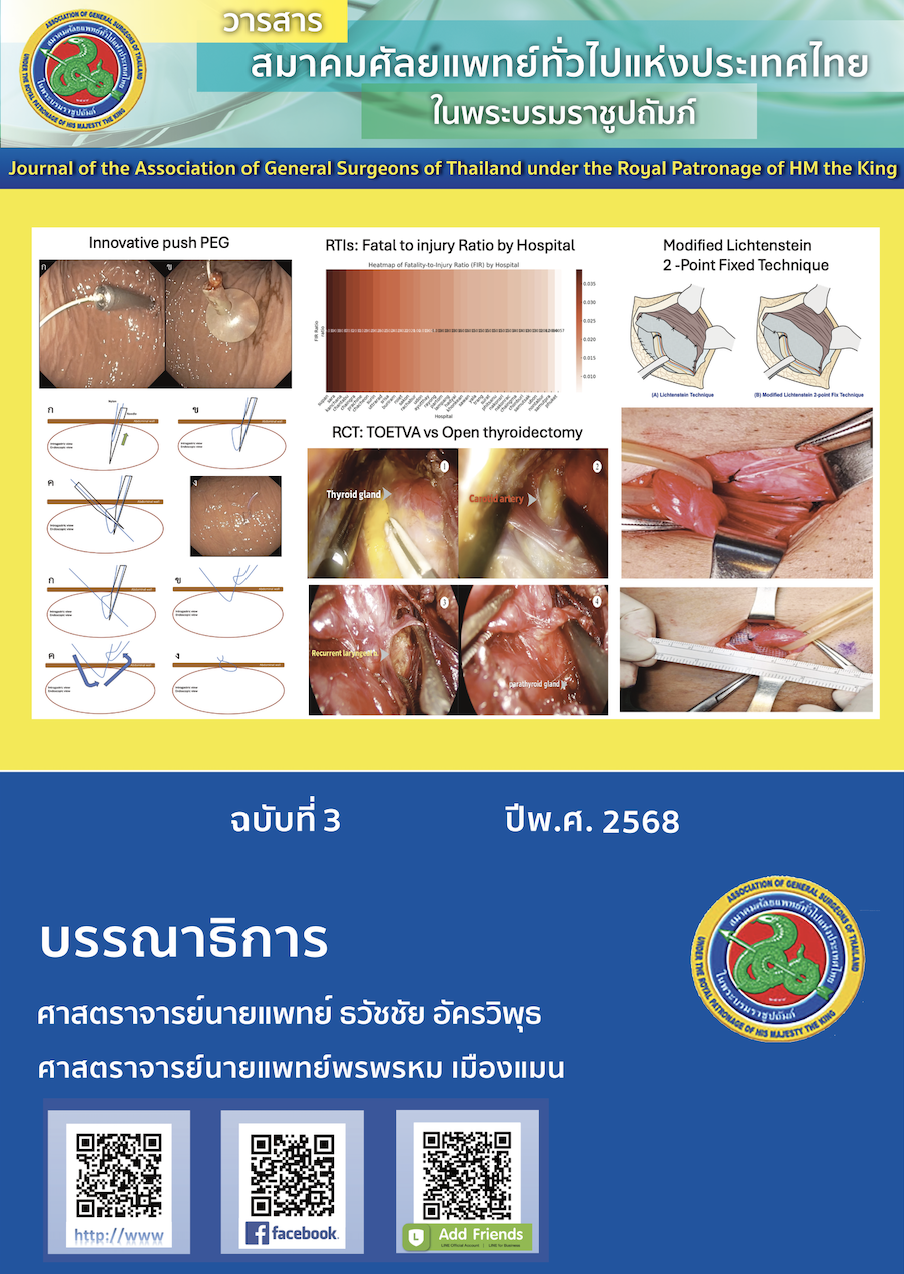
Randomized Controlled Trial of Transoral Endoscopic Thyroidectomy Vestibular Approach (TOETVA) Versus Open Thyroidectomy: A Comparative Study of Efficacy and Complications.
Keywords:
Benign thyroid nodules, Open thyroidectomy, Minimally invasive surgery, Transoral endoscopic thyroidectomy vestibular approach (TOETVA)Abstract
Background: Minimally invasive thyroid surgery has evolved significantly, offering improved cosmetic and clinical outcomes¹. Transoral Endoscopic Thyroidectomy Vestibular Approach (TOETVA) is a scar-free alternative to conventional open thyroidectomy (OT)². This study aims to compare the safety and clinical outcomes of TOETVA and OT in patients with benign thyroid nodules, incorporating data from a randomized controlled trial (RCT).
Methods: A single-blind randomized controlled trial was conducted on patients with thyroid nodules ≤8 cm. Patients were randomized to undergo either TOETVA or conventional thyroidectomy. Postoperative pain had been evaluated using VAS on days 1 and 2. A 3-month follow-up was performed to evaluate complications, including recurrent laryngeal nerve (RLN) palsy, bleeding, and infection.
Results: Seventy patients were randomized to undergo either TOETVA or conventional thyroidectomy. The baseline characteristics, including age and thyroid nodule size, were comparable between groups. The mean operative time was longer in the TOETVA group (99 vs. 75 minutes, P < .001) and the pain score on the second postoperative day (0.74 vs. 1.86, P < .001). At the 3-month follow-up, complications in the TOETVA group included one case of transient RLN palsy, one case of mental nerve injury, and one case of subcutaneous emphysema. No complications were reported in the OT group.
Conclusion: TOETVA is associated with reduced postoperative pain and improved cosmetic outcomes compared to conventional thyroidectomy in the management of benign thyroid nodules.
References
Phillips RKS, Spigelman AD. Endoscopic subtotal parathyroidectomy in patients with primary hyperparathyroidism. Br J Surg. 1996;83(6):875–8.
Anuwong A. Transoral endoscopic thyroidectomy vestibular approach: a series of the first 60 human cases. World J Surg. 2016;40(3):491–7.
Choe JH, Kim SW, Chung KW, Park KS, Han W, Noh DY, et al. Endoscopic thyroidectomy using a new bilateral axillo-breast approach. World J Surg. 2007;31(3):601–6.
Yamamoto M, Sasaki A, Asahi H, Shimada Y, Sato N, Nakajima J, et al. Endoscopic subtotal thyroidectomy for patients with Graves’ disease. Surg Today. 2001;31(4):345–8.
Berti P, Materazzi G, Galleri D, Donatini G, Minuto M, Miccoli P. Video-assisted thyroidectomy for Graves’ disease: report of a preliminary experience. Surg Endosc. 2004;18(8):1208–10.
Maeda S, Uga T, Hayashida N, Ishigaki K, Furui J, Kanematsu T. Video-assisted subtotal or near-total thyroidectomy for Graves’ disease. Br J Surg. 2006;93(1):61–6.
Li ZY, Wang P, Wang Y, Xu SM, Cao LP, Que RS. Endoscopic thyroidectomy via breast approach for patients with Graves’ disease. World J Surg. 2010;34(9):2228–32.
Yang CH, Chew KY, Solomkin JS, Lin PY, Chiang YC, Kuo YR. Surgical site infections among high-risk patients in clean-contaminated head and neck reconstructive surgery: concordance with preoperative oral flora. Ann Plast Surg. 2013;71(Suppl 1):S50–5.
Cho MJ, Park KS, Yoo YB, Yang JH. A comparative analysis of endoscopic thyroidectomy versus conventional thyroidectomy in clinically lymph node negative thyroid cancer. Ann Surg Treat Res. 2015;88(2):69–76.
Wang Y, Liu K, Xiong J, Zhu J. Total endoscopic versus conventional open thyroidectomy for papillary thyroid microcarcinoma. J Craniofac Surg. 2015;26(2):464–8.
Lee MC, Park H, Choi IJ, Lee BC, Lee GH. Comparative study of a gasless transaxillary approach versus a bilateral axillo-breast approach for endoscopic thyroidectomy in a single institute. Head Neck. 2014;36(5):702–8.