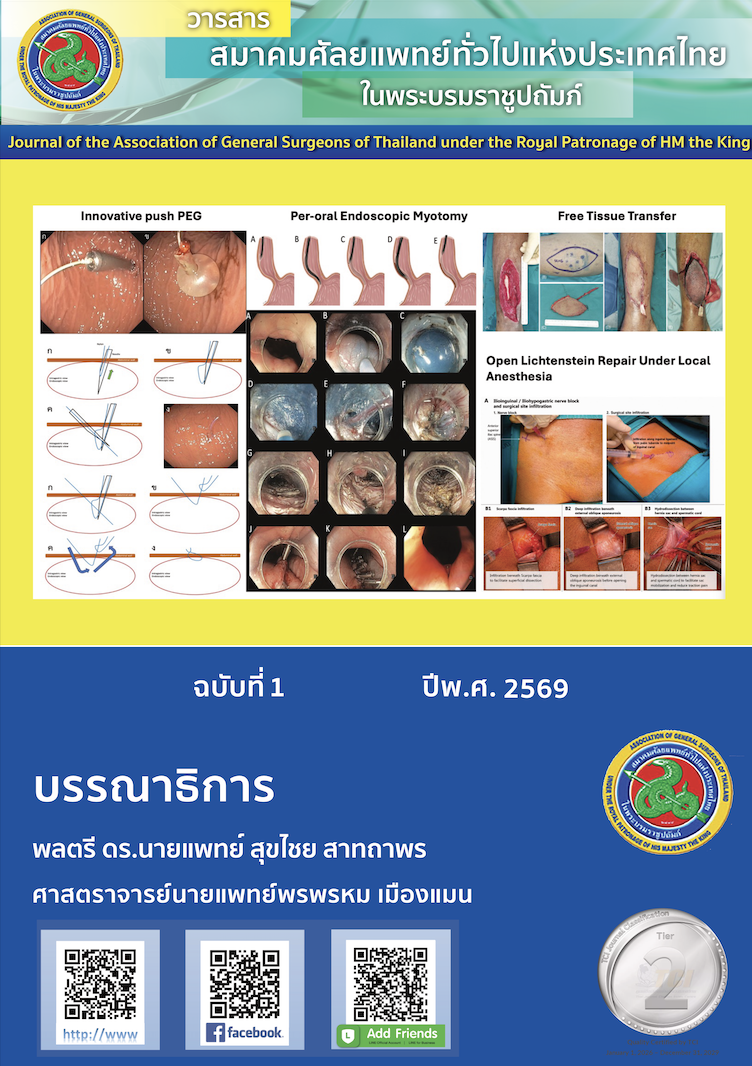
Transient Femoral Nerve Dysfunction During Open Lichtenstein Repair Under Local Anesthesia: A Retrospective Cohort Study
Keywords:
Transient femoral nerve dysfunction (TFND), Lichtenstein hernia repair, Local anesthesia, Inguinal hernia, One-day surgery (ODS)Abstract
Objective
Transient femoral nerve dysfunction (TFND) following inguinal hernia repair under local anesthesia is likely underrecognized because symptoms are typically self-limited. This study evaluated the incidence, clinical presentation, and factors associated with TFND after open inguinal hernia repair under local anesthesia.
Methods
A retrospective cohort study was conducted in 636 consecutive patients undergoing open Lichtenstein inguinal hernia repair under local anesthesia between March 2018 and March 2026. TFND was defined as transient postoperative sensory disturbance over the femoral dermatome and/or motor weakness impairing knee extension or weight-bearing ambulation. Patients were assessed postoperatively until symptom resolution and discharge. Univariable and multivariable logistic regression analyses were performed to identify factors associated with TFND.
Results
TFND occurred in 74 patients (11.6%), including 26 (4.1%) with isolated sensory dysfunction and 48 (7.6%) with motor weakness. All neurological deficits resolved spontaneously within 1.5 – 6 hours without permanent sequelae or unplanned admission. Multivariable analysis identified complex hernia (adjusted odds ratio [aOR] 5.93, p < 0.001), advanced operative phase (phase 2: aOR 6.78, p = 0.001; phase 3: aOR 13.65, p < 0.001), female sex (male sex: aOR 0.30, 95% CI 0.13–0.66; p = 0.017), and left-sided hernia (right-sided hernia: aOR 0.45, 95% CI 0.29–0.83; p = 0.004) as independent factors associated with TFND. Outpatient day surgery was independently associated with lower TFND risk (aOR 0.41, p = 0.006). The composite case-mix index increased progressively across phases (p < 0.001).
Conclusions
TFND after open inguinal hernia repair under local anesthesia occurred in 11.6% of patients but was uniformly transient and self-limited, resolving spontaneously within 1.5 to 6 hours without permanent neurological sequelae or unplanned hospital admission. Multivariable analysis identified complex hernia (aOR 5.93), advanced operative phase (phase 2: aOR 6.78; phase 3: aOR 13.65), female sex, and left-sided hernia as independent risk factors for TFND, while outpatient day surgery was independently protective (aOR 0.41). These findings indicate that TFND is predominantly associated with operative complexity and evolving anesthetic infiltration behavior across the surgeon experience trajectory, rather than a simple dose-dependent effect of local anesthetics. The composite case-mix index further demonstrated that overall operative burden increased progressively across experience phases driven by concurrent changes in hernia complexity and bupivacaine utilization supporting the multidimensional nature of TFND risk in this setting. Greater awareness of this phenomenon and refinement of local-anesthesia infiltration techniques, including potential adoption of ultrasound guidance in complex cases, may improve perioperative safety and reduce TFND occurrence during groin hernia repair.
References
Stabilini C, van Veenendaal N, Aasvang E, Agresta F, Aufenacker T, Berrevoet F, et al. Update of the international HerniaSurge guidelines for groin hernia management. BJS Open. 2023 Sep 5;7(5):zrad080. doi: 10.1093/bjsopen/zrad080. Erratum in: BJS Open. 2024 Mar 1;8(2):zrae034.
Messias BA, Nicastro RG, Mocchetti ER, Roll S, Ribeiro Junior MAF, Waisberg J. Lichtenstein technique for inguinal hernia repair: ten recommendations to optimize surgical outcomes. Hernia. 2024 Oct;28(5):1467-76. doi: 10.1007/s10029-024-03094-w.
Nordin P, Zetterström H, Gunnarsson U, Nilsson E. Local, regional, or general anaesthesia in groin hernia repair: multicentre randomised trial. Lancet. 2003 Sep 13;362(9387):853-8. doi: 10.1016/S0140-6736(03)14339-7.
ทวี รัตนชูเอก, บรรณาธิการ. ข้อเสนอแนะด้านการพัฒนาระบบบริการการผ่าตัดแบบวันเดียวกลับ (One Day Surgery: ODS). นนทบุรี : สำนักวิชาการแพทย์ กรมการแพทย์ กระทรวงสาธารณสุข; 2560.
Standring S, editor. Gray's Anatomy: The Anatomical Basis of Clinical Practice. 42nd ed. Philadelphia: Elsevier; 2020. Chapter 60: Anterior abdominal wall; p. 1122–1136.
Skandalakis JE, Skandalakis LJ, Colborn GL, Androulakis JA, Skandalakis PN, Pemberton LB. Surgical Anatomy: The Embryological and Anatomical Basis of Modern Surgery. Athens: Paschalidis Medical Publications; 2004. Chapter 9: Abdominal Wall and Hernias; p. 393–492.
Inlao P. Comparison of Local and Spinal Anesthesia in Elective Open Repair Primary Unilateral Inguinal Hernia in Rattanaburi Hospital. Thai J Surg. 2023;44(4):133-40.
Khani KR, McMillan R, Paterson-Brown S. Transient femoral nerve palsy following ilio-inguinal nerve blockade for day case inguinal hernia repair. J R Coll Surg Edinb. 2002 Aug;47(4):626-9. PMID: 12363189.
Ido IA, Umeh KU, Eyo CS. Transient femoral nerve palsy following ilioinguinal nerve block for inguinal hernioplasty. Niger J Surg. 2018 Jan-Jun;24(1):23-6. doi: 10.4103/njs.NJS_20_17.
Lipp AK, Woodcock J, Hensman B, Wilkinson K. Leg weakness is a complication of ilio-inguinal nerve block in children. Br J Anaesth. 2004 Feb;92(2):273-4. doi: 10.1093/bja/aeh045.
Rosario DJ, Jacob S, Luntley J, Skinner PP, Raftery AT. Mechanism of femoral nerve palsy complicating percutaneous ilioinguinal field block. Br J Anaesth. 1997 Mar;78(3):314-6. doi: 10.1093/bja/78.3.314.
Refai NA, Tadi P. Anatomy, Bony Pelvis and Lower Limb: Thigh Femoral Nerve. In: StatPearls [Internet]. Treasure Island (FL): StatPearls Publishing; 2023 [updated 2023 Aug 8; cited 2026 May 13]. Available from: https://www.ncbi.nlm.nih.gov/books/NBK556065/
Amid PK, Shulman AG, Lichtenstein IL. Local anesthesia for inguinal hernia repair step-by-step procedure. Ann Surg. 1994 Dec;220(6):735-7. doi: 10.1097/00000658-199412000-00017.
Campanelli G. Lichtenstein onlay mesh hernioplasty: original technique and personal modifications. In: Campanelli G, editor. The art of hernia surgery: a step-by-step guide. Cham: Springer International Publishing; 2018. p. 97-107.
Campanelli G, Bruni PG, Lombardo F, Cavalli M. Local anesthesia in inguinal hernia: indications and techniques. In: Campanelli G, editor. The art of hernia surgery: a step-by-step guide. Cham: Springer International Publishing; 2018. p. 211-7.
วิบูลย์ ภัณฑบดีกรณ์. Ambulatory inguinal hernia surgery. ใน: พรพรหม เมืองแมน, วรุตม์ โล่ห์สิริวัฒน์, ต้น คงเป็นสุข, สุทัศน์ โชตนะพันธ์, ชาญเวช ศรัทธาพุทธ, ธัญญ์ อิงคะกุล, บรรณาธิการ. ศัลยศาสตร์ทั่วไป 27. กรุงเทพฯ: กรุงเทพเวชสาร; 2561. หน้า 91-116.
Nyhus LM, Klein MS, Rogers FB. Inguinal hernia. Curr Probl Surg. 1991 Jun;28(6):401-50. doi: 10.1016/0011-3840(91)90028-n. PMID: 2044437.
Zollinger RM Jr. An updated traditional classification of inguinal hernias. Hernia. 2004 Dec;8(4):318-22. doi: 10.1007/s10029-004-0245-2. PMID: 15221644.
Tsai TY, Huang YS, Tsai YC, Liu YC. Temporary femoral nerve palsy after ilioinguinal nerve blockade combined with splash block for post-inguinal herniorrhaphy analgesia in a pediatric patient. Acta Anaesthesiol Taiwan. 2007 Dec;45(4):237-40.
Greig JD, McArdle CS. Transient femoral nerve palsy complicating preoperative ilioinguinal nerve blockade for inguinal herniorrhaphy. Br J Surg. 1994 Dec;81(12):1828. doi: 10.1002/bjs.1800811236.
Kulacoglu H, Ergul Z, Esmer AF, Sen T, Akkaya T, Elhan A. Percutaneous ilioinguinal-iliohypogastric nerve block or step-by-step local infiltration anesthesia for inguinal hernia repair: what cadaveric dissection says? J Korean Surg Soc. 2011 Dec;81(6):408-13. doi: 10.4174/jkss.2011.81.6.408.
Wang Y, Wu T, Terry MJ, Eldrige JS, Tong Q, Erwin PJ, et al. Improved perioperative analgesia with ultrasound-guided ilioinguinal/iliohypogastric nerve or transversus abdominis plane block for open inguinal surgery: a systematic review and meta-analysis of randomized controlled trials. J Phys Ther Sci. 2016 Mar;28(3):1055-60.
Tani M, Sato M, Son I, Tanabe H, Hirota K, Shirakami G, et al. [Transient femoral nerve palsy after ilioinguinal-iliohypogastric nerve block: comparison of ultrasound-guided and landmark-based techniques in adult inguinal hernia surgery]. Masui. 2015 Jun;64(6):603-9. Japanese.
Kumar V, Patel J, Sharma C, Inkhiya S. Morphometric study of inguinal canal on cadaver. Int J Anat Res. 2018;6(2.1):5172-5175. doi: 10.16965/ijar.2018.147
Bisciotti GN, Bisciotti A, Auci A, Bisciotti A, Volpi P. Anatomical features in inguinal-pubic-adductor area that may contribute to gender difference in susceptibility to groin pain syndrome. J Pers Med. 2024;14(8):860. doi: 10.3390/jpm14080860.
Kapor S, Cezayirli E, Bjelogrlic P, Eric D, Djulejic V. Consistent sex-specific patterns in the anatomy of the femoral and profunda femoris arteries: a cadaveric study. Cureus. 2026;18(1):e100849. doi: 10.7759/cureus.100849.
Abdelaziz H, et al. Surgeon handedness affects the acetabular cup positioning during primary total hip arthroplasty regardless of the surgical approach: a systematic review and metanalysis. BMC Musculoskelet Disord. 2024;25(1):827. doi: 10.1186/s12891-024-07868-2.