
Development of specialized radiological examination appointment program in the Radiology Department at Phichit Hospital
Keywords:
Specialized radiology appointments, Special diagnostic radiology, Specialized radiology appointment programAbstract
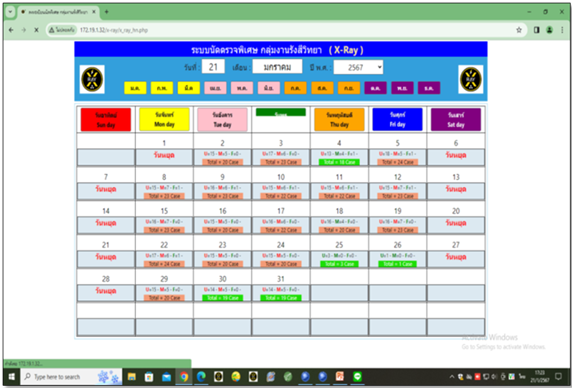
Background: Specialized radiological examinations are crucial tools for diagnosing and monitoring various diseases. However, the traditional appointment scheduling system faces issues such as delays, illegible handwriting, the duplicate appointments, and inefficiencies, causing inconvenience to patients and reducing the overall service efficiency of hospital. To address these problems, the researchers proposed the development of a specialized radiology appointment scheduling program. Methods: The study began with an analysis of the issues in the traditional appointment system, followed by the design and development of the program. The research evaluated user satisfaction with the new system and compared it with the traditional appointment system. Results: After implementing the program, user satisfaction improved significantly: appointment procedures increased by 70%, data security by 62.50%, convenience by 67.50%, accuracy of data entry by 65%, appointment data retrieval by 72.50%, and reduction of duplicate appointments by 65%. Additionally, the waiting time for appointment slips decreased from 10-15 minutes per case to 2-3 minutes, and no duplicate appointment incidents were reported. Conclusion: The developed specialized radiology appointment program can effectively replace the traditional system, improving service efficiency, reducing appointment steps, decreasing waiting times, enhancing user satisfaction, and supporting better management and delivery of high-quality medical services.
Downloads
References
Byrne SC, Barrett B, Bhatia R. The impact of diagnostic imaging wait times on the prognosis of lung cancer. Canadian Association of Radiologists Journal. 2015;66(1):53-7.
Warty RR, Smith V, Salih M, Fox D, Mcarthur SL, Mol BW. Barriers to the diffusion of medical technologies within healthcare: a systematic review. IEEE Access. 2021 Oct 6; 9:139043-58.
Tharakulphan S. Reducing the patient waiting time for radiological examination appointments at Khon Kaen Hospital using the radiological information program system and the process redesign concept. Journal of the Thai Medical Informatics Association. 2024;10(1):59-64.
เวชระเบียนและสถิติ.สถิติข้อมูลโรงพยาบาลพิจิตร:รายงานประจำปี 2565 โรงพยาบาลพิจิตร(2565).
เวชระเบียนและสถิติ.สถิติข้อมูลโรงพยาบาลพิจิตร:รายงานประจำปี 2566 โรงพยาบาลพิจิตร(2566).
Mills MJ, Nguyen JX, Himelhoch B, Souala A, Khashola A, Joseph S, et al. Project to improve the transcription of clinical order information into a radiology information system. Spartan Medical Research Journal. 2018;3(2):6936.
Troude P, Dozol A, Soyer P, Girard D, Martinez F, Montagne B, et al. Improvement of radiology requisition. Diagnostic and Interventional Imaging. 2014;95(1):69-75.
Towbin AJ, Perry LA, Larson DB. Improving efficiency in the radiology department. Pediatric Radiology. 2017; 47:783-92.
Vecellio E, Georgiou A. Integrating the radiology information system with computerised provider order entry: the impact on repeat medical imaging investigations. Digital Health Innovation for Consumers, Clinicians, Connectivity and Community: IOS Press; 2016. p. 126-31.
Vogt WP. Dictionary of statistics and methodology. 1999, 2nd Edition, Sage: Thousand Oaks, California.
Joshi A,Kale S, Chandel S, Pal DK. Likert Scale: Explored and Explained.Current Journal of Applied Science and Technology,2015; 7(4), 396–403. Mcleod S. Likert Scale Questionnaire: Examples & Analysis. [cited 2023 August 13]. Available from: https://www.simplypsychology.org/likert-scale.html
Chirawatkul A. การแปลผลทางสถิติกับการแปลผลวิจัย. Journal of Health Science of Thailand. 2020;29(6):578-9.
Chen P-S, Lai C-H, Chen Y-T, Lung T-Y. Developing a prototype system of computer-aided appointment scheduling: A radiology department case study. Technology and Health Care. 2024;32(2):997-1013.
Downloads
Published
How to Cite
Issue
Section
License
Copyright (c) 2025 The Thai Society of Radiological Technologists

This work is licensed under a Creative Commons Attribution-NonCommercial-NoDerivatives 4.0 International License.
บทความที่ได้รับการตีพิมพ์เป็นลิขสิทธิ์ของสมาคมรังสีเทคนิคแห่งประเทศไทย (The Thai Society of Radiological Technologists)
ข้อความที่ปรากฏในบทความแต่ละเรื่องในวารสารวิชาการเล่มนี้เป็นความคิดเห็นส่วนตัวของผู้เขียนแต่ละท่านไม่เกี่ยวข้องกับสมาคมรังสีเทคนิคแห่งประเทศไทยและบุคคลากรท่านอื่น ๆในสมาคม ฯ แต่อย่างใด ความรับผิดชอบองค์ประกอบทั้งหมดของบทความแต่ละเรื่องเป็นของผู้เขียนแต่ละท่าน หากมีความผิดพลาดใดๆ ผู้เขียนแต่ละท่านจะรับผิดชอบบทความของตนเองแต่ผู้เดียว