
Evaluation of exposure index and deviation index in general digital radiography
Keywords:
Digital radiography, Exposure index, Target exposure index, Deviation indexAbstract
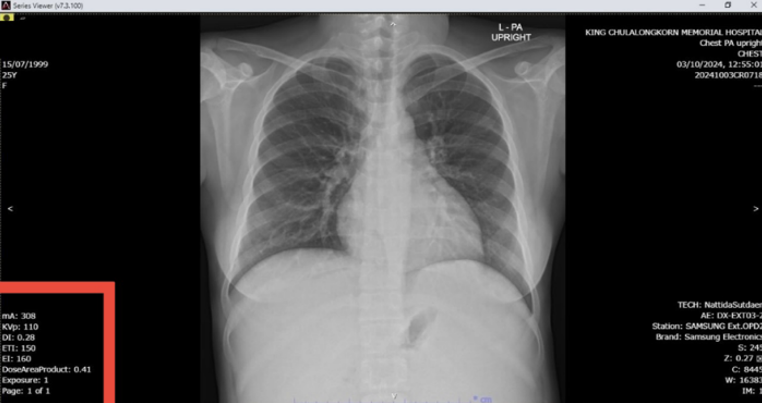
Background: The Exposure index (EI) and Deviation index (DI) are key indicators for evaluating the appropriateness of radiation dose and the quality of radiographic images in digital radiography systems. Objective: to assess the distribution of EI and DI values in general radiographic examinations of the chest, abdomen, pelvis, and lumbar spine using a digital radiography system. Methods: Patient data, technical exposure parameters, index values, and radiation dose information were retrospectively collected according to inclusion criteria from individuals who underwent general radiographic examinations with a Samsung digital radiography unit between October 2024 and February 2025. A total of 602 cases were analyzed using descriptive statistics. Results: The patients ranged in age from 16 to 93 years, with a higher proportion of females than males and body mass index (BMI) values ranging from 12.45 to 46.06. The majority of EI values across all examination sites were lower than the manufacturer’s target exposure index (EIT). Most DI values were between –3 and -1, particularly in chest examinations, while a wider distribution of DI values was observed in abdominal, pelvis, and lumbar spine examinations. Conclusion: The EI and DI values in this study indicate radiation exposure outside the optimal range while still providing sufficient quality for clinical interpretation. Using the EI and DI values to assess deviations helps reflect the image quality, appropriateness of the imaging technique, and patient radiation safety
Downloads
References
Seibert JA, Morin RL. The standardized exposure index for digital radiography: an opportunity for optimization of radiation dose to the pediatric population. Pediatr Radiol. 2011; 41: 573-581.
Mothiram U, Brennan PC, Lewis SJ, Moran B, Robinson J. Digital radiography exposure indices. J Med Radiat Sci. 2014; 61(2): 112-118.
Tsalafoutas IA, AlKhazzam S, AlNaemi H, Kharita MH. From the use of exposure index in quality control testing to the use of exposure index for quality control of clinical images. European Journal of Radiology. 2022; 9: 100454.
Park H, Yoon Y, Kim E, Jeong H, Kim J. Monitoring clinical exposure index and deviation index for dose optimization based on national diagnostic reference level; Focusing on general radiography of extremities. Journal of X-ray Sciences and Technology. 2022; 30: 419-432.
Jamil A, Mohd MI, Zain NM. The consistency of exposure indicator values in digital radiography systems. Radiati Prot Dosimetry. 2018; 82(4): 413-418.
Scott AW, Zhou Y, Allahverdian J, Nute JL, Lee C. Evaluation of digital radiography practice using exposure index tracking. J Appl Clin Med Phys. 2016; 17(6): 343-355.
Mothiram U, Brennan PC, Robinson J, Lewis SJ, Moran B. Retrospective evaluation of exposure index (EI) values from plain radiographs reveals important considerations for quality improvement. J Med Radiat Sci. 2013; 60(4): 115-122.
Shepard SJ, Flynn M, Gingold E, Goldman L, Krugh K, Leong DL, et al. An exposure indicator for digital radiography: AAPM Tack Group 116 (executive summary). Med Phys. 2009; 36(7): 2898-2914.
Dave JK, Jones AK, Flsher R, Hulme K, Rill L, Zamora D, et al. Current state of practice regarding digital radiography exposure indicators and deviation indices: Report of AAPM Imaging Physics Committee Task Group 232. Med Phys. 2018; 45(11): 1146-1160.
Creeden A, Curtis M. Optimising default radiographic exposure factors using deviation index. Radiography. 2020; 26(4): 308-313.
กรมวิทยาศาสตร์การแพทย์กระทรวงสาธารณสุข. ค่าปริมาณรังสีอ้างอิงในการถ่ายภาพรังสีวินิจฉัยทางการแพทย์ของประเทศไทย. กรุงเทพฯ: บียอนด์ พับลิสชิ่ง. 2564.
กรมวิทยาศาสตร์การแพทย์กระทรวงสาธารณสุข. ค่าปริมาณรังสีอ้างอิงในการถ่ายภาพรังสีวินิจฉัยทางการแพทย์ของประเทศไทย. กรุงเทพฯ: บียอนด์ พับลิสชิ่ง. 2566.
Chusin T, Kaewlek T. An exposure indicator in digital radiography systems. Thai J Rad Tech. 2018;43(1):21-8.
Downloads
Published
How to Cite
Issue
Section
License
Copyright (c) 2025 The Thai Society of Radiological Technologists

This work is licensed under a Creative Commons Attribution-NonCommercial-NoDerivatives 4.0 International License.
บทความที่ได้รับการตีพิมพ์เป็นลิขสิทธิ์ของสมาคมรังสีเทคนิคแห่งประเทศไทย (The Thai Society of Radiological Technologists)
ข้อความที่ปรากฏในบทความแต่ละเรื่องในวารสารวิชาการเล่มนี้เป็นความคิดเห็นส่วนตัวของผู้เขียนแต่ละท่านไม่เกี่ยวข้องกับสมาคมรังสีเทคนิคแห่งประเทศไทยและบุคคลากรท่านอื่น ๆในสมาคม ฯ แต่อย่างใด ความรับผิดชอบองค์ประกอบทั้งหมดของบทความแต่ละเรื่องเป็นของผู้เขียนแต่ละท่าน หากมีความผิดพลาดใดๆ ผู้เขียนแต่ละท่านจะรับผิดชอบบทความของตนเองแต่ผู้เดียว