
การประเมินปริมาณรังสีจากการตรวจเอกซเรย์คอมพิวเตอร์ส่วนช่องท้องในโรงพยาบาลมหาราชนครราชสีมา
คำสำคัญ:
เอกซเรย์คอมพิวเตอร์ช่องท้อง, ค่าดัชนีรังสีซีทีเชิงปริมาตร, ค่าผลคูณปริมาณรังสีกับความยาวสแกน, ค่าปริมาณรังสียังผล, ค่าปริมาณรังสีวินิจฉัยอ้างอิงบทคัดย่อ
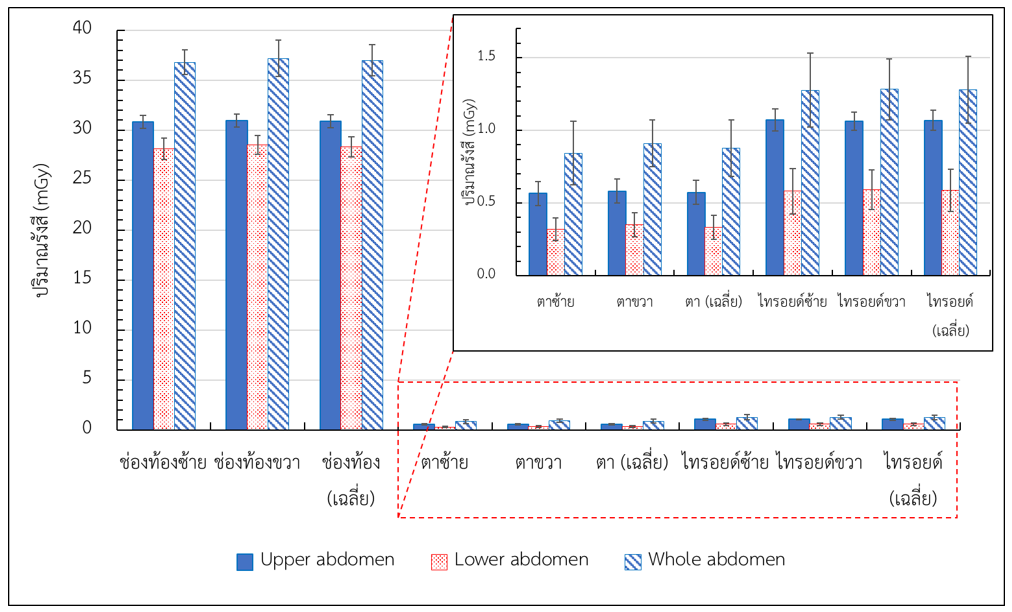
บทนำ: การตรวจช่องท้องด้วยเครื่องเอกซเรย์คอมพิวเตอร์มีความจำเป็นต่อการวินิจฉัยโรคและมีแนวโน้มเพิ่มขึ้น อย่างไรก็ตามรังสีเอกซ์เป็นอันตรายต่อเซลล์ในร่างกาย จำเป็นต้องเฝ้าระวังค่าปริมาณรังสีที่ผู้ป่วยได้รับจากการตรวจ วัตถุประสงค์: เพื่อประเมินปริมาณรังสีจากการตรวจเอกซเรย์คอมพิวเตอร์ช่องท้องส่วนบน ล่าง และช่องท้องทั้งหมด ในโรงพยาบาลมหาราชนครราชสีมา และเปรียบเทียบกับปริมาณรังสีอ้างอิงของประเทศรวมถึงประเมินปริมาณรังสีที่ผิวบริเวณช่องท้อง ตา และไทรอยด์ วิธีการศึกษา: ผู้ป่วยที่ตรวจเอกซเรย์คอมพิวเตอร์ช่องท้องส่วนบน ล่าง และช่องท้องทั้งหมด ในช่วงเดือนกุมภาพันธ์ – เมษายน ปี พ.ศ. 2566 และผ่านเกณฑ์คัดเข้า 30 ราย ในแต่ละการตรวจ ติดอุปกรณ์วัดปริมาณรังสีโอเอสแอลดีชนิดนาโนดอทเพื่อวัดปริมาณรังสีที่ผิวบริเวณตา ไทรอยด์ และช่องท้อง จากนั้นเก็บข้อมูลปริมาณรังสีได้แก่ ค่าดัชนีปริมาณรังสีเชิงปริมาตรของซีที (CTDIvol) ค่าผลคูณปริมาณรังสีกับความยาวของการสแกน (DLP) และผลรวม DLP และคำนวณค่าปริมาณรังสียังผล ผลการศึกษา: ค่า CTDIvol (13.45 มิลลิเกรย์) ค่า DLP (714.19 มิลลิเกรย์.เซนติเมตร) ค่าผลรวม DLP (2575.20 มิลลิเกรย์.เซนติเมตร) และค่าปริมาณรังสียังผล (38.50 มิลลิซีเวริต์) มีค่ามากที่สุดจากการตรวจด้วยเอกซเรย์คอมพิวเตอร์ส่วนช่องท้องทั้งหมด ค่า CTDIvol และ DLP จากการตรวจเอกซเรย์คอมพิวเตอร์ช่องท้องส่วนบน และช่องท้องทั้งหมด มีค่าไม่เกินค่าปริมาณรังสีอ้างอิงของประเทศไทย ปริมาณรังสีที่ผิวบริเวณเลนส์ตา (0.88 ± 0.19 มิลลิเกรย์) ต่อมไทรอยด์ (1.28 ± 0.23 มิลลิเกรย์) และช่องท้อง (36.98 ± 1.54 มิลลิเกรย์) จากการตรวจเอกซเรย์ช่องท้องทั้งหมดมีค่ามากที่สุดเช่นกัน สรุปผลการศึกษา: ค่า CTDIvol และ DLP ที่ได้จากการตรวจเอกซเรย์คอมพิวเตอร์ช่องท้องของผู้ป่วยในโรงพยาบาลมหาราชนครราชสีมา มีค่าต่ำกว่าปริมาณรังสีอ้างอิงของประเทศไทย แสดงให้เห็นว่าโปรโตคอลที่ใช้ในการตรวจเอกซเรย์คอมพิวเตอร์ช่องท้องส่วนบนและช่องท้องทั้งหมดของผู้ป่วยเหมาะสม
Downloads
เอกสารอ้างอิง
OCED. Computed tomography (CT) exams (indicator). doi:10.1787/3c994537-en. Accessed on 1 August 2023. https://data.oecd.org/healthcare/computed-tomography-ct-exams.htm
Poosiri S, Krisanachinda A, Khamwan K. Evaluation of patient radiation dose and risk of cancer from CT examinations. Radiol Phy Technol. 2023. https://dol.org/10.1007/s12194-023-00763-w.
Berrington de GA, Darby S. Risk of cancer from diagnostic X-rays: estimates for the UK and 14 other countries. Lancet. 2004;363(9406):345-51.
Vano E, Miller DL, Martin CJ, Rehani MM, Kang K, Rosenstein M, et al. ICRP Publication 135: Diagnostic Reference Levels in Medical Imaging. Ann ICRP. 2017;46(1):1-44. doi: 10.1177/0146645317717209.
Kanal KM, Butler PF, Sengupta D, Bhargavan-Chatfield M, Coombs LP, Morin RL. U.S. Diagnostic Reference Levels and Achievable Doses for 10 Adult CT Examinations. Radiology. 2017;284(1):120-33.
กรมวิทยาศาสตร์การแพทย์ กระทรวงสาธารณสุข. ค่าปริมาณรังสีอ้างอิงในการถ่ายภาพรังสีวินิจฉัยทางการแพทย์ของประเทศไทย 2564. กรุงเทพมหานคร: บริษัทบียอนด์พับลิสซิ่ง จำกัด; 2564.
Pema D, Kritsaneepaiboon S. Radiation Dose from Computed Tomography Scanning in Patients at Songklanagarind Hospital: Diagnostic Reference Levels. J Health Sci Med Res. 2020;38(2):135-43.
วลัยรัตน์ เงาดีงาม. ปริมาณรังสีที่ผู้ป่วยได้รับจากการตรวจด้วยเอกซเรย์คอมพิวเตอร์ของโรงพยาบาลสิชล. วารสารโรงพยาบาลนครพิงค์. 2564;12(2):97-107.
Donmoon T, Chusin T. Establishment of local diagnostic reference levels for commonly performed computed tomography examinations in Thai cancer hospitals. Thai J Rad Tech. 2021;46(1):35-42.
Sodkokruad P, Asvaphatiboon S, Thanabodeebonsiri J, Tangboonduangit P. Comparision of computed tomography dose index measuring by two detector types of computed tomography simulator. Thai J Rad Tech. 2018;43(1):64-8.
Virginia TS, John EA, Raju S, Maria AS, Anchali K, Madan R, et al. Dose reduction in CT while maintaining diagnostic confidence: diagnostic reference levels at routine head, chest and abdominal CT-IAEA-coordinated research project. Radiology. 2006;240:828-34.
เขมิกา เกื้อพิทักษ์, จุฑามาศ ทนานนท์, ปนัสดา อวิคุณประเสริฐ, สุนิสา แสงสว่าง, จิรภัทร เรืองศรีตระกูล, วิทิต ผึ่งกัน, และคณะ. การศึกษาปริมาณรังสีและปริมาณรังสีกระเจิงจากการตรวจด้วยเครื่องเอกซเรย์คอมพิวเตอร์ในหุ่นจำลอง. J Med Health Sci. 2019;26:19-28.
Nupetch S, Awikunprasert P, Pungkun V. Radiation dose response of Inlight® optically stimulated luminescence (OSL) dosimeter. Thai J Rad Tech. 2018;43(1):36-43.
กรมวิทยาศาสตร์การแพทย์ กระทรวงสาธารณสุข. ค่าปริมาณรังสีอ้างอิงในการถ่ายภาพรังสีวินิจฉัยทางการแพทย์ของประเทศไทย 2566. กรุงเทพมหานคร: บริษัทบียอนด์พับลิสซิ่ง จำกัด; 2566.
Pimsorn P. Factor affecting size–specific dose estimates in addition to scanning parameters for chest–abdomen–pelvis computed tomography using automatic tube current modulation at Chiangrai prachanukroh hospital. Thai J Rad Tech. 2022 Dec.31; (1):43-54.
Allisy-Roberts P, Williams J. Radiation physics. W.B. Saunders; 2008. p. 1–21. Available from: https://www.sciencedirect.com/science/article/pii/B9780702028441500053.
Antonio PL, Caldas LVE. Angular dependence of Tl and OSL responses of Al2O3:C commercial detectors in standard beta radiation beams. Radiat. Prot. Dosim. 2014, 113, 359–365.
Okazaki T, Hayashi H, Takegami K, Okino H, Kimoto N, Maehata I, et al. Fundamental Study of NanoDot OSL Dosimeters for Entrance Skin Dose Measurement in Diagnostic X-Ray Examinations. J. Radiat Prot. Res. 2016, 41, 229–236.
Jursinic PA. Optically stimulated luminescent dosimeters stable response to dose after repeated bleaching. Med Phys. 2020 Jul;47(7):3191-3203.
Zhuang AH, Olch AJ. A practical method for the reuse of nanoDot OSLDs and predicting sensitivities up to at least 7000 cGy. Med Phys. 2020 Apr;47(4):1481-1488.
Kanal KM, Butler PF, Sengupta D, Bhargavan-Chatfield M, Coombs LP, Morin RL. U.S. diagnostic reference levels and achievable doses for 10 adult CT examinations. Radiology. 2017;284(1):120-33.
Radiation Protection No 180. Diagnostic reference levels in thirty-six European countries [monograph on the Internet]. European Commission (EC). Luxembourg: Publication Office of the European Union; 2014 [cited 2019 Feb 11]. Available from: http://ec.europa>files>RP180 part2.
National Diagnostic Reference Levels in Japan (2020) Japan: Japan Network for Research and Information on Medical Exposure (J-RIME); 2020. Available from: https://www.jsmp.org/en/info/national-diagnostic-reference-levels-in-japan-2020-has-been-released/.
Hayton A, Wallace A, Marks P, Edmonds K, Tingey D, Johnston P. Australian diagnostic reference levels for multi-detector computed tomography. Australas Phys Eng Sci Med. 2013;36:19-26.
Trinavarat P, Kritsaneepaiboon S, Rongviriyapanich C, Visrutaratna P, Srinakarin J. Radiation dose from CT scanning: can it be reduced? Asian Biomedicine. 2011;5:13-21.
Nuntue C, Krisanachinda A, Khamwan K. Optimization of a low-dose 320-slice multidetector computed tomography chest protocol using a phantom. Asian Biomedicine. 2016;10:269-276.
ดาวน์โหลด
เผยแพร่แล้ว
รูปแบบการอ้างอิง
ฉบับ
ประเภทบทความ
สัญญาอนุญาต
ลิขสิทธิ์ (c) 2023 สมาคมรังสีเทคนิคแห่งประเทศไทย

อนุญาตภายใต้เงื่อนไข Creative Commons Attribution-NonCommercial-NoDerivatives 4.0 International License.
บทความที่ได้รับการตีพิมพ์เป็นลิขสิทธิ์ของสมาคมรังสีเทคนิคแห่งประเทศไทย (The Thai Society of Radiological Technologists)
ข้อความที่ปรากฏในบทความแต่ละเรื่องในวารสารวิชาการเล่มนี้เป็นความคิดเห็นส่วนตัวของผู้เขียนแต่ละท่านไม่เกี่ยวข้องกับสมาคมรังสีเทคนิคแห่งประเทศไทยและบุคคลากรท่านอื่น ๆในสมาคม ฯ แต่อย่างใด ความรับผิดชอบองค์ประกอบทั้งหมดของบทความแต่ละเรื่องเป็นของผู้เขียนแต่ละท่าน หากมีความผิดพลาดใดๆ ผู้เขียนแต่ละท่านจะรับผิดชอบบทความของตนเองแต่ผู้เดียว