Study of the effects of new Lactobacillus strains on gut and oral microbiota in healthy dogs https://doi.org/10.12982/VIS.2026.048
Article Sidebar
Main Article Content
Abstract
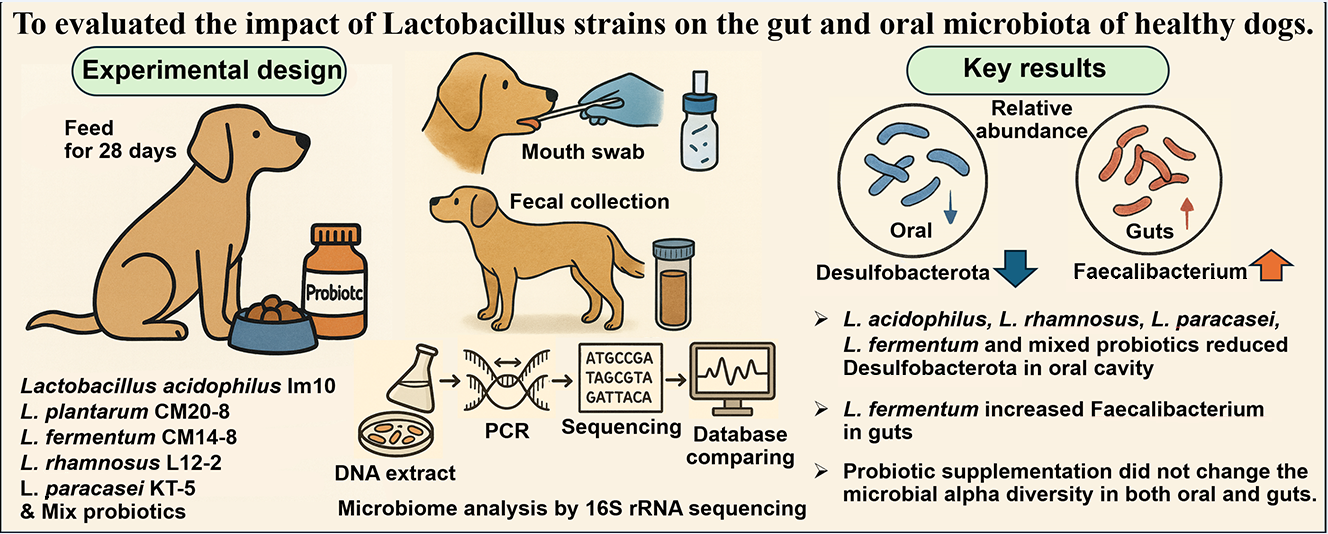
Probiotics, particularly Lactobacillus spp., play a key role in supporting host health by modulating the gut and oral microbiota, enhancing immune responses, and maintaining microbial balance. While microbial diversity and composition are crucial for gastrointestinal and oral health, the impact of new Lactobacillus strains on healthy dogs has not been fully explored. This study evaluated the impact of new Lactobacillus strains on the gut and oral microbiota of healthy dogs. A sample of 35 adult dogs was divided into seven groups. Group 1 received a basal diet, while Groups 2–6 received individual Lactobacillus strain supplements: L. plantarum CM20-8 (TISTR 2676), L. acidophilus Im10 (TISTR 2734), L. rhamnosus L12-2 (TISTR 2716), L. paracasei KT-5 (TISTR 2688), and L. fermentum CM14-8 (TISTR 2720), respectively. Group 7 received a mixed probiotic supplement containing all five strains. Each dog received the respective L. strain at 10⁹ CFU/day. Fecal and oral microbiota were analyzed using 16S rRNA sequencing. Based on the results, probiotic supplementation did not significantly change the overall microbial diversity. Dogs supplemented with L. fermentum CM14-8 (TISTR 2720) had a significantly (p=0.02) higher abundance (1.97%) of the beneficial genus Faecalibacterium in fecal samples than the control group (0.64%). In oral microbiota, compared to the control group, there were significant (p=0.03) reductions in the abundance of the Desulfobacterota in dogs receiving L. acidophilus Im10 (2.19%), L. rhamnosus L12-2 (2.32%), L. paracasei KT-5 (2.59%), L. fermentum CM14-8 (2.11%), and the mixed probiotic (2.69%). These findings highlighted the potential of specific probiotic strains, especially L. fermentum CM14-8, to modulate oral and gut microbiota in healthy dogs. Further studies are essential in clinical populations and functional assessments to define their preventive and therapeutic applications.
Article Details

This work is licensed under a Creative Commons Attribution 4.0 International License.
Publishing an article with open access in Veterinary Integrative Sciences leaves the copyright with the author. The article is published under the Creative Commons Attribution License 4.0 (CC-BY 4.0), which allows users to read, copy, distribute and make derivative works from the material, as long as the author of the original work is cited.
References
Areerat, S., Chundang, P., Lekcharoensuk, C., Patumcharoenpol, P., Kovitvadhi, A., 2023. Insect-based diets (house crickets and mulberry silkworm pupae): a comparison of their effects on canine gut microbiota. Vet. World. 16, 1627.
Asensio-Grau, A., Calvo-Lerma, J., Ferriz-Jordán, M., García-Hernández, J., Heredia, A., Andrés, A., 2023. Effect of Lactobacillaceae probiotics on colonic microbiota and metabolite production in cystic fibrosis: a comparative in vitro study. Nutrients. 15, 3846.
Baillon, M.L.A., Marshall-Jones, Z.V., Butterwick, R.F., 2004. Effects of probiotic Lactobacillus acidophilus strain DSM13241 in healthy adult dogs. Am. J. Vet. Res. 65, 338–343.
Barko, P., McMichael, M., Swanson, K.S., Williams, D.A., 2018. The gastrointestinal microbiome: a review. J. Vet. Intern. Med. 32, 9–25.
Beattie, R.E., 2024. Probiotics for oral health: a critical evaluation of bacterial strains. Front. Microbiol. 15, 1430810.
Bell, S.E., Nash, A.K., Zanghi, B.M., Otto, C.M., Perry, E.B., 2020. An assessment of the stability of the canine oral microbiota after probiotic administration in healthy dogs over time. Front. Vet. Sci. 7, 616.
Bermingham, E.N., Maclean, P., Thomas, D.G., Cave, N.J., Young, W., 2017. Key bacterial families (Clostridiaceae, Erysipelotrichaceae and Bacteroidaceae) are related to the digestion of protein and energy in dogs. PeerJ. 5, e3019.
Bertazzoni, E., Donelli, G., Midtvedt, T., Nicoli, J., Sanz, Y., 2013. Probiotics and clinical effects: is the number what counts? J. Chemother. 25, 193–212.
Bolyen, E., Rideout, J.R., Dillon, M.R., Bokulich, N.A., Abnet, C., Al-Ghalith, G.A., Alexander, H., Alm, E.J., Arumugam, M., Asnicar, F., 2018. QIIME 2: Reproducible, interactive, scalable, and extensible microbiome data science. Available online: https://doi.org/10.7287/peerj.preprints.27295v2.
Brestoff, J.R., Artis, D., 2013. Commensal bacteria at the interface of host metabolism and the immune system. Nat. Immunol. 14, 676–684.
Chaiyasut, C., Sivamaruthi, B.S., Thangaleela, S., Sisubalan, N., Bharathi, M., Khongtan, S., Kesika, P., Sirilun, S., Choeisoongnern, T., Peerajan, S., 2024. Influence of Lactobacillus rhamnosus supplementation on the glycaemic index, lipid profile, and microbiome of healthy elderly subjects: a preliminary randomized clinical trial. Foods. 13, 1293.
Chapman, C., Gibson, G.R., Rowland, I., 2011. Health benefits of probiotics: are mixtures more effective than single strains?. Eur. J. Nutr. 50, 1–17.
Charteris, W.P., Morelli, L., Collins, J.K., 1998. Development and application of an in vitro methodology to determine the transit tolerance of potentially probiotic Lactobacillus and Bifidobacterium species in the upper human gastrointestinal tract. J. Appl. Microbiol. 84, 759–768.
Chen, S., Zhou, Y., Chen, Y., Gu, J., 2018. fastp: an ultra-fast all-in-one FASTQ preprocessor. Bioinformatics. 34, i884–i890.
Ciaravolo, S., Martínez-López, L.M., Allcock, R.J., Woodward, A.P., Mansfield, C., 2021. Longitudinal survey of fecal microbiota in healthy dogs administered a commercial probiotic. Front. Vet. Sci. 8, 664318.
Coelho, L.P., Kultima, J.R., Costea, P.I., Fournier, C., Pan, Y., Czarnecki-Maulden, G., Hayward, M.R., Forslund, S.K., Schmidt, T.S.B., Descombes, P., 2018. Similarity of the dog and human gut microbiomes in gene content and response to diet. Microbiome. 6, 1–11.
Collins, M.D., Gibson, G.R., 1999. Probiotics, prebiotics, and synbiotics: approaches for modulating the microbial ecology of the gut. Am. J. Clin. Nutr. 69, 1052s–1057s.
Costinar, L., Herman, V., Pascu, C., 2010. The presence of sulfate-reducing bacteria in dog's oral cavity. Romanian J. Vet. Sci. xliii, 128-131.
de Melo Pereira, G.V., de Oliveira Coelho, B., Júnior, A.I.M., Thomaz-Soccol, V., Soccol, C.R., 2018. How to select a probiotic? A review and update of methods and criteria. Biotechnol. Adv. 36, 2060–2076.
Fernández, L., Martínez, R., Pérez, M., Arroyo, R., Rodríguez, J.M., 2019. Characterization of Lactobacillus rhamnosus MP01 and Lactobacillus plantarum MP02 and assessment of their potential for the prevention of gastrointestinal infections in an experimental canine model. Front. Microbiol. 10, 1117.
Flancman, R., Singh, A., Weese, J.S., 2018. Evaluation of the impact of dental prophylaxis on the oral microbiota of dogs. PLoS One. 13, e0199676.
Flint, H.J., Scott, K.P., Louis, P., Duncan, S.H., 2012. The role of the gut microbiota in nutrition and health. Nat. Rev. Gastroenterol. Hepatol. 9, 577–589.
Freeman, L., Becvarova, I., Cave, N., MacKay, C., Nguyen, P., Rama, B., Takashima, G., Tiffin, R., van Beukelen, P., Yathiraj, S., 2011. WSAVA nutritional assessment guidelines. J. Feline Med. Surg. 13, 516–525.
Fusco, W., Lorenzo, M.B., Cintoni, M., Porcari, S., Rinninella, E., Kaitsas, F., Lener, E., Mele, M.C., Gasbarrini, A., Collado, M.C., 2023. Short-chain fatty-acid-producing bacteria: key components of the human gut microbiota. Nutrients. 15, 2211.
Garcia-Mazcorro, J.F., Lanerie, D.J., Dowd, S.E., Paddock, C.G., Grützner, N., Steiner, J.M., Ivanek, R., Suchodolski, J.S., 2011. Effect of a multi-species synbiotic formulation on fecal bacterial microbiota of healthy cats and dogs as evaluated by pyrosequencing. FEMS Microbiol. Ecol. 78, 542–554.
Gryaznova, M., Dvoretskaya, Y., Burakova, I., Syromyatnikov, M., Popov, E., Kokina, A., Mikhaylov, E., Popov, V., 2022. Dynamics of changes in the gut microbiota of healthy mice fed with lactic acid bacteria and bifidobacteria. Microorganisms. 10, 1020.
Guard, B.C., Barr, J.W., Reddivari, L., Klemashevich, C., Jayaraman, A., Steiner, J.M., Vanamala, J., Suchodolski, J.S., 2015.
Characterization of microbial dysbiosis and metabolomic changes in dogs with acute diarrhea. PLoS One. 10, e0127259.
Hand, D., Wallis, C., Colyer, A., Penn, C.W., 2013. Pyrosequencing the canine faecal microbiota: breadth and depth of biodiversity. PLoS One. 8, e53115.
Handl, S., Dowd, S.E., Garcia-Mazcorro, J.F., Steiner, J.M., Suchodolski, J.S., 2011. Massive parallel 16S rRNA gene pyrosequencing reveals highly diverse fecal bacterial and fungal communities in healthy dogs and cats. FEMS Microbiol. Ecol. 76, 301–310.
Hernandez, J., Rhimi, S., Kriaa, A., Mariaule, V., Boudaya, H., Drut, A., Jablaoui, A., Mkaouar, H., Saidi, A., Biourge, V., 2022. Domestic environment and gut microbiota: lessons from pet dogs. Microorganisms. 10, 949.
Herstad, K.M.V., Moen, A.E.F., Gaby, J.C., Moe, L., Skancke, E., 2018. Characterization of the fecal and mucosa-associated microbiota in dogs with colorectal epithelial tumors. PLoS One. 13, e0198342.
Hasan, N., Yang, H., 2019. Factors affecting the composition of the gut microbiota, and its modulation. PeerJ. 7, e7502.
Hill, C., Guarner, F., Reid, G., Gibson, G.R., Merenstein, D.J., Pot, B., Morelli, L., Canani, R.B., Flint, H.J., Salminen, S., 2014. Expert consensus document: The International Scientific Association for Probiotics and Prebiotics consensus statement on the scope and appropriate use of the term probiotic. Nat. Rev. Gastroenterol. Hepatol. 11, 506-514.
Hong, J., Fu, T., Liu, W., Du, Y., Bu, J., Wei, G., Yu, M., Lin, Y., Min, C., Lin, D., 2023. Specific alternation of gut microbiota and the role of Ruminococcus gnavus in the development of diabetic nephropathy. J. Microbiol. Biotechnol. 34, 547.
Hooper, L.V., Littman, D.R., Macpherson, A.J., 2012. Interactions between the microbiota and the immune system. Science. 336, 1268–1273.
Huang, Z., Pan, Z., Yang, R., Bi, Y., Xiong, X., 2020. The canine gastrointestinal microbiota: early studies and research frontiers. Gut Microbes. 11, 635–654.
Hullar, M.A., Lampe, J.W., Torok-Storb, B.J., Harkey, M.A., 2018. The canine gut microbiome is associated with higher risk of gastric dilatation-volvulus and high risk genetic variants of the immune system. PLoS One. 13, e0197686.
Jandhyala, S.M., Talukdar, R., Subramanyam, C., Vuyyuru, H., Sasikala, M., Reddy, D.N., 2015. Role of the normal gut microbiota. World J. Gastroenterol. 21, 8787.
Kim, W.K., Jang, Y.J., Seo, B., Han, D.H., Park, S., Ko, G., 2019. Administration of Lactobacillus paracasei strains improves immunomodulation and changes the composition of gut microbiota leading to improvement of colitis in mice. J. Funct. Food. 52, 565–575.
Kingkaw, A., Raethong, N., Patumcharoenpol, P., Suratannon, N., Nakphaichit, M., Keawsompong, S., Roytrakul, S., Vongsangnak, W., 2022. Analyzing predominant bacterial species and potential short-chain fatty acid-associated metabolic routes in human gut microbiome using integrative metagenomics. Biology. 12, 21.
Kozak, M., Pawlik, A., 2023. The role of the oral microbiome in the development of diseases. Int. J. Mol. Sci. 24, 5231.
Kushkevych, I., Coufalová, M., Vítězová, M., Rittmann, S.K.M., 2020. Sulfate-reducing bacteria of the oral cavity and their relation with periodontitis—recent advances. J. Clin. Med. 9, 2347.
Laflamme, D., 1997. Developmental and validation of a body condition score system for dogs. Canine Pract. 22, 10-15.
Lee, D., Goh, T.W., Kang, M.G., Choi, H.J., Yeo, S.Y., Yang, J., Huh, C.S., Kim, Y.Y., Kim, Y., 2022. Perspectives and advances in probiotics and the gut microbiome in companion animals. J. Anim. Sci. Technol. 64, 197.
Lee, S.K., Lee, J.J., Jin, Y.I., Jeong, J.C., Chang, Y.H., Lee, Y.S., Jeong, Y.H., Kim, M.S., 2017. Probiotic characteristics of Bacillus strains isolated from Korean traditional soy sauce. J. Food Sci. Technol. 54, 1858–1869.
Lin, R., Sun, Y., Mu, P., Zheng, T., Mu, H., Deng, F., Deng, Y., Wen, J., 2020. Lactobacillus rhamnosus GG supplementation modulates the gut microbiota to promote butyrate production, protecting against deoxynivalenol exposure in nude mice. Biochem. Pharmacol. 175, 113868.
Liu, Y., Wang, J., Zheng, H., Xin, J., Zhong, Z., Liu, H., Fu, H., Zhou, Z., Qiu, X., Peng, G., 2024. Multi-functional properties of lactic acid bacteria strains derived from canine feces. Front. Vet. Sci. 11, 1404580.
Ma, T., Jin, H., Kwok, L.Y., Sun, Z., Liong, M.T., Zhang, H., 2021. Probiotic consumption relieved human stress and anxiety symptoms possibly via modulating the neuroactive potential of the gut microbiota. Neurobiol. Stress. 14, 100294.
Magoč, T., Salzberg, S.L., 2011. FLASH: fast length adjustment of short reads to improve genome assemblies. Bioinformatics. 27, 2957–2963.
Mahasneh, S.A., Mahasneh, A.M., 2017. Probiotics: a promising role in dental health. Dent. J. 5, 26.
Marchesi, J.R., Adams, D.H., Fava, F., Hermes, G.D., Hirschfield, G.M., Hold, G., Quraishi, M.N., Kinross, J., Smidt, H., Tuohy, K.M., 2016. The gut microbiota and host health: a new clinical frontier. Gut. 65, 330–339.
Marshall-Jones, Z.V., Baillon, M.L.A., Croft, J.M., Butterwick, R.F., 2006. Effects of Lactobacillus acidophilus DSM13241 as a probiotic in healthy adult cats. Am. J. Vet. Res. 67, 1005–1012.
Melara, E., Avellaneda, M., Valdivié, M., García-Hernández, Y., Aroche, R., Martínez, Y., 2022. Probiotics: symbiotic relationship with the animal host. Animals. 12, 719.
Merkouris, E., Mavroudi, T., Miliotas, D., Tsiptsios, D., Serdari, A., Christidi, F., Doskas, T.K., Mueller, C., Tsamakis, K., 2024. Probiotics’ effects in the treatment of anxiety and depression: a comprehensive review of 2014–2023 clinical trials. Microorganisms. 12, 411.
Moon, C.D., Young, W., Maclean, P.H., Cookson, A.L., Bermingham, E.N., 2018. Metagenomic insights into the roles of Proteobacteria in the gastrointestinal microbiomes of healthy dogs and cats. MicrobiologyOpen. 7, e00677.
Morelli, L., Capurso, L., 2012. FAO/WHO guidelines on probiotics: 10 years later. J. Clin. Gastroenterol. 46, S1–S2.
Murphy, M., Parker, V., 2022. 2021 AAHA nutrition and weight management guidelines for dogs and cats. J. Am. Anim. Hosp. Assoc. 57, 153-178.
Noronha, N.Y., Noma, I.H.Y., Fernandes Ferreira, R., Rodrigues, G.D.S., Martins, L.D.S., Watanabe, L.M., Pinhel, M.A.D.S., Mello Schineider, I., Diani, L.M., Carlos, D., 2024. Association between the relative abundance of phyla Actinobacteria, vitamin C consumption, and DNA methylation of genes linked to immune response pathways. Front. Nutr. 11, 1373499.
Oh, C., Lee, K., Cheong, Y., Lee, S.W., Park, S.Y., Song, C.S., Choi, I.S., Lee, J.B., 2015. Comparison of the oral microbiomes of canines and their owners using next-generation sequencing. PLoS One. 10, e0131468.
Oksanen, J., Blanchet, F.G., Kindt, R., Legendre, P., Minchin, P.R., O’hara, R., Simpson, G.L., Solymos, P., Stevens, M.H.H., Wagner, H., 2013. Package ‘vegan’. Community Ecology Package. 2, 1–295.
Oksanen, J., Kindt, R., Legendre, P., O’Hara, B., Stevens, M.H.H., Oksanen, M.J., Suggests, M., 2007. The vegan package. Community Ecology Package. 10, 719.
Panja, K., Areerat, S., Chundang, P., Palaseweenun, P., Akrimajirachoote, N., Sitdhipol, J., Thaveethaptaikul, P., Chonpathompikunlert, P., Niwasabutra, K., Phapugrangkul, P., 2023. Influence of dietary supplementation with new Lactobacillus strains on hematology, serum biochemistry, nutritional status, digestibility, enzyme activities, and immunity in dogs. Vet. World. 16, 834.
Piyadeatsoontorn, S., Sornplang, P., Chuachan, U., Puyati, B., 2018. Effect of lactobacilli probiotics supplementation on intestinal bacteria and growth performance in weaned pigs. Vet. Integr. Sci. 16, 211–221.
Quast, C., Pruesse, E., Yilmaz, P., Gerken, J., Schweer, T., Yarza, P., Peplies, J., Glöckner, F.O., 2012. The SILVA ribosomal RNA gene database project: improved data processing and web-based tools. Nucleic Acids. Res. 41, D590–D596.
Quévrain, E., Maubert, M., Michon, C., Chain, F., Marquant, R., Tailhades, J., Miquel, S., Carlier, L., Bermúdez-Humarán, L., Pigneur, B., 2016. Identification of an anti-inflammatory protein from Faecalibacterium prausnitzii, a commensal bacterium deficient in Crohn’s disease. Gut. 65, 415–425.
Radeerom, T., Thongkorn, K., Buddhachat, K., Pradit, W., Chomdej, S., Siengdee, P., Nganvongpanit, K., 2018. Investigation of the calculus microbiome in canines and felines using next-generation sequencing. Kafkas Univ. Vet. Fak. Derg. 24, 593–600.
Robinson, A.V., Vancuren, S.J., Marcone, M., Allen-Vercoe, E., 2025. Characterization of diet-linked amino acid pool influence on Fusobacterium spp. growth and metabolism. mSphere. e00789-24.
Rossi, G., Pengo, G., Galosi, L., Berardi, S., Tambella, A.M., Attili, A.R., Gavazza, A., Cerquetella, M., Jergens, A.E., Guard, B.C., 2020. Effects of the probiotic mixture Slab51® (SivoMixx®) as food supplement in healthy dogs: evaluation of fecal microbiota, clinical parameters and immune function. Front. Vet. Sci. 7, 613.
Sarowska, J., Choroszy-Król, I., Regulska-Ilow, B., Frej-Madrzak, M., Jama-Kmiecik, A., 2013. The therapeutic effect of probiotic bacteria on gastrointestinal diseases. Adv. Clin. Exp. Med. 22, 759–766.
Sathitkowitchai, W., Suratannon, N., Keawsompong, S., Weerapakorn, W., Patumcharoenpol, P., Nitisinprasert, S., Nakphaichit, M., 2021. A randomized trial to evaluate the impact of copra meal hydrolysate on gastrointestinal symptoms and gut microbiome. PeerJ. 9, e12158.
Segovia, B.M., Torras, M.D.l.Á.C., 2018. Communication of the results of the treatment with probiotics in two cats with chronic gingivostomatitis. Open J. Vet. Med. 8, 9–14.
Song, J., Hwang, J., Kang, I., Cho, J.C., 2021. A sulfate-reducing bacterial genus, Desulfosediminicola gen. nov., comprising two novel species cultivated from tidal-flat sediments. Sci. Rep. 11, 19978.
Strompfová, V., Kubašová, I., Lauková, A., 2017. Health benefits observed after probiotic Lactobacillus fermentum CCM 7421 application in dogs. Appl. Microbiol. Biotechnol. 101, 6309–6319.
Strompfová, V., Marciňáková, M., Simonová, M., Bogovič-Matijašić, B., Lauková, A., 2006. Application of potential probiotic Lactobacillus fermentum AD1 strain in healthy dogs. Anaerobe. 12, 75–79.
Suchodolski, J.S., 2011. Companion animals symposium: microbes and gastrointestinal health of dogs and cats. J. Anim. Sci. 89, 1520–1530.
Suchodolski, J.S., 2022. Analysis of the gut microbiome in dogs and cats. Vet. Clin. Pathol. 50, 6–17.
Suchodolski, J.S., Camacho, J., Steiner, J.M., 2008. Analysis of bacterial diversity in the canine duodenum, jejunum, ileum, and colon by comparative 16S rRNA gene analysis. FEMS Microbiol. Ecol. 66, 567–578.
Swanson, K.S., Dowd, S.E., Suchodolski, J.S., Middelbos, I.S., Vester, B.M., Barry, K.A., Nelson, K.E., Torralba, M., Henrissat, B., Coutinho, P.M., 2011. Phylogenetic and gene-centric metagenomics of the canine intestinal microbiome reveals similarities with humans and mice. ISME J. 5, 639–649.
Thuy, N.P., 2025. Isolation and selection of probiotic Lactobacillus strains from chicken intestinal tract: A potential solution for sustainable poultry production in V0ietnam. Vet. Integr. Sci. 23, 1–17.
Vielkind, P., Jentsch, H., Eschrich, K., Rodloff, A.C., Stingu, C.S., 2015. Prevalence of Actinomyces spp. in patients with chronic periodontitis. Int. J. Med. Microbiol. 305, 682–688.
Xiang, B., Runzhi, C., Min, Z., Yuanqi, Z., Xiang, P., Wei, W., Qi, Z., Zhiyin, G., Jun, H., Tao, D., 2024. P1214 The crosstalk between oral and intestinal microbiota in inflammatory bowel disease patients. J. Crohns. Colitis. 18, i2158.
Xu, H., Huang, W., Hou, Q., Kwok, L.Y., Laga, W., Wang, Y., Ma, H., Sun, Z., Zhang, H., 2019. Oral administration of compound probiotics improved canine feed intake, weight gain, immunity and intestinal microbiota. Front. Immunol. 10, 666.
Xu, H., Zhao, F., Hou, Q., Huang, W., Liu, Y., Zhang, H., Sun, Z., 2019. Metagenomic analysis revealed beneficial effects of probiotics in improving the composition and function of the gut microbiota in dogs with diarrhoea. Food Funct. 10, 2618–2629.
Yamazaki, K., 2023. Oral-gut axis as a novel biological mechanism linking periodontal disease and systemic diseases: a review. J. Dent. Sci. Rev. 59, 273–280.
You, I., Kim, M.J., 2021. Comparison of gut microbiota of 96 healthy dogs by individual traits: breed, age, and body condition score. Animals. 11, 2432.
You, I., Mahiddine, F.Y., Park, H., Kim, M.J., 2022. Lactobacillus acidophilus novel strain, MJCD175, as a potential probiotic for oral health in dogs. Front. Vet. Sci. 9, 946890.
Zhang, D., Liu, H., Wang, S., Zhang, W., Wang, J., Tian, H., Wang, Y., Ji, H., 2019. Fecal microbiota and its correlation with fatty acids and free amino acids metabolism in piglets after a Lactobacillus strain oral administration. Front. Microbiol. 10, 785.
Zhang, J., Wu, G., Tang, Y., Liu, H., Ge, X., Peng, R., Cao, J., Tu, D., Su, B., Jin, S., 2023. Causal associations between gut microbiota and primary biliary cholangitis: a bidirectional two-sample Mendelian randomization study. Front. Microbiol. 14, 1273024.
Zheng, T., Meng, C., Lv, Z., Wu, C., Zhou, X., Mao, W., 2025. The critical role of Faecalibacterium prausnitzii in cardiovascular diseases. Rev. Cardiovasc. Med. 26, 26740.
