Effects of slow-release ammonium sulfate as non-protein nitrogen sources on rumen fermentation characteristics: An in vitro study https://doi.org/10.12982/VIS.2026.036
Article Sidebar
Main Article Content
Abstract
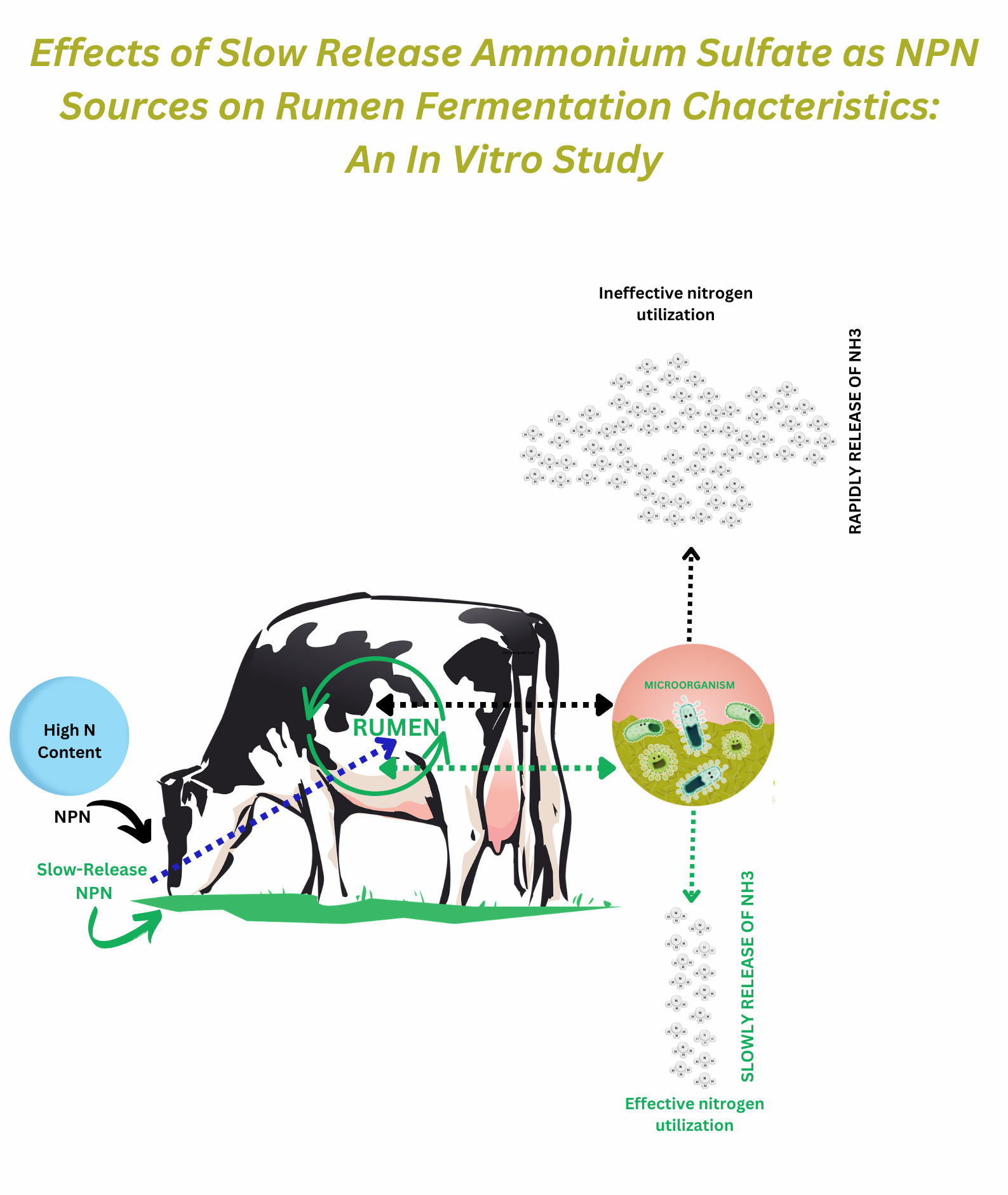
This experiment aimed to evaluate the effects hydrated lime (Ca(OH)2) as slow-release agent for ammonium sulfate in non-protein nitrogen supplementation on ruminal fermentation characteristics under in vitro method. A completely randomized design (CRD) was employed with four treatments and six replications: ZA (100% ammonium sulfate); ZA-Corn (29.26% ammonium sulfate and 70.74% corn meal); ZA+Lime-Corn (a mixture of 60% ammonium sulfate and calcium hydroxide, and 40% corn meal); and Pangola grass as standard. The variables observed included total gas production, methane (CH₄) production, ammonia (NH3) concentration, protozoa population, microbial protein synthesis (MPS), and in vitro dry matter (IVDMD) and organic matter (IVOMD) degradability. Results presented that the inclusion of Ca(OH)₂ as a binding agent for slow-release ammonium sulfate significantly reduced (P<0.05) total gas production compared to ammonium sulfate and corn meal combination, which showed the highest gas production. There were no differences (P>0.05) in fermenter pH across treatments. However, the inclusion of Ca(OH)₂ decreased cumulative gas production, NH₃ concentration, MPS, IVDMD, IVOMD and protozoa populations (P < 0.05). Conversely, the ZA-Corn treatment significantly increased (P<0.05) cumulative gas production, MPS, CH₄ production, IVDMD, and IVOMD. The ZA treatment increased (P < 0.05) NH₃, IVDMD, and IVOMD. These findings suggest that the inclusion of Ca(OH)₂ slows the ruminal nitrogen release and prevents excessive NH₃ accumulation, though it can slightly suppress microbial synthesis and digestibility
Article Details

This work is licensed under a Creative Commons Attribution 4.0 International License.
Publishing an article with open access in Veterinary Integrative Sciences leaves the copyright with the author. The article is published under the Creative Commons Attribution License 4.0 (CC-BY 4.0), which allows users to read, copy, distribute and make derivative works from the material, as long as the author of the original work is cited.
References
Alipour, D., Saleem, A.M., Sanderson, H., Brand, T., Santos, L.V., Mahmoudi-Abyane, M., Marami, M.R., McAllister, T.A., 2020. Effect of combinations of feed-grade urea and slow-release urea in a finishing beef diet on fermentation in an artificial rumen system. Transl. Anim. Sci. 4, 839–847.
Anggraeni, A.S., Jayanegara, A., Sofyan, A., Laconi, E.B., Kumalasari, N.R., Gunadarma, I.N., Herdian, H., Fidriyanto, R., 2024. In vitro and in sacco evaluation of total mixed ration silage added different levels of chitosan. Czech J. Anim. Sci. 69, 178–190.
AOAC, 2005. Official Methods of Analysis of the Association of Analytical Chemists International. AOAC International, Virginia USA.
Balch, W.E., Fox, G.E., Magrum, L.J., Woese, C.R., Wolfe, R., 1979. Methanogens: reevaluation of a unique biological group. Microbiol. Rev. 43, 260–296.
Baffa, D.F., Oliveira, T.S., Fernandes, A.M., Camilo, M.G., Silva, I.N., Júnior, J.R.M., Aniceto, E.S., 2023. Evaluation of associative effects of in vitro gas production and fermentation profile caused by variation in ruminant diet constituents. Methane. 2, 344–360.
Cherdthong, A., Wanapat, M., 2010. Development of urea products as rumen slow-release feed for ruminant production: a review. Aust. J. Basic Appl. Sci. 4, 2232–2241.
Cherdthong, A., Wanapat, M., Wachirapakorn, C., 2011. Influence of urea calcium mixture supplementation on ruminal fermentation characteristics of beef cattle fed on concentrates containing high levels of cassava chips and rice straw. Anim. Feed Sci. Technol. 163, 43–51.
Conway, E.J., Byrne, A., 1933. An absorption apparatus for micro-determination of certain volatile substances: The micro-determination of ammonia. Biochem. J. 27, 419–429.
Crookshank, H.R., Smalley, H.E., Furr, D., Ellis, G.F., 1973. Ammonium chloride and ammonium sulfate in cattle feedlot finishing rations. J. Anim. Sci. 36, 107–109.
Dai, X., Kalscheur, K.F., Huhtanen, P., Faciola, A.P., 2022. Effects of ruminal protozoa on methane emissions in ruminants—A meta-analysis. J. Dairy Sci. 105, 7482–7491.
de Lucena, K.H.D.O., Mazza, P.H., Oliveira, R.L., Barbosa, A.M., Perreira Filho, J.M., Bessa, R.J., Alves, S.P., Edvan, R.L., Pereira, E.S., Fonseca, M., Silva Filho, E.C., 2024. Slow-releasing urea coated with low-trans vegetable lipids: Effects on lamb performance, nutrient digestibility, nitrogen balance, and blood parameters. Anim. Feed Sci. Technol. 310, 115925.
de Mendonça Lopes, A.S., de Oliveira, J.S., Cruz, G.F. L., Viera., D.S., Santos, F.N.S., Lemos, M.L.P., Pinheiro, J.K., de Sousa, L.S., de Oliviera, C.J.B., Santos, E.M., 2023. Effects of non-protein nitrogen on buffel grass fiber and ruminal bacterial composition in sheep. Livest. Sci. 272, 105237.
da Silva, C.J., Leonel, F.P., Pereira, J.C., Costa, M.G., Moreira, L.M., de Oliveira, T.S., de Abreu, C.L., 2014. Sulfur sources in protein supplements for ruminants. R. Bras. Zootec. 43, 537–543.
Fan, C., Li, H., Li, S., Zhong, G., Jia, W., Zhuo, Z., Xue, Y., Koontz, A.F., Cheng, J., 2024. Effect of different slow-release urea on the production performance, rumen fermentation, and blood parameter of Angus Heifer. Animals. 14, 2296.
Fitriyah, N.S., Oluodo, L.A., Hnokaew, P., Umsook, S., Thirawong, P., Khamlor, T., Yammuen-Art, S., 2024. Optimum level of Lactobacillus plantarum supplementation as probiotic on in vitro degradability and rumen fermentation products of total mixed ration. Vet. Integr. Sci. 22(2), 489–500.
Guo, Y., Xiao, L., Jin, L., Yan, S., Niu, D., Yang, W., 2022. Effect of commercial slow-release urea product on in vitro rumen fermentation and ruminal microbial community using RUSITEC technique. J. Anim. Sci. Biotechnol. 13, 56.
Harahap, M.A., Nuswantara, L.K., Pangestu, E., Wahyono, F., Achmadi, J., 2018. Nitrogen degradation of the limestone-urea mixtures in the rumen of goats. J. Indonesian Trop. Anim. Agric. 43, 282–288
Harahap, M.A., Nuswantara, L.K., Wahyono, F., Pangestu, E., Achmadi, J., 2019. In vitro rumen fermentability of urea-limestone mixture combined with different sources of non-fiber carbohydrate. Livestock Res. Rural Dev. 31, 75.
Liu, L., Xu, X., Cao, Y., Cai, C., Cui, H., Yao, J., 2017. Nitrate decreases methane production also by increasing methane oxidation through stimulating NC10 population in ruminal culture. Amb Expr. 7, 1–7.
López-García, A., Saborío-Montero, A., Gutiérrez-Rivas, M., Atxaerandio, R., Goiri, I., García-Rodríguez, A., Jiménez-Montero, J.A., González, C., Tamames, J., Puente-Sánchez, F., Serrano, M., 2022. Fungal and ciliate protozoa are the main rumen microbes associated with methane emissions in dairy cattle. Gigascience. 11, giab088.
Lowry, O.H., Rosebrough, N.J., Farr, A.L., Randall, R.J., 1951. Protein measurement with the folin phenol reagent. J. Biol. Chem. 193, 265–75.
Machado, L., Magnusson, M., Paul, N.A., de Nys, R., Tomkins, N., 2014. Effects of marine and freshwater macroalgae on in vitro total gas and methane production. PLoS One. 9, e85289.
Majewska, M.P., Miltko, R., Bełżecki, G., Kędzierska, A., Kowalik, B., 2020. Protozoa population and carbohydrate fermentation in sheep fed diet with different plant additives. Anim. Biosci. 34, 1146–1156.
Makkar, H.P., Sharma, O.P., Dawra, R.K., Negi, S.S., 1982. Simple determination of microbial protein in rumen liquor. J. Dairy Sci. 65, 2170-2173.
Morgavi, D.P., Martin, C., Jouany, J.P., Ranilla, M.J., 2012. Rumen protozoa and methanogenesis: not a simple cause–effect relationship. Br. J. Nutr. 107, 388–397.
Nandiyanto, A.B.D., Oktiani, R., Ragadhita, R., 2019. How to read and interpret FTIR spectroscope of organic material. Indones. J. Sci. Technol. 4, 97–118.
Niazifar, M., Besharati, M., Jabbar, M., Ghazanfar, S., Asad, M., Palangi, V., Eseceli, H., Lackner, M., 2024. Slow-release non-protein nitrogen sources in animal nutrition: A review. Heliyon. 10, e33752
Norrapoke, T., Wanapat, M., Cherdthong, A., Kang, S., Phesatcha, K., Pongjongmit, T., 2018. Improvement of nutritive value of cassava pulp and in vitro fermentation and microbial population by urea and molasses supplementation. J. Appl. Anim. Res. 46, 242–247.
Ogimoto, K., Imai, S., 1981. Atlas of rumen microbiology. Scientific Societies, Tokyo, pp. 231
Pacheco, R.F., Machado, D.S., Viana, A.F.P., Teixeira, J.S., Milani, L., 2021. Comparison of the effects of slow-release urea vs conventional urea supplementation on some finishing cattle parameters: A meta-analysis. Livest. Sci. 250, 1871-1413.
R Core Team, 2024. R: A language and environment for statistical computing. R Foundation for Statistical Computing, Vienna, Austria.
Rashmi, K.M., Prabhu, T.M., Mahesh, M.S., 2024. Potential of slow-release nitrogen in ruminant feeding. In: Mahesh, M.S., Yata, V.K. (Eds.), Feed Additives and Supplements for Ruminants. Springer, Singapore, pp. 281-300.
Sánchez-Meraz, J.A., González-Muñoz, S.S., Pinos-Rodríguez, J.M., López-Hernández, Y., Miranda, L.A., 2014. Effects of slow-release urea on in vitro degradation of forages. J. Anim. Plant Sci. 24, 1840–1843.
Spanghero, M., Nikulina, A., Mason, F., 2018. Use of an in vitro gas production procedure to evaluate rumen slow-release urea products. Anim. Feed Sci. Technol. 237, 19–26.
Stefański, T., Ahvenjärvi, S., Vanhatalo, A., Huhtanen, P. 2020. Ruminal metabolism of ammonia N and rapeseed meal soluble N fraction. J. Dairy Sci. 103, 7081-7093.
Theodorou, M.K., Williams, B.A., Dhanoa, M.S., Mc Allan, A.B., France. J., 1994. A Simple gas production method using a pressure transducer to determine the germentation kinetics of ruminant feed. Anim. Feed Sci. Technol. 48, 185-197.
Vargas, J.J., Tarnonsky, F., Podversich, F., Maderal, A., Fernández-Marenchino, I., Cuervo, W., Schulmeister, T.M., Ruiz-Ascacibar, I., Ipharraguerre, I.R., DiLorenzo, N., 2024. Non-protein nitrogen supplementation on in vitro fermentation profile, methane production, and microbial nitrogen synthesis in a corn silage-based substrate. Transl. Anim. Sci. 8, txae065.
Xin, H.S., Schaefer, D.M., Liu, Q.P., Axe, D.E., Meng, Q.X., 2010. Effects of polyurethane coated urea supplement on in vitro ruminal fermentation, ammonia release dynamics and lactating performance of Holstein dairy cows fed a steam-flaked corn-based diet. Asian-Austr. J. Anim. Sci. 23, 491–500.
Xiu, W., Wang, X., Yu, S., Na, Z., Li, C., Yang, M., Ma, Y., 2023. Structural characterization, in vitro digestion property, and biological activity of sweet corn cob polysaccharide iron (III) complexes. Molecules. 28, 2961.
Zhao, L., Huang, Q., Huang, S., Lin, J., Wang, S., Huang, Y., Hong, J., Rao, P., 2014. Novel peptide with a specific calcium-binding capacity from whey protein hydrolysate and the possible chelating mode. J. Agric. Food Chem. 62, 10274–10282.
Zheng, W., Duan, H., Cao, L., Mao, S., Shen, J., 2024. Acid-base properties of non-protein nitrogen affect nutrients intake, rumen fermentation and antioxidant capacity of fattening Hu sheep. Front. Vet. Sci. 11, 1381871.
