First detection and genetic characterization of a novel duck reovirus in Vietnam based on the S1 segment https://doi.org/10.12982/VIS.2026.023
Article Sidebar
Main Article Content
Abstract
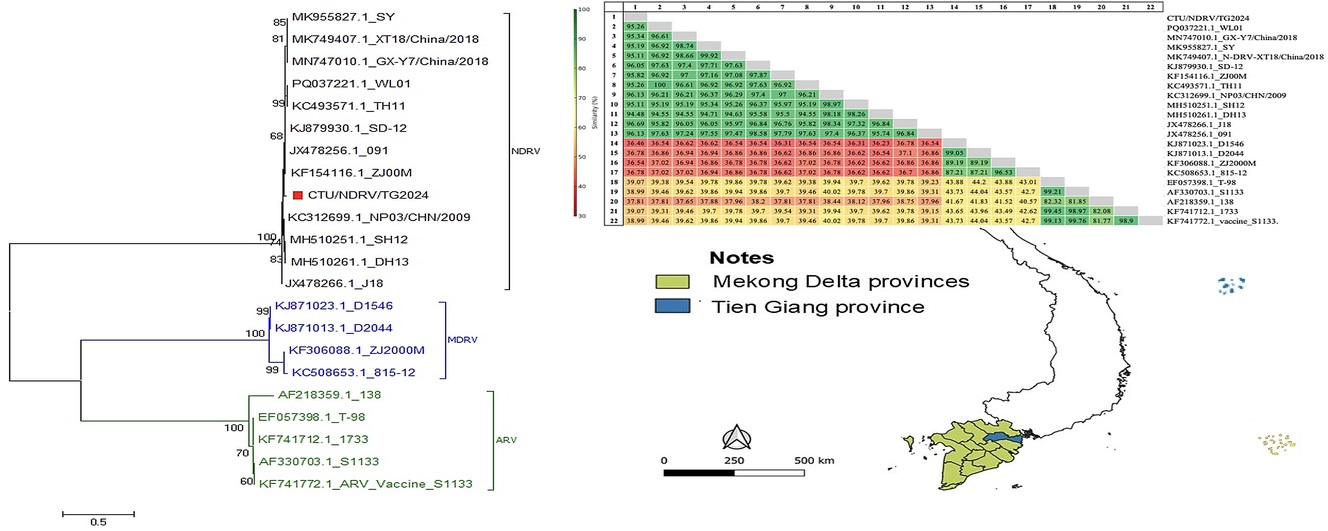
Duck reovirus (DRV), a member of the Orthoreovirus genus within the Reoviridae family, is associated with significant economic losses in the duck farming industry. This study aimed to detect the presence of DRV and genetically characterize the S1 gene segment of DRV strains identified on duck farms in Tien Giang Province, Vietnam. A total of 110 liver and spleen samples were collected from ducks exhibiting clinical signs suggestive of DRV infection. Reverse transcription-polymerase chain reaction was used to detect DRV. Positive samples were subjectied to phylogenetic and pairwise distance analyses based on the S1 gene sequence to determine genetic relatedness. The overall incidence of DRV infection was 14.54% (16/110), with a statistically significant association observed between infection rate and duck age (p < 0.05). Notably, ducks aged less than 4 weeks were 7.4 times more likely to be infected with DRV compared with those older than 6 weeks (95% confidence interval, 1.49–36.68; p = 0.01). Phylogenetic analysis revealed that the detected strain, designated CTU/NDRV/TG2024 (GenBank Accession No. PV034365), is closely related to novel DRV (NDRV) strains, sharing 94.48%–96.69% nucleotide identity. These findings confirm the circulation of an NDRV strain in Tien Giang Province, representing the first documented occurrence of DRV in the Mekong Delta region of Vietnam.
Article Details

This work is licensed under a Creative Commons Attribution 4.0 International License.
Publishing an article with open access in Veterinary Integrative Sciences leaves the copyright with the author. The article is published under the Creative Commons Attribution License 4.0 (CC-BY 4.0), which allows users to read, copy, distribute and make derivative works from the material, as long as the author of the original work is cited.
References
Alzohairy, A., 2011. BioEdit: an important software for molecular biology. GERF Bull. Biosci. 2, 60-61.
Benavente, J., Martínez-Costas, J., 2007. Avian reovirus: structure and biology. Virus Res. 123(2), 105-119.
Chen, S.Y., Chen, S.L., Lin, F.Q., Wang, S., Jiang, B., Cheng, X.X., Zhu, X.L., Li, Z.L., 2012. The isolation and identification of novel duck reovirus. Bing Du Xue Bao. 28(3), 224-230.
Chen, Z., Zhu, Y., Li, C., Liu, G., 2012. Outbreak-associated novel duck Reovirus, China, 2011. Emerg. Infect. Dis. 18(7), 1209–1211.
Du, X., Ding, M., Wu, Q., Li, C.H., Guo, H., Liu, G., Chen, Z., 2020. Characterization of a P18 protein in the S1 segment of the novel duck reovirus genome. Acta. Virol. 64(1), 59-66.
Fahey, J.E., Crawley, J.F., 1954. Studies on chronic respiratory disease of chickens II. isolation of a virus. Can. J. Comp. Med. Vet. Sci. 18, 13–21.
Gaudry, D., Charles, J.M., Tektoff, J., 1972. A new disease expressing itself by a viral pericarditis in Barbary ducks. Comptes rendus hebdomadaires des seances de l'Academie des sciences. C R Acad. Hebd. Seances. Acad. Sci. D. 274(21), 2916–2919.
Heggen-Peay, C.L., Qureshi, M.A., Edens, F.W., Sherry, B., Wakenell, P.S., O'Connell, P.H., Schat, K.A., 2002. Isolation of a reovirus from poult enteritis and mortality syndrome and its pathogenicity in turkey poults. Avian. Dis. 46(1), 32-47.
Islam, M.S., Sabuj, A.A.M., Haque, Z.F., Pondit, A., Hossain, M.G., Saha, S., 2020. Seroprevalence and risk factors of avian reovirus in backyard chickens in different areas of Mymensingh district in Bangladesh. J. Adv. Vet. Anim. Res. 7(3), 546-553.
Kumar, S., Stecher, G., Tamura, K., 2016. MEGA7: Molecular Evolutionary Genetics Analysis Version 7.0 for bigger datasets. Mol. Biol. Evol. 33(7), 1870-1874.
Khanh, N.P., Tan, S.W., Yeap, S.K., Satharasinghe, D.A., Hair-Bejo, M., Bich, T.N., Omar, A.R., 2017. Molecular characterization of QX-Like and variant infectious bronchitis virus strains in malaysia based on partial genomic sequences comprising the S-3a/3b-E-M-Intergenic Region-5a/5b-N gene order. Avian Dis. 61(4), 442-452.
Li, N., Hong, T., Wang, Y., Wang, Y., Yu, K., Cai, Y., Liu, S., Wei, L., Chai, T., 2016. The pathogenicity of novel duck reovirus in Cherry Valley ducks. Vet. Microbiol. 192, 181-185.
Li, Y., Yin, X., Chen, X., Li, X., Li, J., Liu, C., Liu, M., Zhang, Y., 2012. Antigenic analysis monoclonal antibodies against different epitopes of σB protein of Muscovy duck reovirus. Virus. Res. 163(2), 546-551.
Liu, Q., Zhang, G., Huang, Y., Ren, G., Chen, L., Gao, J., Zhang, D., Han, B., Su, W., Zhao, J., Hu, X., Su, J., 2011. Isolation and characterization of a reovirus causing spleen necrosis in Pekin ducklings. Vet. Microbiol. 148(2-4), 200-206.
Malkinson, M., Perk, K., Weisman, Y., 1981. Reovirus infection of young Muscovy ducks (Cairina moschata). Avian pathol. 10(4), 433-440.
Palomino-Tapia, V., Mitevski, D., Inglis, T., van der Meer, F., Abdul-Careem, M.F., 2018. Molecular characterization of emerging avian reovirus variants isolated from viral arthritis cases in Western Canada 2012–2017 based on partial sigma (σ) C gene. Virology. 522, 138-146.
Szumilas, M., 2010. Explaining odds ratios. J. Can. Acad. Child. Adolesc. Psychiatry. 19(3), 227-229.
Thompson, J.D., Higgins, D.G., Gibson, T.J., 1994. CLUSTAL W: improving the sensitivity of progressive multiple sequence alignment through sequence weighting, position-specific gap penalties and weight matrix choice. Nucleic. Acids. Res. 22(22), 4673-4680.
Wang, S., Lin, F., Cheng, X., Wang, J., Zhu, X., Xiao, S., Zheng, M., Huang, M., Chen, S., Chen, S., 2020. The genomic constellation of a novel duck reovirus strain associated with hemorrhagic necrotizing hepatitis and splenitis in Muscovy ducklings in Fujian, China. Mol. Cell. Probes. 53, 101604.
Woźniakowski, G., Samorek-Salamonowicz, E., Gaweł, A., 2014. Occurrence of reovirus infection in Muscovy ducks (Cairina moschata) in south western Poland. Pol. J. Vet. Sci. 17(2), 299-305.
Yun, T., Yu, B., Ni, Z., Ye, W., Chen, L., Hua, J., Zhang, C., 2013. Isolation and genomic characterization of a classical Muscovy duck reovirus isolated in Zhejiang, China. Infect. Genet. Evol. 20, 444-453.
Yun, T., Yu, B., Ni, Z., Ye, W., Chen, L., Hua, J., Zhang, C., 2014. Genomic characteristics of a novel reovirus from Muscovy duckling in China. Vet. Microbiol. 168(2-4), 261-271.
Zhang, X.L., Shao, J.W., Li, X.W., Mei, M.M., Guo, J.Y., Li, W.F., Huang, W.J., Chi, S.H., Yuan, S., Li, Z.L., Huang, S.J., 2019. Molecular characterization of two novel reoviruses isolated from Muscovy ducklings in Guangdong, China. BMC Vet. Res. 15(1), 143.
Zheng, X., Wang, D., Ning, K., Liang, T., Wang, M., Jiang, M., Zhang, D., 2016. A duck reovirus variant with a unique deletion in the sigma C gene exhibiting high pathogenicity in Pekin ducklings. Virus. Res. 215, 37-41.
