First molecular identification of Anaplasma marginale in Horses from Kelantan, Malaysia https://doi.org/10.12982/VIS.2026.032
Article Sidebar
Main Article Content
Abstract
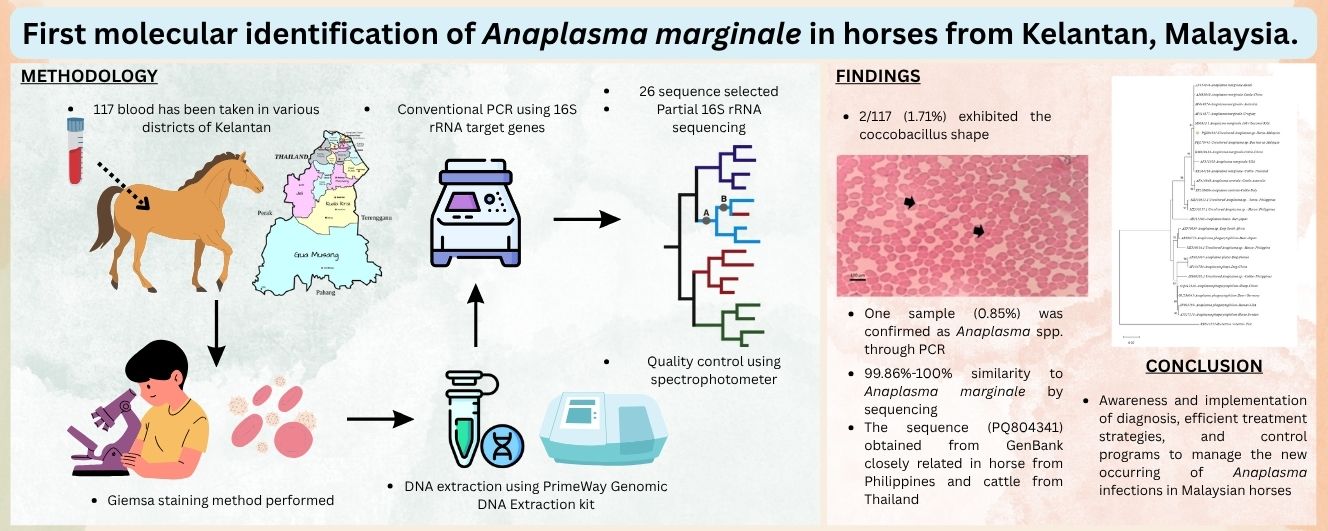
This study aimed to detect the presence of Anaplasma spp. in blood samples from equine stables in Kelantan, Malaysia. Blood samples were collected from 117 horses from different equine stables from Kelantan. Microscopic examination was conducted using the Giemsa staining method followed by conventional polymerase chain reaction (PCR) to confirm the Anaplasma spp. Out of 117 samples, two (1.71%) exhibited the coccobacillus shape characteristic of Anaplasma spp. under microscopic examination, while one sample (0.85%) was confirmed as Anaplasma spp. through PCR analysis. The confirmed sample was then sent for 16S rRNA gene sequencing, which revealed 99.86%–100% similarity to Anaplasma marginale. The sequence was submitted to GenBank under the accession number PQ804341. Phylogenetic analysis showed that PQ804341 was closely related to Anaplasma marginale strains detected in horses from the Philippines and cattle from Thailand. These findings confirm the presence of Anaplasma marginale in horses in Kelantan region even in the absence of clinical signs for anaplasmosis in horses. Appropriate molecular diagnostic and screening is crucial to prompt implementation of prevention and control measures. The close relationship among Anaplasma marginale and other zoonotic Anaplasma should raise concern for further study on potential risk to humans, transmission rate which closely related among infected host and tick
Article Details

This work is licensed under a Creative Commons Attribution 4.0 International License.
Publishing an article with open access in Veterinary Integrative Sciences leaves the copyright with the author. The article is published under the Creative Commons Attribution License 4.0 (CC-BY 4.0), which allows users to read, copy, distribute and make derivative works from the material, as long as the author of the original work is cited.
References
Bakken, J.S., Dumler, J.S., 2015. Human granulocytic anaplasmosis. Infect. Dis. Clin. N. Am. 29(2), 341–355.
Bartoš, O., Chmel, M., Swierczková, I., 2024. The overlooked evolutionary dynamics of 16S rRNA revises its role as the “gold standard” for bacterial species identification. Sci. Rep., 14(1), 9067.
Bogdan, A.M., Mitrea, I.L., Ionita, M., 2024. Equine granulocytic anaplasmosis: a systematic review and meta-analysis on clinico-pathological findings, diagnosis, and therapeutic management. Vet. Sci., 11(6), 269.
Chankong, T., Srita, D., Tongsangiam, P., Meesuwan, S., Klinpakdee, K., 2021. The study of prevalence and factors affecting Anaplasma maginale infection in domestic goats in Chonburi province, Thailand. Vet. Integr. Sci. 20(1), 85–93.
Da Silva, N.B., Taus, N.S., Johnson, W.C., Mira, A., Schnittger, L., Valente, J.D.M., Vidotto, O., Masterson, H.E., Vieira, T.S.W.J., Ueti, M.W., Vieira, R.F.C., 2018. First report of Anaplasma marginale infection in goats, Brazil. PLoS One. 13(8), e0202140.
Darmansah, N.F., Misnan, M.S., Sam, A.R.M., Omar, A.H., 2017. Contribution of equine education to the equine industry development in Malaysia. Adv. Sci. Lett. 23(4), 2818–2820.
Faber, J., Fonseca, L.M., 2014. How sample size influences research outcomes. Dental. Press. J. Orthod. 19(4), 27–29.
Hairgrove, T., Schroeder, M.E., Budke, C.M., Rodgers, S., Chung, C., Ueti, M.W., Bounpheng, M.A., 2015. Molecular and serological in-herd prevalence of Anaplasma marginale infection in Texas cattle. Prev. Vet. Med. 119(1–2), 1–9.
Han, T.Z., Han, K.T., Aye, K.H., Hlaing, T., Thant, K.Z., Vythilingam, I., 2017. Comparison of microscopy and PCR for the detection of human Plasmodium species and Plasmodium knowlesi in southern Myanmar. Asian Pac. J. Trop. Biomed. 7(8), 680–685.
Hanis, F., Chung, E.L.T., Kamalludin, M.H., Idrus, Z., 2020. The Influence of stable management and feeding practices on the abnormal behaviors among stabled horses in Malaysia. J. Equine. Vet. Sci. 94, 103230.
Hussain, M., Saeed, Z., Gulsher, M., Shaikh, R.S., Ali, M., Ahmad, A.N., Hussain, I., Akhtar, M., Iqbal, F., 2016. A report on the molecular detection and seasonal prevalence of Trypanosoma brucei in Dromedary Camels from Dera Ghazi Khan District in Southern Punjab (Pakistan). Trop. Biomed. 33(2), 268–275.
Janda, J.M., Abbott, S.L., 2007. 16S rRNA gene sequencing for bacterial identification in the diagnostic laboratory: Pluses, perils, and pitfalls. J. Clin. Microbiol. 45(9), 2761–2764.
Lucena-Aguilar, G., Sánchez-López, A.M., Barberán-Aceituno, C., Carrillo-Ávila, J.A., López-Guerrero, J.A., Aguilar-Quesada, R., 2016. DNA source selection for downstream applications based on DNA quality indicators analysis. Biopreserv. Biobank. 14(4), 264–270.
M’ghirbi, Y., Yaïch, H., Ghorbel, A., Bouattour, A., 2012. Anaplasma phagocytophilum in horses and ticks in Tunisia. Parasit Vectors. 5(1), 180.
Ola-Fadunsin, S.D., Gimba, F.I., Abdullah, D.A., Sharma, R.S.K., Abdullah, F.J.F., Sani, R.A., 2018. Epidemiology and risk factors associated with Anaplasma marginale infection of cattle in Peninsular Malaysia. Parasitol. Int. 67(6), 659–665.
Pusterla, N., Madigan, J.E., 2013. Equine granulocytic anaplasmosis. J. Equine. Vet. Sci. 33(7), 493–496.
Qi, Y., Ai, L., Zhu, C., Lu, Y., Lv, R., Mao, Y., Lu, N., Tan, W., 2022. Co-existence of multiple Anaplasma species and variants in ticks feeding on hedgehogs or cattle poses potential threats of anaplasmosis to humans and livestock in Eastern China. Front. Microbiol. 13, 913650.
Rahman, M., Faruque, Md. R., Rahman, Md. M., Chowdhury, M.Y.E., 2022. Epidemiology and molecular detection of Anaplasma spp. In goats from Chattogram district, Bangladesh. Vet. Med. Sci. 8(3), 1240–1249.
Tamura, K., Nei, M., Kumar, S., 2004. Prospects for inferring very large phylogenies by using the neighbor-joining method. Proc. Natl. Acad. Sci. U. S. A. 101(30), 11030–11035.
Tamura, K., Stecher, G., Kumar, S., 2021. MEGA11: Molecular evolutionary genetics analysis version 11. Mol. Biol. Evol. 38(7), 3022–3027.
Tan Li, P., 2024. First report of Anaplasma marginale and Anaplasma ovis in goats in Kelantan, Malaysia. Trop. Biomed. 41(S), 404–411.
Woldehiwet, Z., 2008. Immune evasion and immunosuppression by Anaplasma phagocytophilum, the causative agent of tick-borne fever of ruminants and human granulocytic anaplasmosis. Vet. J. 175(1), 37–44.
Zobba, R., Anfossi, A.G., Pinna Parpaglia, M.L., Dore, G.M., Chessa, B., Spezzigu, A., Rocca, S., Visco, S., Pittau, M., Alberti, A., 2014. Molecular investigation and phylogeny of Anaplasma spp. in mediterranean ruminants reveal the presence of neutrophil-tropic strains closely related to A. platys. Appl. Environ. Mircobiol. 80(1), 271–280.
