Effects of glutamine supplementation on performance, carcass traits, and oxidative stress markers in native crossbred chickens under heat stress conditions https://doi.org/10.12982/VIS.2026.027
Article Sidebar
Main Article Content
Abstract
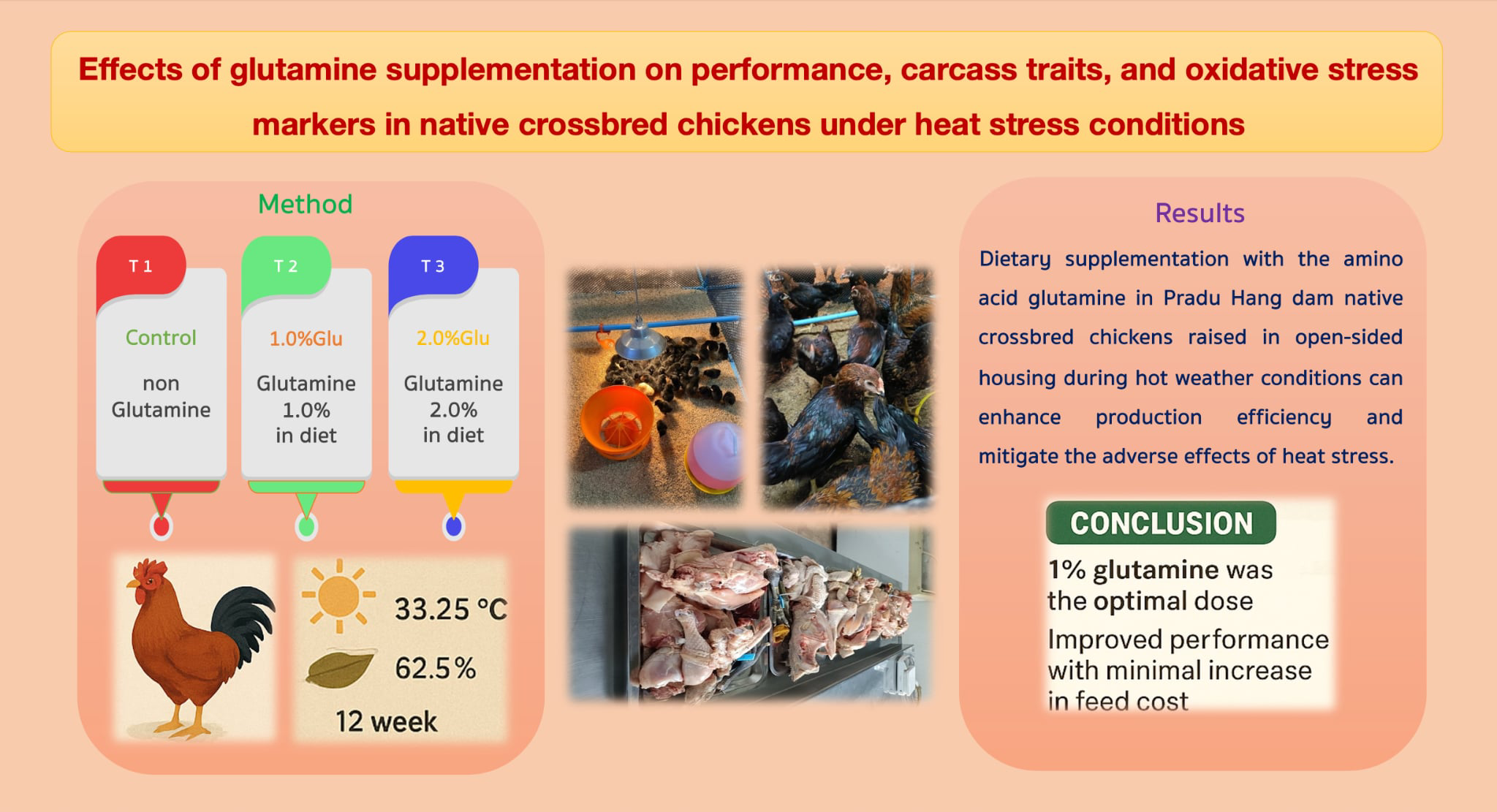
Glutamine is a conditionally essential amino acid known to support energy metabolism, immune function, and antioxidant capacity in poultry. This study aimed to evaluate the effects of dietary glutamine supplementation on growth performance, carcass characteristics, meat quality, and oxidative stress indicators in Pradu Hang dam native crossbred chickens raised in open-sided housing during hot weather conditions. A total of 750 day-old male chicks were allocated to three dietary treatments: control (0% glutamine), 1% glutamine, and 2% glutamine, in a completely randomized design with five replicates per treatment (50 birds/replicate). The trial lasted 12 weeks, from May to July 2024, during which ambient temperature averaged 33.25 °C with relative humidity at 62.5%. Results showed that glutamine supplementation significantly improved final body weight (P = 0.002), average daily gain (P < 0.001), and feed conversion ratio (P = 0.021). Mortality rates decreased in a dose-dependent manner (P < 0.001). Carcass traits such as wing, breast, and drumstick weights were significantly increased (P < 0.05), while meat protein content was higher in the supplemented groups (P < 0.05). Glutamine reduced malondialdehyde (MDA) levels (P < 0.05) and increased glutathione (GSH) and glutathione peroxidase (GPx) activity (P < 0.05), indicating reduced oxidative stress. No significant differences were observed in cortisol levels. The 1% glutamine level was identified as the optimal dose, offering improved performance with minimal increase in feed cost.
Article Details

This work is licensed under a Creative Commons Attribution 4.0 International License.
Publishing an article with open access in Veterinary Integrative Sciences leaves the copyright with the author. The article is published under the Creative Commons Attribution License 4.0 (CC-BY 4.0), which allows users to read, copy, distribute and make derivative works from the material, as long as the author of the original work is cited.
References
Abdulkarimi, R., Shahir, M.H., Daneshyar, M., 2019. Effects of dietary glutamine and arginine supplementation on performance, intestinal morphology and ascites mortality in broiler chickens reared under cold environment. Asian-Australas J. Anim. Sci. 32(1),110-117.
AOAC, 2000. Official methods of analysis, 17th edition. Association of Official Analytical Chemists, Maryland.
Chalvon-Demersay, T., Luise, D., Le Floc’h, N., Tesseraud, S., Lambert, W., Bosi, P., Beaumont, M., Corrent, E., 2021. Functional amino acid in pig and chickens: implication for gut health. Front. Vet. Sci. 8, 663727.
Dai, S.F., Wang, L.K., Wen, A.Y., Wang, L.X., Jin, G.M., 2009. Dietary glutamine supplementation improves growth performance, meat quality and colour stability of broilers under heat stress. Br. Poult. Sci. 50(3), 333-340.
Kim, D.Y., Kim, J.H., Choi, W.J., Han, G.P., Kil, D.Y., 2021. Comparative effects of dietary functional nutrients on growth performance, met quality, immune response, and oxidative stress biomarkers in broiler chickens raised under heat stress conditions. Anim. Biosci. 34(11), 1839-1848.
Li, P., Yin Y.L., Li, D., Kim, S.W., Wu, G., 2007. Amino acids and immune function. Br. J. Nutr. 98(2), 237-252.
Lin, H., Jiao, H.C., Buyse, J., Decuypere, E., 2006. Strategies for preventing heat stress in poultry. Worlds. Poult. Sci. J. 62(1), 71–85.
Maiorka, A., Silva, A.V.F., Santin, S., Borges, I., Boleli, Macari, M., 2000. Influence of glutamine supplementation on performance and intestinal villous and crypt development in broiler chickens. Arqu. Brasil. Med. Vet. Zootec. 52, 487-490.
Ncho, C.M., Gupta, V., Choi, Y.H., 2023. Effects of dietary glutamine supplementation on heat-induced oxidative stress in broiler chickens: a systematic review and meta-analysis. Antioxidants, 12, 570.
Newsholme, P., 2001. Why is L-glutamine metabolism important to cells of the immune system in health, post-injury, surgery, or infection?. J. Nutr. 131(9 Suppl), 2515S–2522S.
NRC, 1994. Nutrient requirements of poultry, 9th revised edition. National Academy Press, Washington.
Patcharee, K., Wanaporn, T., Chompunut, L., Tossapol, M., Wipasiri, C., Suwit, C., Mongkol, Y., Montri, P., 2023. Effect of fiber source diet supplement on growth performance, carcass quality, oxidative stress and intestinal morphology in Thai native chicken (Pradu Hang dum). Vet. Integr. Sci. 21(2), 365-381.
Sahin, N., Sahin, K., Küçük, O., 2001. Effects of vitamin E and vitamin A supplementation on performance, thyroid status and serum concentrations of some metabolites and minerals in broilers reared under heat stress (32 degrees C). Vet. Med-Czech. 46(11), 286-292.
Shakeri, M., Le, H.H., 2022. Deleterious effects of heat stress on poultry production: Unveiling the benefits of betaine and polyphenols. Poultry. 1(3), 147-156.
Wu, G., 2010. Functional amino acids in growth, reproduction, and health. Adv. Nutr. 1(1), 31–37.
Wu, G., Knabe, D.A., 1994. Free and protein-bound amino acids in sow’s colostrum and milk. J. Nutr. 125(2), 415–424.
Yi, G.F., Allee, G.L., Knight, C.D., Dibner, J.J., 2005. Impact of glutamine and oasis hatchling supplement on growth performance, small intestinal morphology, and immune response of broilers vaccinated and challenged with Eimeria maxima. Poult. Sci. 84(2), 283–293.
