Meat quality, muscle fiber traits, fatty acid profiles, and sensory evaluation of Wagyu crossbred with Kamphaengsaen, Brahman, and Thai Holstein Friesian cattle https://doi.org/10.12982/VIS.2026.030
Article Sidebar
Main Article Content
Abstract
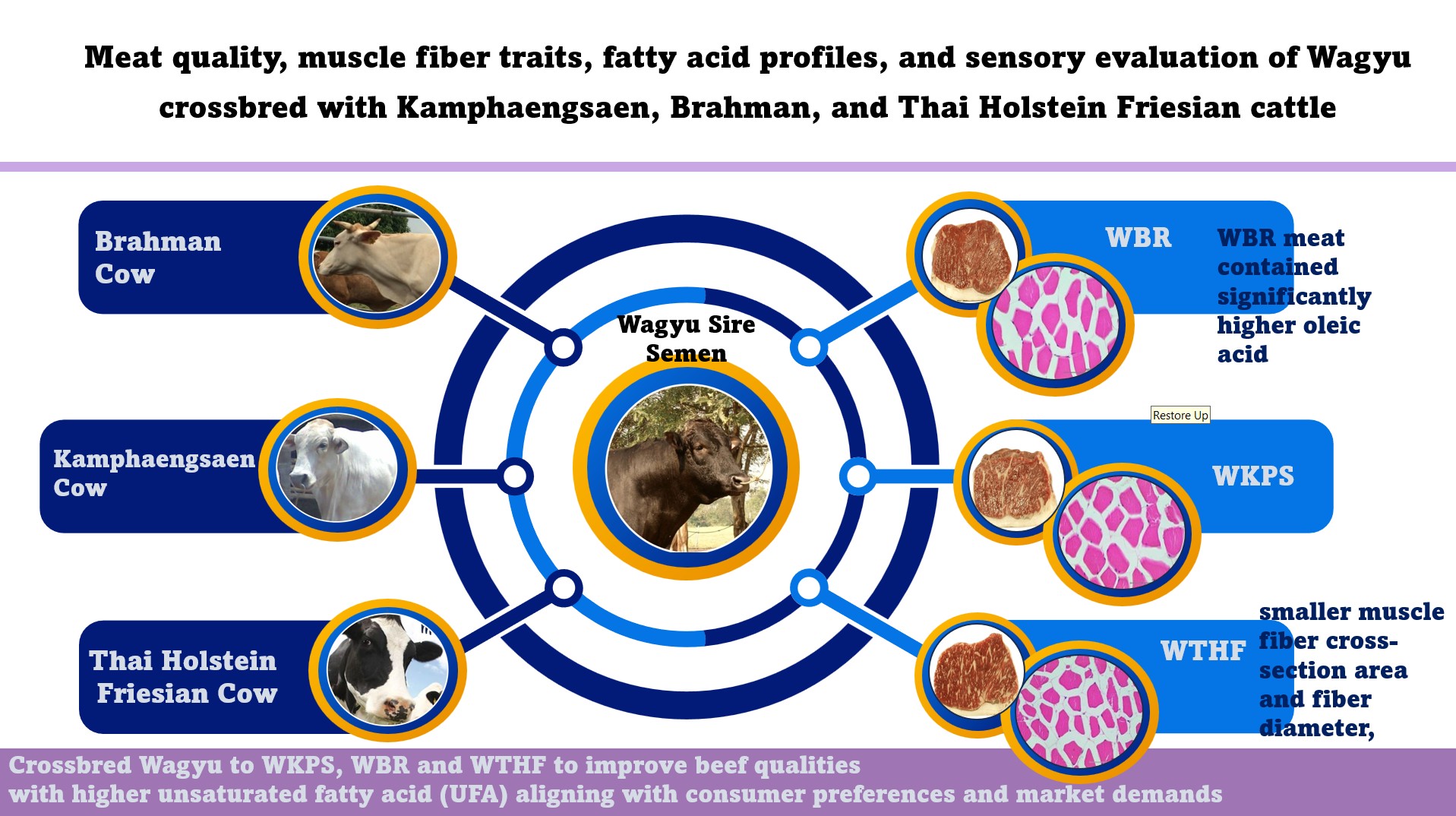
This study aimed to evaluate the effects of crossbreeding Wagyu cattle with Kamphaengsaen (WKPS), Brahman (WBR), and Thai Holstein Friesian (WTHF) on growth performance, meat quality, sensory attributes, and fatty acid composition. Three groups of F1 crossbred cattle were produced by artificial insemination with Wagyu semen. The animals were reared under standardized feeding and management conditions for 11 months. Growth performance, carcass traits, pH, color, water-holding capacity (WHC), shear force, and sensory attributes were evaluated. The fatty acid profile of longissimus dorsi (LD) muscle and muscle fiber characteristics were assessed and histological analysis. Results shown, WTHF demonstrated higher average daily gain (ADG) and lower feed conversion ratio (FCR) compared to WKPS and WBR (p<0.05) while WBR exhibited the highest carcass yield percentage. WTHF showed significantly lower shear force values (p<0.001) and smaller muscle fiber cross-section area and fiber diameter, conversely the highest number of muscle fiber density (p<0.001) outperformed other groups. In terms of sensory attributes, including tenderness, juiciness, taste and overall acceptability (p<0.001). WTHF exhibited higher saturated fatty acid (SFA) levels (p<0.05), while WBR meat contained significantly higher oleic acid. All Wagyu crossbreeds exhibited higher monounsaturated fatty acid (MUFA) than saturated fatty acid (SFA) content. Crossbreeding Wagyu semen with local Thai cattle breeds significantly improved growth performance and meat quality, with distinct benefits across groups. WTHF excelled in tenderness and sensory attributes, while WBR demonstrated a favorable fatty acid profile. Wagyu crossbred with higher unsaturated fatty acid (UFA) content compared to saturated fatty acids (SFA), aligning with consumer preferences and market demands. These findings underscore the effectiveness of Wagyu crossbreeding in improving beef quality and meeting diverse consumer needs in tropical regions.
Article Details

This work is licensed under a Creative Commons Attribution 4.0 International License.
Publishing an article with open access in Veterinary Integrative Sciences leaves the copyright with the author. The article is published under the Creative Commons Attribution License 4.0 (CC-BY 4.0), which allows users to read, copy, distribute and make derivative works from the material, as long as the author of the original work is cited.
References
AMSA, 2015. Research guidelines for cookery, sensory evaluation, and instrumental tenderness measurements of meat, 2nd edition. American Meat Science Association, Champaign, Illinois USA.
AOAC, 2006. Official methods of analysis, 18th edition. AOAC International, Gaithersburgs.
Boccard, R., Buchter, L., Casteels, E., Cosentino, E., Dransfield, E., Hood, D.E., Joseph, R.L., MacDougall, D.B., Rhodes, D.N., Schön, I., Tinbergen, B.J., Touraille, C., 1981. Procedures for measuring meat quality characteristics in beef production experiments. Report of a working group in the commission of the European communities’ (CEC) beef production research programme. Livest. Prod. Sci. 8(5), 385–397.
Bunmee, T., Chaiwang, N., Kaewkot, C., Jaturasitha, S., 2018. Current situation and future prospects for beef production in Thailand-A review. Asian-Australas J. Anim. Sci. 31(7), 968–975.
Burrow, H.M., Moore, S.S., Johnston, D.J., Barendse, W., Bindon, B.M., 2001. Quantitative and molecular genetic influences on properties of beef: a review. Aust. J. Exp. Agric. 41(7), 893–919.
Casas, E., Thallman, R.M., Kuehn, L.A., Cundiff, L.V., 2010. Postweaning growth and carcass traits in crossbred cattle from Hereford, Angus, Brangus, Beefmaster, Bonsmara, and Romosinuano maternal grandsires. J. Anim. Sci. 88(1), 102–108.
Choe, J.H., Choi, Y.M., Lee, S.H., Shin, H.G., Ryu, Y.C., Hong, K.C., Kim, B.C., 2008. The relation between glycogen, lactate content and muscle fiber type composition, and their influence on postmortem glycolytic rate and pork quality. Meat. Sci. 80(2), 355-362.
Chriki, S., Renand, G., Picard, B., Micol, D., Journaux, L., Hocquette, J.F., 2013. Meta-analysis of the relationships between beef tenderness and muscle characteristics. Livest. Sci. 155(2), 424-434.
Coyne, J.M., Evans, R.D., Berry, D.P., 2019. Dressing percentage and the differential between live weight and carcass weight in cattle are influenced by both genetic and non-genetic factors. J. Anim. Sci. 97(4), 1501–1512.
Domingo, G., Iglesias, A., Monserrat, L., Sanchez, L., Cantalapiedra, J., Lorenzo, J.M., 2015. Effect of crossbreeding with Limousine, Rubia Gallega and Belgium Blue on meat quality and fatty acid profile of Holstein calves. Anim. Sci. J. 86(11), 913-921.
Du, M., Ford, S.P., Zhu, M.J., 2017. Optimizing livestock production efficiency through maternal nutritional management and fetal developmental programming. Anim. Front. 7(3), 5-11.
Folch, J., Lees, M., Stanley, G.H., 1957. A simple method for the isolation and purification of total lipids from animal tissues. J. Biol. Chem. 226(1), 497–509.
Gotoh, T., Nishimura, T., Kuchida, K., Mannen, H., 2018. The Japanese Wagyu beef industry: current situation and future prospects-A review. Asian-Australas J. Anim. Sci. 31(3), 933–950.
Gotoh, T., Takahashi, H., Nishimura, T., Kuchida, K., Mannen, H., 2014. Meat produced by Japanese Black cattle and Wagyu. Anim. Front. 4(4), 46–54.
Gotoh, T., 2003. Histochemical properties of skeletal muscles in Japanese cattle and their meat production ability. Anim. Sci. J. 74(3), 339–354.
Herdmann, A., Martin, J.O., Nuernberg, G., Dannenberger, D., Nuernberg, K., 2010. Effect of dietary n-3 and n-6 pufa on lipid composition of different tissues of german holstein bulls and the fate of bioactive fatty acids during processing. J. Agric. Food. Chem. 58(14), 8314–8321.
Honikel, K.O., 1998. Reference methods for the assessment of physical characteristics of meat. Meat Sci. 49(4), 447–457.
Huffman, K.L., Miller, M.F., Hoover, L.C., Wu, C.K., Brittin, H.C., Ramsey, C.B., 1996. Effect of beef tenderness on consumer satisfaction with steaks consumed in the home and restaurant. J. Anim. Sci. 74(1), 91-97.
Joo, S.T., Kim, G.D., Hwang, Y.H., Ryu, Y.C., 2013. Control of fresh meat quality through manipulation of muscle fiber characteristics. Meat Sci. 95(4), 828–836.
Kotupan, S., Sommart, K., 2020. Broken rice in a fermented total mixed ration improves carcass and marbling quality in fattened beef cattle. Anim Biosci. 34(8), 1331–1341.
Leal, J., Elzo, M., Johnson, D., Scheffler, T., Scheffler, J., Mateescu, R., 2018. Association of μ-Calpain and calpastatin polymorphisms with meat tenderness in a brahman–angus population. Front. Genet. 9.
Lee, D., Lee, H.J., Yoon, J.W., Ryu, M., Jo, C., 2021. Effects of cooking conditions on the physicochemical and sensory characteristics of dry- and wet-aged beef. Anim. Biosci. 34(10), 1705–1716.
Milićević, D., Vranić, D., Mašić, Z., Parunović, N., Trbović, D., Nedeljković-Trailović, J., Petrović, Z., 2014. The role of total fats, saturated/unsaturated fatty acids and cholesterol content in chicken meat as cardiovascular risk factors. Lipids. Health. Dis. 13(42), 1–12.
Mir, Z., Paterson, L., Mir, P., 2000. Fatty acid composition and conjugated linoleic acid content of intramuscular fat in crossbred cattle with and without Wagyu genetics fed a barley-based diet. Can. J. Anim. Sci. 80(1), 195-197.
Morrison, W.R., Smith, L., 1964. Preparation of fatty acid methyl esters and dimethylacetals from lipids with boron fluoride–methanol. J. Lipid. Res. 5(4), 600–608.
Nogi, T., Honda, T., Mukai, F., Okagaki, T., Oyama, K., 2011. Heritabilities and genetic correlations of fatty acid compositions in longissimus muscle lipid with carcass traits in Japanese Black cattle. J. Anim. Sci. 89(3), 615–621.
NRC, 2015. Nutrient requirements of beef cattle, 8th revised edition. National Academies Press, Washington D.C.
Oka, A., Iwaki, F., Dohgo, T., Ohtagaki, S., Noda, M., Shiozaki, T., Endoh, O., Ozaki, M., 2002. Genetic effects on fatty acid composition of carcass fat of Japanese Black Wagyu steers. J. Anim. Sci. 80(4), 1005–1011.
Papaleo Mazzucco, J., Goszczynski, D.E., Ripoli, M.V., Melucci, L.M., Pardo, A.M., Colatto, E., Rogberg-Muñoz, A., Mezzadra, C.A., Depetris, G.J., Giovambattista, G., Villarreal, E.L., 2016. Growth, carcass and meat quality traits in beef from Angus, Hereford and cross-breed grazing steers, and their association with SNPs in genes related to fat deposition metabolism. Meat. Sci. 114, 121–129.
Park, B.K., Lee, D.K., Ahn, J.S., Park, J.K., Kim, M.J., Son, G.H., Shin, J.S., 2019. Effects of dietary levels of tapioca residue on growth performance and carcass characteristics in Hanwoo steers. Asian-Australas J. Anim. Sci. 32(8), 1128–1136.
Pette, D., Staront, R.S., 1997. Mammalian skeletal muscle fiber type transitions. Int. Rev. Cytol. 170, 143–223.
Picard, B., Lefaucheur, L., Berri, C., Duclos, M.J., 2002. Muscle fibre ontogenesis in farm animal species. Reprod. Nutr. Dev. 42, 415–431.
Schmid, A.R., Goodrich, R.D., Jordan, R.M., Marten, G.C., Meiske, J.C., 1976. Relationships among agronomic characteristics of corn and sorghum cultivars and silage quality. Agron. J. 68, 403–406.
Silva, D.R.G., de Moura, A.P.R., Ramos, A.L.S., Ramos, E.M., 2017. Comparison of Warner-Bratzler shear force values between round and square cross-section cores for assessment of beef Longissimus tenderness. Meat. Sci. 125, 102–105.
Sniffen, C.J., O’Connor, J.D., Van Soest, P.J., Fox, D.G., Russell, J.B., 1992. A net carbohydrate and protein system for evaluating cattle diets: II. Carbohydrate and protein availability. J. Anim. Sci. 70, 3562–3577.
Thirawong, P., Oluodo, L.A., Hnokaew, P., Buaphan, S., Yammuen-Art, S., 2024. Growth performance, carcass traits, and meat quality of Wagyu crossbred with Kamphaengsaen, Brahman, and Thai Holstein Friesian cattle. Vet. Integr. Sci. 23(1), 1-11.
Van Soest, P.J., Robertson, J.B., Lewis, B.A., 1991. Methods for dietary fiber, neutral detergent fiber, and nonstarch polysaccharides in relation to animal nutrition. J. Dairy. Sci. 74(10), 3583–3597.
Waritthitham, A., Lambertz, C., Langholz, H.J., Wicke, M., Gauly, M., 2010. Assessment of beef production from Brahman × Thai native and Charolais × Thai native crossbred bulls slaughtered at different weights. II: Meat quality. Meat. Sci. 85(1), 196–200.
Whipple, G., Koohmaraie, M., Dikeman, M.E., Crouse, J.D., Hunt, M.C., Klemm, R.D., 1990. Evaluation of attributes that affect longissimus muscle tenderness in Bos taurus and Bos indicus cattle. J. Anim. Sci. 68(9), 2716-2728.
Wolfová, M., Wolf, J., Kvapilík, J., Kica, J., 2007. Selection for profit in Cattle: II. economic weights for dairy and beef sires in crossbreeding systems. J. Dairy. Sci. 90, 2456–2467.
Wulf, D.M., Wise, J.W., 1999. Measuring muscle color on beef carcasses using the L*a*b* color space. J. Anim. Sci. 77, 2418–2427.
Zheng, Y., Wang, S., Yan, P., 2018. The meat quality, muscle fiber characteristics and fatty acid profile in Jinjiang and F1 Simmental×Jinjiang yellow cattle. Asian-Australas J. Anim. Sci. 31, 301–308.
