The plight of dugongs in Thailand: A race against extinction https://doi.org/10.12982/VIS.2026.054
Article Sidebar
Main Article Content
Abstract
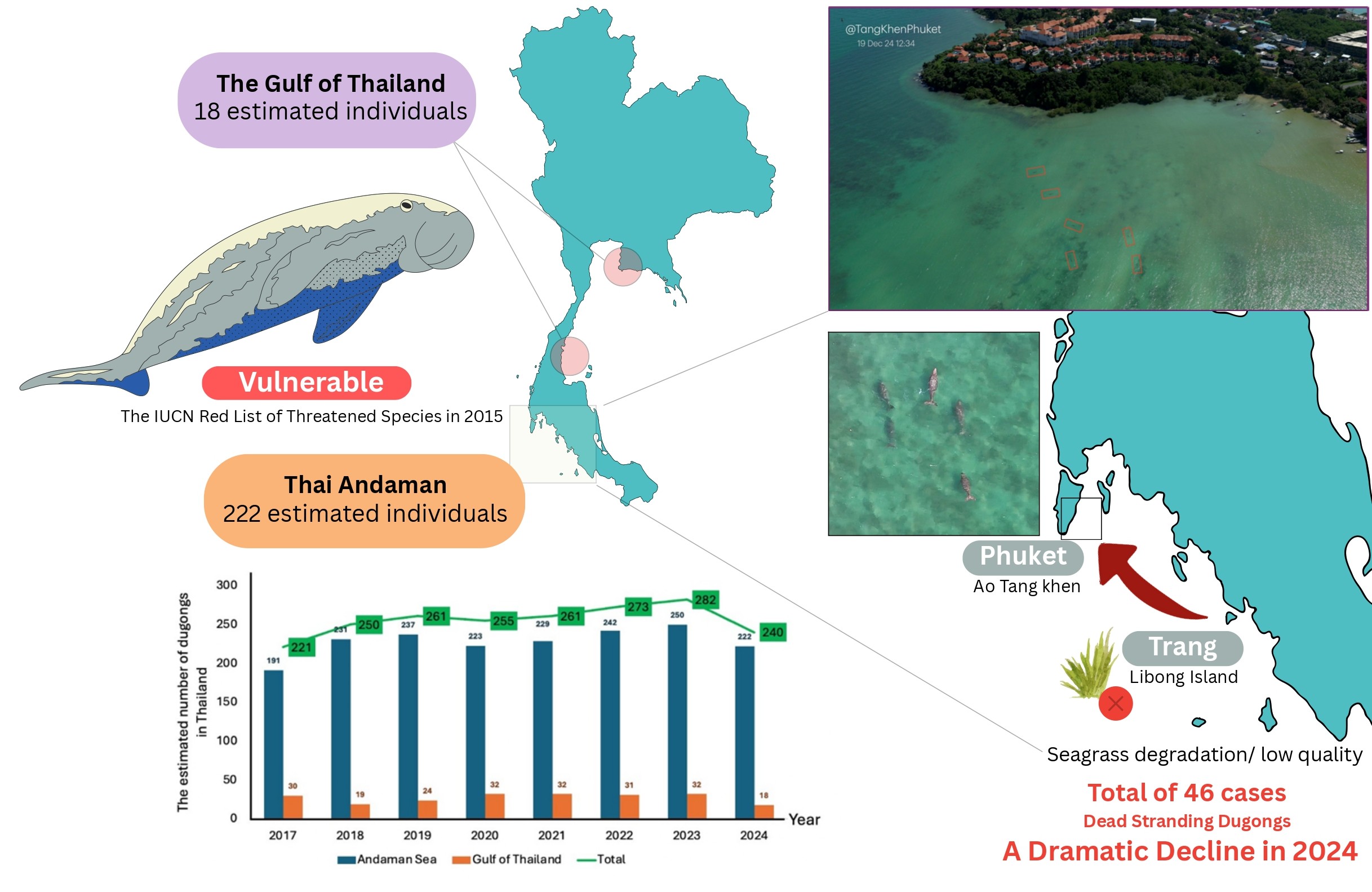
The dugong (Dugong dugon), a herbivorous marine mammal, is experiencing significant population declines in Thai waters, primarily due to habitat degradation, bycatch, and environmental changes. Here, this review aims to synthesize current knowledge on the population status, threats, and conservation efforts of dugongs in Thailand and management priorities. By summarizing recent findings from genetic, ecological, and community-based studies, this article provides an updated perspective to guide future conservation planning. Historically abundant, particularly in the Andaman Sea and the Gulf of Thailand, dugong numbers have decreased dramatically over the past few decades. Surveys from 2004 estimated approximately 250 individuals in Thailand, with the majority concentrated in Trang Province. However, by 2024, the total population was estimated at 240 individuals, with a notable shift in distribution driven by habitat loss. The total number of dugongs strandings has exhibited a concerning upward trend, increasing from 19 individuals in 2022 to 40 in 2023, and more than doubling to 46 in 2024. This sharp rise underscores the deteriorating status of the species, which is particularly vulnerable due to its low reproductive rate and limited capacity for recovery. A sharp decline in the Gulf of Thailand reduced its population to merely 18 dugongs. Despite showing temporary increases, the Andaman Sea population is threatened by seagrass degradation and mortality events. Migration patterns observed in late 2024 suggest dugongs are moving from Trang to regions like Phuket in search of viable habitats. Conservation efforts, including community-driven initiatives and establishing marine protected areas, have shown promise in mitigating threats. However, the sustainability of dugong populations in Thailand remains precarious, necessitating urgent and coordinated action to address habitat protection, reduce anthropogenic pressures, and foster long-term ecological resilience.
Article Details

This work is licensed under a Creative Commons Attribution 4.0 International License.
Publishing an article with open access in Veterinary Integrative Sciences leaves the copyright with the author. The article is published under the Creative Commons Attribution License 4.0 (CC-BY 4.0), which allows users to read, copy, distribute and make derivative works from the material, as long as the author of the original work is cited.
References
Department of Marine and Coastal Resources, 2018. The status of Thai marine endangered animals. Department of Marine and Coastal Resources (DMCR), Ministry of Natural Resources and Environment, Thailand. Available online: https://km.dmcr.go.th/c_10/d_935
Department of Marine and Coastal Resources, 2019a. The causes of dugong strandings in 2019. Department of Marine and Coastal Resources (DMCR), Ministry of Natural Resources and Environment, Thailand. Available online: https://km.dmcr.go.th/c_10/d_957
Department of Marine and Coastal Resources, 2019b. The marine endangered species stranding in Thailand. Department of Marine and Coastal Resources (DMCR), Ministry of Natural Resources and Environment, Thailand. Available online: https://newweb.dmcr.go.th/detailAll/24441/nws/
Department of Marine and Coastal Resources, 2023. Status Assessment and Conservation Manual for Marine Mammals in Thailand. Department of Marine and Coastal Resources (DMCR), Ministry of Natural Resources and Environment, Thailand. Available online: https://qrcode.dmcr.go.th/qrcode/detail/55/6.
Central Database System and Data Standard for Marine and Coastal Resources, 2020a. Dugong Jamil: Status of strandings and causes of death. Department of Marine and Coastal Resources (DMCR), Ministry of Natural Resources and Environment, Thailand. Available online: https://km.dmcr.go.th/c_264/d_19208
Central Database System and Data Standard for Marine and Coastal Resources, 2020b. Dugong Marium. Department of Marine and Coastal Resources (DMCR), Ministry of Natural Resources and Environment, Thailand. Available online: https://km.dmcr.go.th/c_264.
Manager Online, 2024. Dugongs move into Phuket: Over 30 individuals at risk from multiple threats. Available online: https://mgronline.com/south/detail/967000 0113954#google_vignette.
BBC Thai, 2024. Investigating the dugong crisis: "Now there may be only just over 100 left, or fewer. Available online: https://www.bbc.com/thai/articles/c89 v28xj2w7o.
Marine and Coastal Resources Survey Information and Technology Division, 2024. Marine Mammal Survey and Assessment Techniques. Department of Marine and Coastal Resources (DMCR), Ministry of Natural Resources and Environment, Thailand. Available online: https://qrcode.dmcr.go.th/qrcode/ detail/55/6.
Adulyanukosol, K., 1996. Breathing behavior of dugong (Dugong dugon) in captivity. In: Proceedings of the Seminar of the Department of Fisheries 1996, Bangkok, Thailand, pp. 832–834.
Adulyanukosol, K., 1999. Dugong, dolphin and whale in Thai waters. In: Proceedings of the First Korea–Thailand Joint Workshop on Comparison of Coastal Environment: Korea–Thailand, Seoul, Korea, pp. 5–15.
Adulyanukosol, K., 2002. Report of dugong and seagrass survey in Vietnam and Cambodia, Vietnam.
Adulyanukosol, K., 2004. Dugong and conservation of dugong in Thailand. Phuket Marine Biological Center, Phuket.
Adulyanukosol, K., Chantrapornsyl, S., Poovachiranon, S., 1997. Aerial survey of Dugong (Dugong dugon) in Andaman Coast, Thailand.
Adulyanukosol, K., Hines, E., Boonyanate, P., 2010. Cultural significance of dugong to Thai villagers: implications for conservation. In: Proceedings of the 5th International Symposium on SEASTAR2000 and Asian Bio-logging Science (The 9th SEASTAR2000 Workshop), Graduate School of Informatics, Kyoto University, Kyoto, Japan, pp. 43–49.
Adulyanukosol, K., Patiyasawee, O., 1994. Feeding behavior of enclosed captive dugong (Dugong dugon). In: Proceedings of the Seminar of the Department of Fisheries 1994, Bangkok, Thailand, pp. 386–392.
Adulyanukosol, K., Poovachiranon, S., 2006. Dugong (Dugong dugon) and seagrass in Thailand: present status and future challenges. In: Proceedings of the 3rd International Symposium on SEASTAR2000 and Asian Bio-logging Science (The 7th SEASTAR2000 Workshop), Graduate School of Informatics, Kyoto University, Kyoto, Japan, pp. 41–50.
Adulyanukosol, K., Prasittipornkul, C., Mananansap, S., Boukaew, P., 2009. Stranding records of dugong (Dugong dugon) in Thailand. In: Proceedings of the 4th International Symposium on SEASTAR2000 and Asian Bio-logging Science (The 8th SEASTAR2000 Workshop), Graduate School of Informatics, Kyoto University, Kyoto, Japan, pp. 51–57.
Al-Abdulrazzak, D., Pauly, D., 2017. Reconstructing historical baselines for the Persian/Arabian Gulf dugong, Dugong dugon (Mammalia: Sirenia). Zool. Middle East. 63, 95–102.
Aryuthaka, C., Poovachiranon, S., 1994. Status of seagrass in Thai waters (In Thai). In: Proceedings of the Fifth Seminar in Marine Science of Thailand 1994, Rayong, Thailand, pp. 23.
Aryuthaka, C., Sungthong, S., Awaiwanont, K., 1992. Seagrass community in Khung Kraben Bay, Chanthaburi, East Thailand. In: Proceedings of the Fisheries Seminar, pp. 369–378.
Baker, D.N., Abueg, L., Escalona, M., Farquharson, K.A., Lanyon, J.M., Le Duc, D., Schöneberg, T., Absolon, D., Sims, Y., Fedrigo, O., 2024. A chromosome-level genome assembly for the dugong (Dugong dugon). J. Hered. 115, 212–220.
Boonprakob, U., Chatrapornsyl, S., Bhatia, O., 1983. Report of occurrence of dugong (Dugong dugon) in coastal waters of Phuket, Thailand and the attempt to keep in captivity. In: Symposium on Marine Mammals of the Indian Ocean, Colombo, Sri Lanka.
Boyd, I., Lockyer, C., Marsh, H.D., 1999. Reproduction in marine mammals. In: Reynolds, J.E. III, Rommel, S.A. (Eds.), Biology of Marine Mammals. Melbourne University Press, Melbourne, pp. 218–286.
Burgess, E.A., Lanyon, J.M., Brown, J.L., Blyde, D., Keeley, T., 2012a. Diagnosing pregnancy in free-ranging dugongs using fecal progesterone metabolite concentrations and body morphometrics: a population application. Gen. Comp. Endocrinol. 177, 82–92.
Burgess, E.A., Lanyon, J.M., Keeley, T., 2012b. Testosterone and tusks: maturation and seasonal reproductive patterns of live, free-ranging male dugongs (Dugong dugon) in a subtropical population. Reproduction. 143, 683–697.
Chansang, H., Poovachiranon, S., 1994. Distribution of seagrass beds in the Andaman Sea. Phuket Mar. Biol. Cent. Res. Bull. 59, 43–52.
Cherdsukjai, P., Buddhachat, K., Brown, J., Kaewkool, M., Poommouang, A., Kaewmong, P., Kittiwattanawong, K., Nganvongpanit, K., 2020. Age relationships with telomere length, body weight and body length in wild dugong (Dugong dugon). PeerJ. 8, e10319.
Cleguer, C., Garrigue, C., Fuentes, M., Everingham, Y., Hagihara, R., Hamann, M., Payri, C., Marsh, H., 2017. Drivers of change in the relative abundance of dugongs in New Caledonia. Wildl. Res. 44, 365–376.
Daochai, C., Sornying, P., Keawchana, N., Manmoo, S., Khumraksa, P., Kaewmong, P., Ninwat, S., Upanoi, T., Sukkarun, P., Suyapoh, W., 2024. Investigation into the causes of mortality in cetaceans and sirenian populations in the Andaman Sea, Thailand: A retrospective analysis spanning 2018–2023. Vet. World. 17, 2889–2898.
Domning, D. P. (1996). Bibliography and index of the Sirenia and Desmostylia. Available online: https://www.biodiversitylibrary.org/bibliography/159008.
Domning, D.P., 2018. Sirenian evolution. In: Würsig, B., Thewissen, J.G.M., Kovacs, K.M. (Eds.), Encyclopedia of Marine Mammals. Elsevier, Amsterdam, pp. 856–859.
Edwards, A.J., 2021. Impact of climatic change on coral reefs, mangroves, and tropical seagrass ecosystems. In: Eisma, D. (Ed.), Climate Change Impact on Coastal Habitation. CRC Press, pp. 209–234.
Heinsohn, R., Lacy, R.C., Lindenmayer, D.B., Marsh, H., Kwan, D., Lawler, I.R., 2004. Unsustainable harvest of dugongs in Torres Strait and Cape York (Australia) waters: two case studies using population viability analysis. Animal Conserv. 7(4), 417–425.
Hines, E., Adulyanukosol, K., Duffus, D., Dearden, P., 2005a. Community perspectives and conservation needs for dugongs (Dugong dugon) along the Andaman coast of Thailand. Environ. Manage. 36, 654–664.
Hines, E., Adulyanukosol, K., Poochaviranon, S., Somany, P., Ath, L.S., Cox, N., Symington, K., Tun, T., Ilangakoon, A., De Iongh, H., 2012. Dugongs in Asia. In: Sirenian Conservation. University Press of Gainesville, Florida, USA, pp. 58–76.
Hines, E., Duffus, D., Dearden, P., 2002. Dugongs in Trang Province, Thailand: Recommendations for conservation strategy. In: Making Ecosystem-Based Management Work. pp. 536–549.
Hines, E.M., 2002. Conservation of the dugong (Dugong dugon) along the Andaman Coast of Thailand: An example of the integration of conservation and biology in endangered species research. University of Victoria, Victoria, British Columbia.
Hines, E.M., Adulyanukosol, K., Duffus, D.A., 2005b. Dugong (Dugong dugon) abundance along the Andaman coast of Thailand. Mar. Mamm. Sci. 21, 536–549.
Hines, E.M., Strindberg, S., Junchumpoo, C., Ponnampalam, L.S., Ilangakoon, A.D., Jackson-Ricketts, J., Monanunsap, S., 2015. Line transect estimates of Irrawaddy dolphin abundance along the eastern Gulf Coast of Thailand. Front. Mar. Sci. 2, 63.
Infantes, E., Cossa, D., Stankovic, M., Panyawai, J., Tuntiprapas, P., Daochai, C., Prathep, A., 2020. Dugong (Dugong dugon) reproductive behaviour in Koh Libong, Thailand: Observations using drones. Aquat. Mamm. 46, 1–9.
Kaewmong, P., Jongjit, P., Boonkasemsanti, A., Kittiwattanawong, K., Kongtueng, P., Matchimakul, P., Tangphokhanon, W., Pirintr, P., Khonmee, J., Buddhasiri, S., Piboon, P., Umsumarng, S., Mektrirat, R., Nganvongpanit, K., Pongkan, W., 2023. Histological study of seventeen organs from dugong (Dugong dugon). PeerJ 11, e15859.
Kayanne, H., Hara, T., Arai, N., Yamano, H., Matsuda, H., 2021. Local extinction of an isolated dugong population near Okinawa Island, Japan. Mar. Mamm. Sci. 37, 1002–1013.
Kellogg, M.E., Burkett, S., Dennis, T.R., Stone, G., Gray, B.A., McGuire, P.M., Zori, R.T., Stanyon, R., 2007. Chromosome painting in the manatee supports Afrotheria and Paenungulata. BMC Evol. Biol. 7, 1–7.
Khogkhao, C., Hayashizaki, K.-I., Tuntiprapas, P., Prathep, A., 2017. Changes in seagrass communities along the runoff gradient of the Trang River, Thailand. Sci. Asia 43, 339–346.
Kittiwattanawong, K., 2024. Status assessment and Conservation Manual for Marine Mammals in Thailand (Unpublished manuscript). Department of Marine and Coastal Resources (DMCR). Ministry of Natural Resources and Environment, Thailand.
Kwan, D., 2002. Towards a sustainable indigenous fishery for dugongs in Torres Strait: a contribution of empirical data analysis and process (PhD Thesis). James Cook University, Townsville, p. 282.
Lanyon, J., Smith, K., Carrick, F., 2005. Reproductive steroids are detectable in the faeces of dugongs. Aust. Zool. 33, 247–250.
Lanyon, J.M., 2003. Distribution and abundance of dugongs in Moreton Bay, Queensland, Australia. Wildl. Res. 30, 397–409.
Lanyon, J.M., Noad, M., Meager, J., 2019. Ecology of the marine mammals of Moreton Bay. In: Tibbetts, I.R., Rothlisberg, P.C., Neil, D.T., Homburg, T.A., Brewer, D.T., Arthington, A.H. (Eds.), Moreton Bay Quandamooka & Catchment: Past, Present, and Future. The Moreton Bay Foundation, Brisbane, Australia, p. 415.
Lewmanomont, K., Deetae, S., Srimanobhas, V., 1996. Seagrasses of Thailand. In: Kuo, J., Phillips, R.C., Walker, D.I., Kirkman, H. (Eds.), Seagrass Biology: Proceedings of an International Workshop. Rottnest Island, Western Australia, pp. 25–29.
Lewmanomont, K., Deetae, S., Srimanobhas, V., 1991. Taxonomy and ecology studies of seagrass in Thailand. pp. 1–20. (in Thai).
Marsh, H., 2012. Dugongs in Asia. In: Hines, E.M., Reynolds, J.E., Aragones, L.V., Mignucci-Giannoni, A.A., Marmontel, M. (Eds.), Sirenian Conservation: Issues and Strategies in Developing Countries. University Press of Florida, Florida, pp. 58–76.
Marsh, H., Albouy, C., Arraut, E., Castelblanco-Martínez, D.N., Collier, C., Edwards, H., James, C., Keith–Diagne, L., 2022. How might climate change affect the ethology and behavioral ecology of dugongs and manatees? In: Ethology and Behavioral Ecology of Sirenia. Springer Cham, Switzerland, pp. 351–406.
Marsh, H., Grayson, J., Grech, A., Hagihara, R., Sobtzick, S., 2015. Re-evaluation of the sustainability of a marine mammal harvest by indigenous people using several lines of evidence. Biol. Conserv. 192, 324–330.
Marsh, H., Grech, A., McMahon, K., 2018. Dugongs: seagrass community specialists. In: Larkum, A.W.D., Kendrick, G.A., Ralph, P.J. (Eds.), Seagrasses of Australia: Structure, Ecology and Conservation. Springer, Cham, Switzerland, pp. 629–661.
Marsh, H., Heinsohn, G.E., Marsh, L.M., 1984. Breeding cycle, life history and population dynamics of the dugong, Dugong dugon (Sirenia: Dugongidae). Aust. J. Zool. 32, 767–788.
Marsh, H., Penrose, H., Eros, C., Hughes, J., 2002. Dugong: status report and action plans for countries and territories. United Nations Environment Programme, Nairobi.
Marsh, H., Sobtzick, S., 2019. Dugong dugon (amended version of 2015 assessment). Available online: https://www.iucnredlist.org/species/6909 /160756767.
Marshall, C.D., Al Ansi, M., Dupont, J., Warren, C., Al Shaikh, I., Cullen, J., 2018. Large dugong (Dugong dugon) aggregations persist in coastal Qatar. Mar. Mamm. Sci. 34, 1–10.
McDonald, B.J., 2005. Population genetics of dugongs around Australia: implications of gene flow and migration (Ph.D. Thesis). James Cook University, Townsville.
Müller, P.S., 1776. Des Ritters Carl von Linné Königlich Schwedischen Leibarztes u. u. Vollständigen Natursystems Supplements und Register Band über alle sechs Theile oder Classen des Thierreichs. Available online: http://www.animalbase.uni-goettingen.de/zooweb/servlet/AnimalBase/home/ reference?id=1315.
Nganvongpanit, K., Buddhachat, K., Kaewmong, P., Cherdsukjai, P., Kittiwatanawong, K., 2017a. What the skull and scapular morphology of the dugong (Dugong dugon) can tell us: sex, habitat and body length? Sci. Rep. 7, 1964.
Nganvongpanit, K., Buddhachat, K., Piboon, P., Euppayo, T., Kaewmong, P., Cherdsukjai, P., Kittiwatanawong, K., Thitaram, C., 2017b. Elemental classification of the tusks of dugong (Dugong dugon) by HH-XRF analysis and comparison with other species. Sci. Rep. 7, 46167.
Nganvongpanit, K., Cherdsukjai, P., Boonsri, B., Buddhachat, K., Kaewmong, P., Kittiwattanawong, K., 2020. Pelvic bone morphometric analysis in the dugong (Dugong dugon). Sci. Rep. 10, 19350.
Panyawai, J., Prathep, A., 2022. A systematic review of the status, knowledge, and research gaps of dugong in Southeast Asia. Aquat. Mamm. 48, 203–222.
Panyawai, J., Prathep, A., 2025. Spatial and seasonal variation of dugong feeding grounds and habitat use in intertidal seagrass meadows: a case study at Libong Island, Thailand. Mar. Mamm. Sci. e70067.
Perrin, W.F., Würsig, B., Thewissen, J.G.M. (Eds.), 2009. Encyclopedia of marine mammals. Academic Press, San Diego.
Poommouang, A., Kriangwanich, W., Buddhachat, K., Brown, J.L., Piboon, P., Chomdej, S., Kampuansai, J., Mekchay, S., Kaewmong, P., Kittiwattanawong, K., 2021. Genetic diversity in a unique population of dugong (Dugong dugon) along the sea coasts of Thailand. Sci. Rep. 11, 11624.
Poommouang, A., Piboon, P., Buddhachat, K., Brown, J.L., Kriangwanich, W., Chomdej, S., Kampuansai, J., Mekchay, S., Kaewmong, P., Kittiwattanawong, K., 2022. Microsatellite polymorphism and the population structure of dugongs (Dugong dugon) in Thailand. Animals. 12, 235.
Poovachiranon, S., Adulyanukosol, K., 1999. Seagrass community and marine algae in Thailand. In: Proceedings of the 1st Korea–Thailand Joint Workshop on Comparison of the Coastal Environment, Hoam Convention Center, 9–10 September, pp. 84–96.
Poovachiranon, S., Adulyanukosol, K., Saelim, P., Charoenpornwattana, A., Yaemarunchai, C., Wutthivorawong, C., 2006. Seagrasses in Thai waters. Phuket Mar. Biol. Cent., Phuket. (in Thai).
Pradip Na Thalang, P., Thongratsakul, S., Poolkhet, C., 2023. Spatial, temporal, and geographical factors associated with stranded marine endangered species in Thailand during 2006–2015. Biology 12, 448.
Preen, A., 1989. Observations of mating behavior in dugongs (Dugong dugon). Mar. Mamm. Sci. 5, 382–387.
Rajamani, L., 2009. The conservation biology of the dugong (Dugong dugon) and its seagrass habitat in Sabah, Malaysia: a basis for conservation planning. Universiti Malaysia Sabah, Kota Kinabalu, Malaysia.
Rojchanaprasart, N., Tinnungwattana, W., Tongnunui, P., 2015. Sustainability of coastal community-based ecotourism in Trang Province. Kasetsart J. Soc. Sci. 36, 60–73.
Rojchanaprasart, N., Tongnunui, P., Tinnungwattana, W., 2014. Comparison between traditional ecological knowledge of coastal villagers in Thailand and scientific ecological knowledge regarding dugong. Kasetsart J. Soc. Sci. 35, 368–377.
Saif, M.L.M., Apandi, A., 2009. Status of research, conservation and management of dugong and cetacean in Malaysia. In: The 1st Regional Workshop on Information Gathering and Cetacean Research in the Southeast Asian Waters. SEAFDEC/TC, Samutprakarn, Thailand, pp. 1–14.
Saranakomkul, K., 2002. Laws of dugong and seagrass conservation. Phuket Provincial Fishery Office, Technical Paper 7, 50. (in Thai).
Supholdhavanij, J., 2022. Conflict resolution mechanisms for developing marine protected area governance: the case of Ko Libong, Thailand (Doctor of Philosophy). University of Hawai'i at Manoa.
Wirachwong, P., 2021. Assessment of Libong seagrass report. Faculty of Sciences and Fisheries Technology, Rajamangala University of Technology Srivijaya, p. 15.
Yamato, C., Ichikawa, K., Arai, N., Tanaka, K., Nishiyama, T., Kittiwattanawong, K., 2021. Deep neural networks-based automated extraction of dugong feeding trails from UAV images in the intertidal seagrass beds. PLoS One. 16, e0255586.
