From pasture to sea: Assessing the viability of ruminant forage species for dugong (Dugong dugon) domestication and welfare https://doi.org/10.12982/VIS.2026.035
Article Sidebar
Main Article Content
Abstract
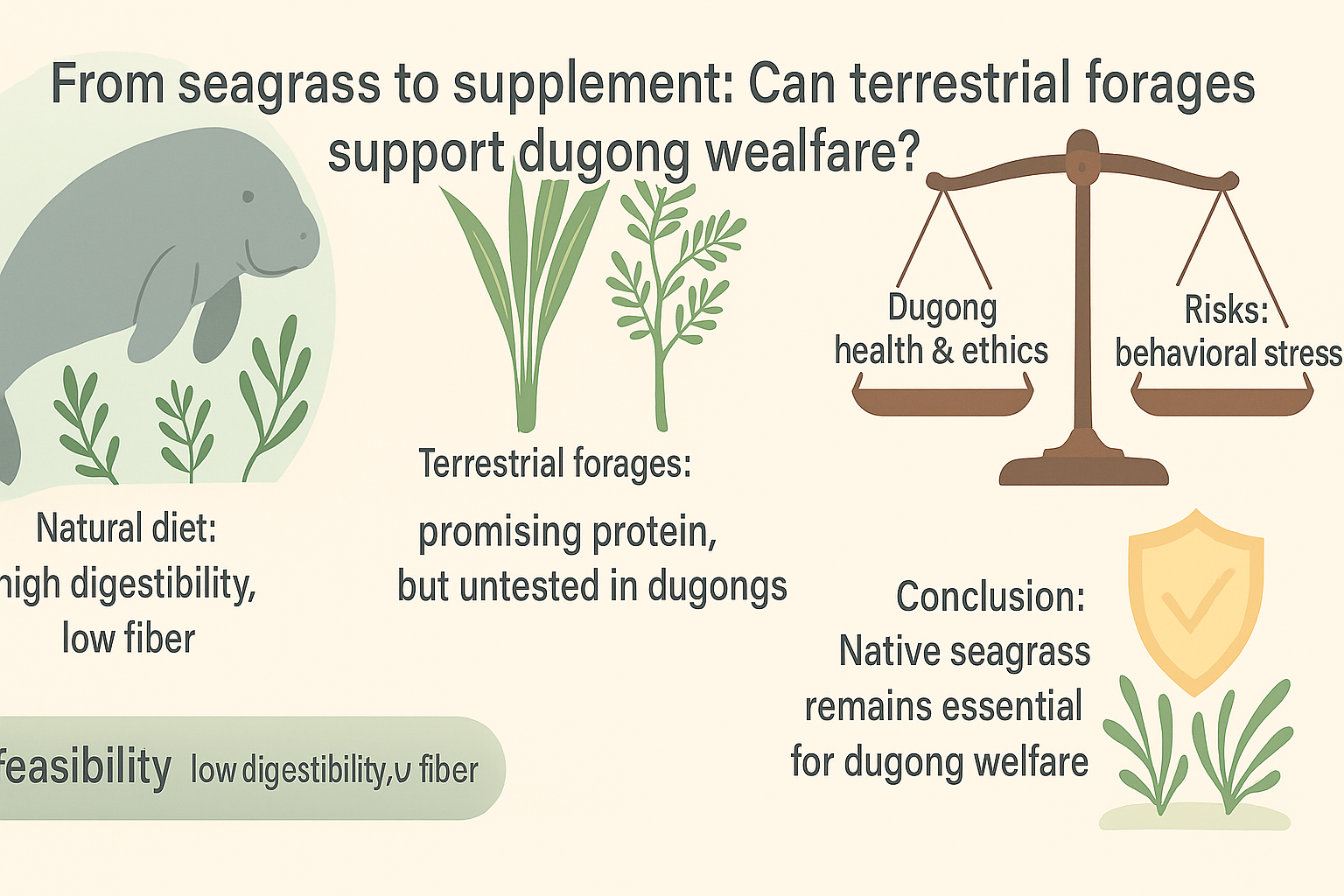
Dugongs (Dugong dugon) are specialized marine herbivores that primarily feed on seagrass species such as Thalassia hemprichii, Halophila ovalis, and Halodule uninervis. Their feeding behavior, including grazing and excavating, is influenced by seagrass morphology and sediment type. Dugongs exhibit high digestive efficiency (>90%) when consuming low-fiber seagrasses, which support consistent weight gain and health maintenance. While terrestrial forage species like Brachiaria, Pennisetum purpureum, and Leucaena leucocephala are widely used in ruminant nutrition, their suitability for dugongs remains unproven due to significant differences in palatability, digestive physiology, and ecological compatibility. Captive feeding trials have demonstrated dugongs' strong preference for native seagrasses, supported by nutritional analyses indicating high digestibility and adequate protein content. Ethical and ecological concerns further limit the use of non-native diets and domestication practices. Conservation and ex-situ management strategies must prioritize habitat protection, forage availability, and species-specific nutritional requirements. This review underscores the critical role of seagrass ecosystems in dugong survival and cautions against introducing alternative forages without thorough ecological and physiological evaluation.
Article Details

This work is licensed under a Creative Commons Attribution 4.0 International License.
Publishing an article with open access in Veterinary Integrative Sciences leaves the copyright with the author. The article is published under the Creative Commons Attribution License 4.0 (CC-BY 4.0), which allows users to read, copy, distribute and make derivative works from the material, as long as the author of the original work is cited.
References
Abobatta, W.F., Fouad, F.W., 2024. Sustainable agricultural development: introduction and overview. In: Abobatta W.F.,-Hussein, W.S. (Eds.), Achieving food security through sustainable agriculture. IGI Global, Hershey, PA, pp. 1–27.
Albores-Moreno, S., Alayón-Gamboa, J.A., Miranda-Romero, L.A., Alarcón-Zúñiga, B., Jiménez-Ferrer, G., Ku-Vera, J.C., Piñeiro-Vázquez, A.T., 2019. Effect of tree foliage supplementation of tropical grass diet on in vitro digestibility and fermentation, microbial biomass synthesis and enteric methane production in ruminants. Trop. Anim. Health. Prod. 51, 893–904.
Amany, C., Kamal, M.M., Kurniawan, F., Sabila, V., 2022. Seagrass, dugong, and people: Lessons learned from community-based conservation in Tolitoli Regency, Sulawesi Tengah, Indonesia. IOP Conf. Ser. Earth. Environ. Sci. 967, 012032.
André, J., Gyuris, E., Lawler, I.R., 2005. Comparison of the diets of sympatric dugongs and green turtles on the Orman Reefs, Torres Strait, Australia. Wildl. Res. 32, 53–62.
Ann Clark, E., 2009. Forages in organic crop–livestock systems. In: Francis, C. (Ed.), Organic farming: the ecological system, pp. 85–112.
Aragones, L.V, Lawler, I.R., Foley, W.J., Marsh, H., 2006. Dugong grazing and turtle cropping: grazing optimization in tropical seagrass systems?. Oecologia. 149, 635–647.
Awadh, A., Mwakumanya, M., Omar, M., 2024. The viability of seagrass ecosystems for supporting dugong recovery in Kenya. West Indian Ocean J. Mar. Sci. 23, 19–26.
Bass, D.K., 2010. Status of dugong dugong dugon and australian snubfin dolphin orcaella heinsohni, in the Solomon Islands. Pac. Conserv. Biol. 16, 133–143.
Belén Argüelles, M., Fiorito, C., Coscarella, M., Fazio, A., Bertellotti, M., 2023. First observations of cooperative circle feeding in Southern Right Whales (Eubalaena australis). Aquat. Mamm. 49(1), 1-6.
Bowen, J.M., Haskell, M.J., Miller, G.A., Mason, C.S., Bell, D.J., Duthie, C.A., 2021. Early prediction of respiratory disease in preweaning dairy calves using feeding and activity behaviors. J. Dairy. Sci. 104, 12009–12018.
Burgess, E.A., Blanshard, W.H., Barnes, A.D., Gilchrist, S., Keeley, T., Chua, J., Lanyon, J.M., 2013. Reproductive hormone monitoring of dugongs in captivity: Detecting the onset of sexual maturity in a cryptic marine mammal. Anim. Reprod. Sci. 140, 255–267.
Burkholder, D.A., Heithaus, M.R., Fourqurean, J.W., 2012. Feeding preferences of herbivores in a relatively pristine subtropical seagrass ecosystem. Mar. Freshw. Res. 63, 1051–1058.
Castellini, M., Mellish, J.A., 2023. Physiology of marine mammals: adaptations to the ocean. CRC Press, Boca Raton.
Dewi, C.S.U., Wahyudi, S., Tarno, H., Ciptadi, G., Wiadnya, D.G.R., 2024. Dugong dugon (Muller 1776) and its habitat in coastal areas and small islands of East Java Province, Indonesia. IOP Conf. Ser. Earth. Environ. Sci. 1328, 12003.
Dewi, C.S.U., Wahyudi, S., Tarno, H., Wiadnya, D.G.R., Iranawati, F., Sukandar, S., Martinah, A., Sani, L.M.I., Subhan, B., Herandarudewi, S.M., 2025. Genetic of stranded Dugong dugon (Müller 1776) in the Java Sea, Indonesia, through COX1-based DNA barcoding. Biodiversitas J. Biol. Divers. 26, 951-962.
Folkmanova, V., 2015. The oil of the dugong: towards a history of an Indigenous medicine. Hist. Aust. 12, 97–112.
Goto, M., Ito, C., Sani Yahaya, M., Wakamura, K., Asano, S., Wakai, Y., Oka, Y., Furuta, M., Kataoka, T., 2004. Effects of age, body size and season on food consumption and digestion of captive dugongs (Dugong dugon). Mar. Freshw. Behav. Physiol. 37(2), 89–97.
Goto, M., Watanabe, A., Karita, S., Tokita, N., Yamamoto, Y., Wakaki, Y., Asano, S., Oka, Y., Furuta, M., 2008. Nutrient and energy consumption of captive mature dugong (Dugong dugon) consuming eelgrass at the Toba Aquarium. Mar. Freshw. Behav. Physiol. 41, 169–177.
Gutiérrez A,F.W., Zaldívar R,J., Contreras S,G., 2009. Effect of various levels of digestible energy and protein in the diet on the growth of" gamitana"(Colossoma macropomum) Cuvier 1818. Revista de Inves. Vet. del Perú (RIVEP). 20, 178-186.
Hashim, M., Ito, S., Numata, S., Hosaka, T., Hossain, M.S., Misbari, S., Yahya, N.N., Ahmad, S., 2017. Using fisher knowledge, mapping population, habitat suitability and risk for the conservation of dugongs in Johor Straits of Malaysia. Mar. Policy. 78, 18–25.
Heng, H.W.K., Ooi, J.L.S., Affendi, Y.A., Alfian, A.A.K., Ponnampalam, L.S., 2022. Dugong feeding grounds and spatial feeding patterns in subtidal seagrass: A case study at Sibu Archipelago, Malaysia. Estuar. Coast. Shelf. Sci. 264, 107670.
Hines, E., Adulyanukosol, K., Duffus, D., Dearden, P., 2005. Community perspectives and conservation needs for dugongs (Dugong dugon) along the Andaman coast of Thailand. Environ. Manag. 36, 654–664.
Jack, H.A., Cranston, L., Burke, J.L., Knights, M., Morel, P.C.H., 2020. Determining the chemical composition and in vitro digestibility of forage species used in small ruminant production systems in the english speaking Caribbean–Part 1. Trop. Agric. 97, 32-45.
Jiménez-Ramos, R., Brun, F.G., Egea, L.G., Vergara, J.J., 2018. Food choice effects on herbivory: Intra-specific seagrass palatability and inter-specific macrophyte palatability in seagrass communities. Estuar. Coast. Shelf. Sci. 204, 31–39.
Jiménez-Ramos, R., Egea, L.G., Ortega, M.J., Hernández, I., Vergara, J.J., Brun, F.G., 2017. Global and local disturbances interact to modify seagrass palatability. PLoS One, 12, e0183256.
Juntasin, W., Imura, Y., Thaikua, S., Poungkaew, R., Kawamoto, Y., 2022. Effects of plant spacing on seed yield and seed quality in new Urochloa cultivars. Grassl. Sci. 68, 88–98.
Kavana, P.Y., Kizima, J.B., Msanga, Y.N., Kilongozi, N.B., Msangi, B.S.J., Kadeng’uka, L.A., Mngulu, S., Shimba, P.K., 2005. Potential of pasture and forage for ruminant production in Eastern zone of Tanzania. Livest. Res. Rural. Dev. 17, 144.
Khamis, A., Abdulla, A., D’Souza, E., Kelkar, N., Arthur, R., Al Khalifa, E., Bader, H., Alcoverro, T., 2023. Long‐term persistence of large dugong groups in a conservation hotspot around Hawar Island, Kingdom of Bahrain. Aqua. Conserv. Mar. Freshwater Eco. 33, 592–605.
Khamis, A., Alcoverro, T., D’Souza, E., Arthur, R., Pages, J.F., Shah, J., Al-Qahtani, T., Eweida, A.A., 2022. Identifying conservation priorities for a widespread dugong population in the Red Sea: Megaherbivore grazing patterns inform management planning. Mar. Environ. Res. 181, 105762.
Koura, B.I., Vastolo, A., Kiatti, D.D., Cutrignelli, M.I., Houinato, M., Calabrò, S., 2022. Nutritional value of climate-resilient forage species sustaining peri-urban dairy cow production in the coastal grasslands of Benin (West Africa). Anim. 12, 3550.
Lanyon, J.M., Dawson, L.C., Baublys, K., 2025. Validation and application of stable isotope analysis of dugong tusks to determine long‐term shifts in foraging patterns. Mar. Mammal Sci. 41, e13202.
Lanyon, J.M., Sanson, G.D., 2006. Mechanical disruption of seagrass in the digestive tract of the dugong. J. Zool. 270, 277–289.
Lyu, Z., Zang, J., Lai, C., Li, P., Ma, D., Zhao, J., Zhang, S., Huang, C., 2019. Effects of dietary fibre level and body weight of pigs on nutrient digestibility and available energy in high‐fibre diet based on wheat bran or sunflower meal. J. Anim. Physiol. Anim. Nutr. 103, 1895–1907.
Machado, G.B.O., Leite, F.P.P., Sotka, E.E., 2018. Nutrition of marine mesograzers: integrating feeding behavior, nutrient intake and performance of an herbivorous amphipod. PeerJ. 6, e5929.
Marsh, H., Grech, A., McMahon, K., 2018. Dugongs: seagrass community specialists. IN: Larkum, A., Kendrick, G., Ralph, P. (Eds), Seagrasses of Australia: structure, ecology and conservation. Springer, Cham, pp. 629–661.
Nurdianti, R.R., Dickhoefer, U., Castro-Montoya, J.M., 2024. Relationship between nutritional composition and fibre digestibility in tropical forages compared to temperate forages. Itali. J. Anim. Sci. 23, 1839–1853.
Pakeerathan, K., 2025. A global overview and the fundamentals of sustainable agriculture. In: Singh, S., Sood, V., Srivastav, A.L., Ampatzidis, Y. (Eds.), Hyperautomation in precision agriculture. Academic Press, United States, pp. 3–13.
Panyawai, J., Prathep, A., 2022. A systematic review of the status, knowledge, and research gaps of dugong in Southeast Asia. Aqua. Mam. 48, 203–222.
Pérez-Reverón, R., Perdomo-González, A., de la Roza-Delgado, B., Rodríguez, C., Pérez-Pérez, J.A., Díaz-Peña, F.J., 2024. Extending beyond traditional forage: potential nutritional benefits of native plants in extreme arid insular regions. Front. Plant. Sci. 15, 1476809.
Piñeiro-Vázquez, A.T., Canul-Solis, J.R., Jiménez-Ferrer, G.O., Alayón-Gamboa, J.A., Chay-Canul, A.J., Ayala-Burgos, A.J., Aguilar-Pérez, C.F., Ku-Vera, J.C., 2017. Effect of condensed tannins from Leucaena leucocephala on rumen fermentation, methane production and population of rumen protozoa in heifers fed low-quality forage. Asian-Austra. J. Anim. Sci. 31, 1738.
Podturkin, A.A., Krebs, B.L., Watters, J.V., 2023. A quantitative approach for using anticipatory behavior as a graded welfare assessment. J. Appl. Anim. Welf. Sci. 26, 463–477.
Poore, A.G.B., Hill, N.A., 2006. Sources of variation in herbivore preference: among-individual and past diet effects on amphipod host choice. Mar. Biol. 149, 1403–1410.
Prado, P., Heck, K.L. Jr., 2011. Seagrass selection by omnivorous and herbivorous consumers: determining factors. Mar. Ecol. Prog. Ser. 429, 45–55.
Raghunathan, C., Venkataraman, K., Rajan, P.T., 2012. Status of sea cow, dugong(Dugong dugon) in Andaman and Nicobar Islands. Nature, Environ. Pollut. Techno. 11, 105–112.
Rajamani, L., 2013. Using community knowledge in data-deficient regions: conserving the Vulnerable dugong Dugong dugon in the Sulu Sea, Malaysia. Oryx. 47, 173–176.
Robinson, P.H., Grattan, S.R., Getachew, G., Grieve, C.M., Poss, J.A., Suarez, D.L., Benes, S.E., 2004. Biomass accumulation and potential nutritive value of some forages irrigated with saline-sodic drainage water. Anim. Feed Sci. Techno. 111, 175–189.
Said, N.E., Cleguer, C., Lavery, P., Hodgson, A.J., Gorham, C., Tyne, J.A., Frouws, A., Strydom, S., Lo, J., Raudino, H.C., 2025. Sparse seagrass meadows are critical dugong habitat: A novel rapid assessment of habitat-wildlife associations using paired drone and in-water surveys. Ecol. Indic. 171, 113135.
Sarmiento, B.G., 2025. Sustainable ecosystem design: biodiversity-integrated organic farming system. E3S Web. Conf. 624, 2002.
Schop, M., Jansman, A.J.M., de Vries, S., Gerrits, W.J.J., 2020. Increased diet viscosity by oat β-glucans decreases the passage rate of liquids in the stomach and affects digesta physicochemical properties in growing pigs. Anim. 14, 269–276.
Sharma, P., Sharma, P., Thakur, N., 2024. Sustainable farming practices and soil health: a pathway to achieving SDGs and future prospects. Discov. Sustain. 5, 250.
Shawky, A.M., Shabaka, S., 2024. The grazing effects of dugongs on seagrass meadows: A field experiment at Wadi El Gemal National Park, Red Sea, Egypt. In Najeeb, M.A. Rasul, Ian, C.F. Stewart (Eda.), Oceanographic and marine environmental studies around the Arabian Peninsula. CRC Press, United States, pp. 267-272.
Sheppard, J.K., Carter, A.B., Coles, R.G., 2008. Spatial patterns of sub-tidal seagrasses and their tissue nutrients in the Torres Strait, northern Australia: Implications for management. Cont. Shelf. Res. 28, 2282–2291.
Svendsen, P.M., Palme, R., Malmkvist, J., 2013. Novelty exploration, baseline cortisol level and fur-chewing in farm mink with different intensities of stereotypic behaviour. Appl. Anim. Behav. Sci. 147, 172–178.
Thibault, M., Letourneur, Y., Cleguer, C., Bonneville, C., Briand, M.J., Derville, S., Bustamante, P., Garrigue, C., 2024. C and N stable isotopes enlighten the trophic behaviour of the dugong (Dugong dugon). Sci. Rep. 14, 896.
Tol, S.J., Coles, R.G., Congdon, B.C., 2016. Dugong dugon feeding in tropical Australian seagrass meadows: implications for conservation planning. PeerJ. 4, e2194.
Tsutsumi, C., Ichikawa, K., Arai, N., Akamatsu, T., Shinke, T., Hara, T., Adulyanukosol, K., 2006. Feeding behavior of wild dugongs monitored by a passive acoustical method. J. Acoust. Soc. America. 120, 1356–1360.
Waasdorp, S., Tuffnell, J.A., Bruins-van Sonsbeek, L., Schilp, C.M., van Zeeland, Y.R.A., Sterck, E.H.M., 2021. Chopped and dispersed food enhances foraging and reduces stress-related behaviours in captive white-naped mangabeys (Cercocebus lunulatus). Appl. Anim. Behav. Sci. 241, 105392.
Wang, B., Liu, K., Sakornwimon, W., Huang, W., Li, T., Lai, X., Li, C., Zhao, L., Cong, B., Liu, S., 2025. Spatial planning for dugong conservation: Assessing habitat suitability and conservation gaps in Indo-Pacific Convergence Zone. Mar. Policy. 180, 106777.
Wang, J., Cao, W., Shi, H., Li, W., 2024. Forage plants in grasslands with different topographies affect yak foraging preferences on the eastern Tibetan plateau. Front. Plant. Sci. 15, 1347576.
Wirsing, A.J., Heithaus, M.R., Frid, A., Dill, L.M., 2008. Seascapes of fear: evaluating sublethal predator effects experienced and generated by marine mammals. Mar. Mamm. Sci. 24, 1–15.
Zeh, D.R., Heupel, M.R., Hamann, M., Limpus, C.J., Marsh, H., 2016. Quick Fix GPS technology highlights risk to dugongs moving between protected areas. Endanger. Species. Res. 30, 37–44.
