Impacts of hot red pepper inclusion in diet on physical and chemical traits, antioxidant capacity, and fatty acid profile of eggs https://doi.org/10.12982/VIS.2026.046
Article Sidebar
Main Article Content
Abstract
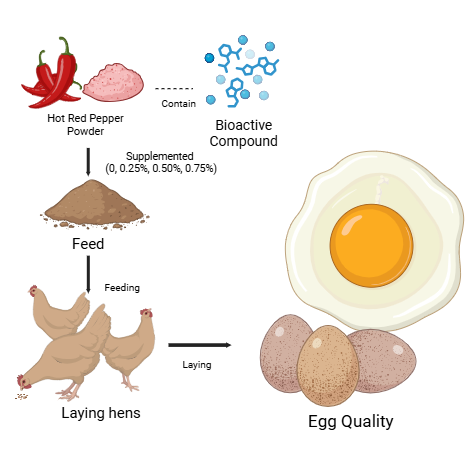
Hot red pepper (HRP) has potential as a natural enhancer of various egg nutrition and quality attributes in poultry. This study investigates the effects of HRP supplementation on the physical and chemical quality of eggs, lipid oxidation, and their fatty acid profiles. A total of 100 laying hens, 56 weeks old, were randomly assigned to five treatment groups, each consisting of five replications with five hens per replication. The dietary treatments included a basal diet (control) and HRP supplementation at concentrations of 0.25%, 0.50%, and 0.75% for 8 weeks. Eggs were collected at the end of weeks 4 and 8 to assess physical traits, chemical composition, and antioxidant activity. Additionally, fatty acid profiling was conducted at the end of week 8. The results indicated that HRP supplementation at all levels enhanced yolk colour score (P<0.001). Specifically, supplementation with 0.50% and 0.75% HRP at week 8 led to a significant reduction in cholesterol levels (P<0.05). Moreover, dietary HRP at 0.75% significantly improved DPPH inhibition at 8 week and HRP at 0,50% and 0.75%reduced malondialdehyde (MDA) in yolk (P<0.05). In conclusion, HRP supplementation improved yolk colour, antioxidant activity, and reduced cholesterol levels in eggs. These findings suggest that HRP could be a promising natural additive in poultry diets to improve the quality and health attributes of eggs, offering potential benefits for both the poultry industry and consumers.
Article Details

This work is licensed under a Creative Commons Attribution 4.0 International License.
Publishing an article with open access in Veterinary Integrative Sciences leaves the copyright with the author. The article is published under the Creative Commons Attribution License 4.0 (CC-BY 4.0), which allows users to read, copy, distribute and make derivative works from the material, as long as the author of the original work is cited.
References
Abeyrathne, E.D.N.S., Nam, K.C., Huang, X., Ahn, D.U., 2022. Egg yolk lipids: separation, characterization, and utilization. Food Sci. Biotechnol. 31(10), 1243–1256.
Abou-Elkhair, R., Selim, S., Hussein, E., 2018. Effect of supplementing layer hen diet with phytogenic feed additives on laying performance, egg quality, egg lipid peroxidation and blood biochemical constituents. Anim. Nutr. 4, 394–400.
Agustina, A., Hidayati, N., S. Putri., 2019. Penetapan kadar β-karoten pada wortel (Daucus carota, L) mentah dan wortel rebus dengan spektrofotometri visibel. Jurnal Farmasi Sains dan Praktis. 5(1), 6-10.
Aikpitanyi, K.U., Imasuen, J.A., 2024. Evaluation of blood biochemical indices and egg yolk lipid profile in laying hens fed diets with black pepper and red pepper additives. Eur. J. Vet. Med. 4(6), 1-9.
Al-Harthi, M.A., 2004. Responses of laying hens to different levels of amoxicillin, hot pepper or green tea and their effects on productive performance, egg quality and chemical composition of yolk and blood plasma constituents. Egypt. Poult. Sci. 24, 845–868.
Alty, L.T., 2009. Analysis of fatty acid methyl esters in egg yolk using GC–MS. J. Chem. Educ. 86, 962.
Antova, G.A., Gerzilov, V.T., Petkova, Z.Y., Boncheva, V.N., Bozhichkova, I.N., Penkov, D.S., Petrov, P.B., 2019. Comparative analysis of nutrient content and energy of eggs from different chicken genotypes. J. Sci. Food Agric. 99, 5890–5898.
AOAC., 2005. Official Methods of Analysis of AOAC International. AOAC International, Gaithersburg, MD.
Arimboor, R., Natarajan, R.B., Menon, K.R., Chandrasekhar, L.P., Moorkoth, V., 2014. Red pepper (Capsicum annuum) carotenoids as a source of natural food colors: analysis and stability—a review. J. Food Sci. Technol. 52, 1–14.
Bae, H., Jayaprakasha, G.K., Jifon, J., Patil, B.S., 2012. Extraction efficiency and validation of an HPLC method for flavonoid analysis in peppers. Food Chem. 130, 751–758.
Bala, D.A., Matur, E.R.D.A.L., Ekiz, E.E., Akyazi, I., Ergen, E., Erek, M., Atmaca, G.İ.Z.E.M., Eseceli, H., Keten, M., 2020. Can dried tomato and red pepper powder be used as a dietary supplement to strengthen defence systems and production performance in laying hens?. Eur. Poult. Sci. 84, 1-15.
Blesso, C.N., 2015. Egg phospholipids and cardiovascular health. Nutrients. 7(4), 2731–2747.
Bovšková, H., Míková, K., Panovská, Z., 2014. Evaluation of egg yolk colour. Czech. J. Food Sci. 32(3), 213-217.
Brand-Williams, W., Cuvelier, M.E., Berset, C., 1995. Use of a free radical method to evaluate antioxidant activity. LWT - Food Sci. Technol. 28, 25–30.
Ceylan, N., Ciftçi, I., Mızrak, C., Kahraman, Z. Efil, H., 2011. Influence of different dietary oil sources on performance and fatty acid profile of egg yolk in laying hens. J. Anim. Feed Sci. 20, 71-83.
Chanwitheesuk, A., Teerawutgulrag, A., Rakariyatham, N., 2005. Screening of antioxidant activity and antioxidant compounds of some edible plants of Thailand. Food Chem. 92(3), 491-497.
Cimrin, T., Avsaroglu, M.D., Tunca, R.I., Kandir, S., Ayasan, T., 2019. Effects of the dietary supplementation of layer diets with natural and synthetic antioxidant additives on yolk lipid peroxidation and fatty acid composition of eggs stored at different temperatures and duration. Braz. J. Poult. Sci. 21, eRBCA-2019.
Coniglio, S., Shumskaya, M., Vassiliou, E., 2023. Unsaturated fatty acids and their immunomodulatory properties. Biology. 12(2), 279.
Crowell, P.L., 1999. Prevention and therapy of cancer by dietary monoterpenes. J. Nutr. 129, 775S–778S.
De Ketelaere, B., Corion, M., Adriaens, I., Van Liedekerke, P., Saeys, W., 2023. Non-destructive eggshell strength assessment using Hertz contact theory—Part II: Implementation and validation. Food. 12(6), 1340.
de Oliveira, D.D., Baião, N.C., Cançado, S.D.V., Oliveira, B.L.D., Lana, Â.M.Q., Figueiredo, T.C.D., 2011. Effects of the use of soybean oil and animal fat in the diet of laying hens on production performance and egg quality. Ciênc. Agrotec. 35, 995-1001.
El-Salam, A.A., Hamouda, Y., El-Safty, S., El-Attar, A., 2022. Genetic differences in egg quality traits between W-36 and Brown Breeder strains. Adv. Anim. Vet. Sci. 10, 1827–1833.
Filik, G., Filik, A.G., Altop, A., 2020. The effects of dietary hot pepper Capsicum annuum waste powder supplementation on egg production traits of Japanese quail layers. Ciên. Rural. 50, e20190945.
Ghani, M.A., Barril, C., Bedgood, D.R., Prenzler, P.D., 2017. Measurement of antioxidant activity with the thiobarbituric acid reactive substances assay. Food Chem. 230, 195–207.
Gosler, A.G., Higham, J.P., Reynolds, S.J., 2005. Why are birds’ eggs speckled? Ecol. Lett. 8, 1105–1113.
Gray, J., Griffin, B., 2009. Eggs and dietary cholesterol – dispelling the myth. Nutr. Bull. 34, 66–70.
Grela, E.R., Knaga, S., Winiarska-Mieczan, A., Zięba, G., 2020. Effects of dietary alfalfa protein concentrate supplementation on performance, egg quality, and fatty acid composition of raw, freeze-dried, and hard-boiled eggs from Polbar laying hens. Poult. Sci. 99, 2256–2265.
Hamed, M., Kalita, D., Bartolo, M.E., Jayanty, S.S., 2019. Capsaicinoids, polyphenols and antioxidant activities of Capsicum annuum: Comparative study of the effect of ripening stage and cooking methods. Antioxidants. 8(9), 364.
Hanif, M.F., Agus, A., Ariyadi, B., Muhlisin, M., Pambuka, S.R., 2025a. Effect of turmeric powder supplementation on physical and chemical egg quality, antioxidant activity, and yolk fatty acid profile. Vet. Integr. Sci. 23(2), e2025031-1-12.
Hanif, M.F., Ariyadi, B., Muhlisin, Agus, A., 2024. Effect of pepper (Capsicum sp.) on productivity and egg quality of laying hens: a meta-analysis. Vet. Integr. Sci. 22(3), 749-767.
Hanif, M.F., Ariyadi, B., Muhlisin, M., Al-Huda, M., Luschandina, C., Agus, A., 2025b. Effect of hot red pepper supplementation and different storage times on hen egg quality. Agron. Mesoam. 36(1), 59760.
Hassan, M.H., Edfawy, M., Mansour, A., Hamed, A.A., 2012. Antioxidant and antiapoptotic effects of capsaicin against carbon tetrachloride-induced hepatotoxicity in rats. Toxicol. Ind. Health. 28, 428–438.
Hassan, S., Hassan, M., Soliman, F., Safwat, A., 2023. Influence of hot red pepper oil in broiler diets on blood, antioxidant, immunological parameters and intestinal bacteria counts. Anim. Biotechnol. 34(4), 1295-1304.
Haugh, R., 1937. The Haugh unit for measuring egg quality. U.S. Egg Poult. Mag. 43, 522–555.
Hayat, Z., Cherian, G., Pasha, T.N., Khattak, F.M., Jabbar, M.A., 2010. Oxidative stability and lipid components of eggs from flax-fed hens: Effect of dietary antioxidants and storage. Poult. Sci. 89, 1285-1292.
Henchion, M., Moloney, A.P., Hyland, J., Zimmermann, J., McCarthy, S., 2021. Trends for meat, milk and egg consumption for the next decades and the role played by livestock systems in the global production of proteins. Animal. 15, 100287.
Hernández-Pérez, T., Gómez-García, M.D.R., Valverde, M.E., Paredes-López, O., 2020. Capsicum annuum (hot pepper): an ancient Latin-American crop with outstanding bioactive compounds and nutraceutical potential. A review. Compr. Rev. Food Sci. Food Saf. 19, 2972–2993.
Honchar, V., Iakubchak, O., Shevchenko, L., Midyk, S., Korniyenko, V., Kondratiuk, V., Rozbytska, T., Melnik, V., Kryzhova, Y., 2022. The effect of astaxanthin and lycopene on the content of fatty acids in the yolks of chicken eggs under different storage regimes. Potravinarstvo Slovak J. Food Sci. 16, 473–489.
Kuang, H., Yang, F., Zhang, Y., Wang, T. and Chen, G., 2018. The impact of egg nutrient composition and its consumption on cholesterol homeostasis. Cholesterol. 2018(1), 6303810.
Li, H., Jin, L., Wu, F., Thacker, P., Li, X., You, J., Wang, X., Liu, S., Li, S., Xu, Y., 2012. Effect of red pepper (Capsicum frutescens) powder or red pepper pigment on the performance and egg yolk color of laying hens. Asian-Australas. J. Anim. Sci. 25, 1605–1610.
Liu, X., Peng, C., Qu, X., Guo, S., Chen, J.F., He, C., Zhou, X., Zhu, S., 2019. Effects of s C-3102 on production, hatching performance, egg quality, serum antioxidant capacity and immune response of laying breeders. J. Anim. Physiol. Anim. Nutr. 103, 182–190.
Lokaewmanee, K., Yamauchi, K., Okuda, N., 2013. Effects of dietary red pepper on egg yolk colour and histological intestinal morphology in laying hens. J. Anim. Physiol. Anim. Nutr. 97(5), 986–995.
Losada-Barreiro, S., Sezgin-Bayindir, Z., Paiva-Martins, F., Bravo-Díaz, C., 2022. Biochemistry of antioxidants: Mechanisms and pharmaceutical applications. Biomedicines. 10(12), 3051.
Luqman, S., Rizvi, S.I., 2006. Protection of lipid peroxidation and carbonyl formation in proteins by capsaicin in human erythrocytes subjected to oxidative stress. Phytother. Res. 20, 303–306.
Maramis, R.N., Nahor, E.M., Rindengan, E.R., 2025. Comparison of different extraction methods on sorghum seeds (Shorgum bicolor (L). Moench) on extract yield and secondary metabolite compound levels. Jurnal Farmasimed. 7(2), 274-283.
Matić, P., Sabljić, M. and Jakobek, L., 2017. Validation of spectrophotometric methods for the determination of total polyphenol and total flavonoid content. J. AOAC Int. 100(6),1795-1803.
Matumoto-Pintro, P.T., Murakami, A.E., Vital, A.C.P., Croge, C., da Silva, D.F., Ospina-Roja, I.C., Guerra, A.F.Q.G. 2017. Effects of storage time and temperature on lipid oxidation of egg powders enriched with natural antioxidants. Food Chem. 228, 463–468.
Medalcho, T.H., Ali, K.A., Augchew, E.D., 2025. Effects of spices mixture and cooking on antioxidant activity in Ethiopian spicy hot red pepper powder. Sci. Rep. 15(1), 5203.
Mierliță, D., 2019. Fatty acids profile and oxidative stability of eggs from laying hens fed diets containing hemp seed or hempseed cake. S. Afr. J. Anim. Sci. 49, 310.
Miller, V., Reedy, J., Cudhea, F., Zhang, J., Shi, P., Erndt-Marino, J., Coates, J., Micha, R., Webb, P., Mozaffarian, D., Abbott, P., 2022. Global, regional, and national consumption of animal-source foods between 1990 and 2018: findings from the Global Dietary Database. Lancet Planet. Health. 6(3), e243–e256.
Miranda, J., Anton, X., Redondo-Valbuena, C., Roca-Saavedra, P., Rodriguez, J., Lamas, A., Franco, C., Cepeda, A., 2015. Egg and egg-derived foods: Effects on human health and use as functional foods. Nutrients. 7, 706–729.
Mjøs, S.A., 2003. Identification of fatty acids in gas chromatography by application of different temperature and pressure programs on a single capillary column. J. Chromatogr. A. 1015, 151–161.
Molnár, S., Szőllősi, L., 2020. Sustainability and quality aspects of different table egg production systems: a literature review. Sustainability. 12(19), 7884.
Montenegro, A., Garcia, E., Molino, A., Cruvinel, J., Ouros, C., Alves, K., 2019. Methods to evaluate the eggshell quality of table eggs. Braz. J. Poult. Sci. 21.
Morris, S.S., Beesabathuni, K., Headey, D., 2018. An egg for everyone: Pathways to universal access to one of nature’s most nutritious foods. Matern. Child Nutr. 14, e12679.
Muhammad, A.I., Mohamed, D.A.A., Chwen, L.T., Akit, H., Samsudin, A.A., 2021. Effect of sodium selenite, selenium yeast, and bacterial enriched protein on chicken egg yolk color, antioxidant profiles, and oxidative stability. Foods. 10(4), 871.
Narinc, D., Aygun, A., Karaman, E., Aksoy, T., 2015. Egg shell quality in Japanese quail: Characteristics, heritabilities and genetic and phenotypic relationships. Animal. 9, 1091–1096.
Nolte, T., Jansen, S., Weigend, S., Moerlein, D., Halle, I., Simianer, H., Sharifi, A.R., 2021. Genotypic and dietary effects on egg quality of local chicken breeds and their crosses fed with faba beans. Animals. 11, 1947.
OECD-FAO, 2023. OECD-FAO Agricultural Outlook 2023-2032. OECD Publishing, Paris. France.
Okur, A.A., Kayhan, E.U., 2019. Impacts of red pepper supplemented diets and different storage conditions on eggs obtained from free-range laying hens. S. Afr. J. Anim. Sci. 48, 987.
Olatunji, T.L., Afolayan, A.J., 2018. The suitability of chili pepper (Capsicum annuum L.) for alleviating human micronutrient dietary deficiencies: a review. Food Sci. Nutr. 6, 2239–2251.
Olgun, O., Gül, E.T., Kılınç, G., Yıldız, A., Çolak, A., Sarmiento-García, A., 2022. Performance, egg quality, and yolk antioxidant capacity of the laying quail in response to dietary choline levels. Animals. 12(23), 3361.
Omidi, M., Rahimi, S., Torshizi, M.A.K., 2015. Modification of egg yolk fatty acids profile by using different oil sources. Vet. Res. Forum. 6(2), 137.
Paganotti, R.S., Barbeira, P.J., 2024. Accuracy enhancement of the Folin-Ciocalteu method for propolis. Am. J. Anal. Chem. 15(8), 253-267.
Pal, M., Molnár, J., 2021. The role of eggs as an important source of nutrition in human health. Int. J. Food Sci. Agric. 5(1), 180-182.
Panaite, T.D., Nour, V., Saracila, M., Turcu, R.P., Untea, A.E., Vlaicu, P.A., 2021. Effects of linseed meal and carotenoids from different sources on egg characteristics, yolk fatty acid and carotenoid profile and lipid peroxidation. Foods. 10(6), 1246.
Prajapati, D., Makvana, A., Patel, M., Chaudhary, R., Patel R., 2024. Spectrophotometric method for the determination of total alkaloids in selected plant parts. J. Pharmacogn. Phytochem. 13(5), 491-494.
Poureslami, R., Raes, K., Huyghebaert, G., Batal, A.B., De Smet, S., 2012. Egg yolk fatty acid profile in relation to dietary fatty acid concentrations. J. Sci. Food Agric. 92(2), 366–372.
Puglisi, M.J., Fernandez, M.L., 2022. The health benefits of egg protein. Nutrients. 14, 2904.
Puvača, N., Kostadinović, L., Ljubojević, D., Lukač, D., Lević, J., Popović, S., Novakov, N., Vidović, B., Đuragić, O., 2015. Effect of garlic, black pepper and hot red pepper on productive performances and blood lipid profile of broiler chickens. Eur. Poult. Sci. 79, 1-13.
Réhault-Godbert, S., Guyot, N., Nys, Y., 2019. The golden egg: nutritional value, bioactivities, and emerging benefits for human health. Nutrients. 11, 684.
Salamatullah, A.M., Hayat, K., Husain, F.M., Ahmed, M.A., Arzoo, S., Althbiti, M.M., Alzahrani, A., Al-Zaied, B.A.M., Alyahya, H.K., Albader, N., Nafidi, H.A., 2022. Effects of different solvents extractions on total polyphenol content, HPLC analysis, antioxidant capacity, and antimicrobial properties of peppers (red, yellow, and green Capsicum annuum L.). Evid.-Based Complement. Altern. Med. 2022(1), 7372101.
Saleh, A.A., Gawish, E., Mahmoud, S.F., Amber, K., Awad, W., Alzawqari, M.H., Shukry, M., Abdel-Moneim, A.M.E., 2021. Effect of natural and chemical colorant supplementation on performance, egg-quality characteristics, yolk fatty-acid profile, and blood constituents in laying hens. Sustainability, 13(8), 4503.
Silviani, V.C., 2013. Uji aktivitas antioksidan ekstrak etanolik buah cabai rawit putih (Capsicum frutescens l.) dengan metode dpph (1, 1-difenil-2-pikrilhidrazil) dan penetapan kadar kapsaisin secara kromatografi lapis tipis (klt)–densitometri. Bachelor Thesis, Faculty of Pharmacy, Universitas Sanata Dharma, Indonesia.
Sinanoglou, V.J., Strati, I.F., Miniadis-Meimaroglou, S., 2011. Lipid, fatty acid and carotenoid content of edible egg yolks from avian species: a comparative study. Food Chem. 124(3), 971–977.
Sözcü, A., 2019. Effects of supplementing layer hen diet with red pepper (Capsicum annuum L.) powder as natural yolk colourant on laying performance, pigmentation of yolk, egg quality and serum immunoglobulin levels. Tavukçuluk Araşt. Derg. 16(2), 80–85.
Srinivasan, K., Sambaiah, K., 1991. The effect of spices on cholesterol 7 alpha-hydroxylase activity and on serum and hepatic cholesterol levels in the rat. Int. J. Vitam. Nutr. Res. 61, 364–369.
Sunwoo, H.H., Gujral, N., 2015. Chemical composition of eggs and egg products. In: Cheung, P., Mehta, B. (Eds.), Handbook of food chemistry. Springer, Berlin, Heidelberg, pp. 331–363.
Surai, P.F., Bortolotti, G.R., Fidgett, A.L., Blount, J.D., Speake, B.K., 2001. Effects of piscivory on the fatty acid profiles and antioxidants of avian yolk: studies on eggs of the gannet, skua, pelican and cormorant. J. Zool. 255, 305–312.
Suselowati, T., Kurnianto, E., Kismiati, S., 2019. Hubungan indeks bentuk telur dan surface area telur terhadap bobot telur, bobot tetas, persentase bobot tetas, daya tetas dan mortalitas embrio pada itik Pengging. Sains Peternakan. 17, 24–30.
Tarasewicz, Z., Szczerbińska, D., Ligocki, M., Dańczak, A., Majewska, D., Romaniszyn, K., 2005. The effect of a low-protein diet on Japanese quail rearing, egg quality and hatchability. J. Anim. Feed Sci. 14, 499–502.
Tian, Y., Lin, S., Jiang, P., Jiang, G., Bao, Z., 2023. Oxidative modification of malondialdehyde influences the structure and emulsification properties of egg yolk high-density lipoprotein. Food Biosci. 52, 102444.
Tiwari, C., Balehegn, M., Adesogan, A.T., McKune, S.L., 2023. Benefits, perceived and actual risks and barriers to egg consumption in low- and middle-income countries. Front. Anim. Sci. 4, 1270588.
Tomaszewska, E., Muszyński, S., Arczewska-Włosek, A., Domaradzki, P., Pyz-Łukasik, R., Donaldson, J., Świątkiewicz, S., 2021. Cholesterol content, fatty acid profile and health lipid indices in the egg yolk of eggs from hens at the end of the laying cycle, following alpha-ketoglutarate supplementation. Foods. 10(3), 596.
Tufarelli, V., Baghban-Kanani, P., Azimi-Youvalari, S., Hosseintabar-Ghasemabad, B., Slozhenkina, M., Gorlov, I., Seidavi, A., Ayaşan, T., Laudadio, V., 2021. Effects of horsetail (Equisetum arvense) and spirulina (Spirulina platensis) dietary supplementation on laying hens productivity and oxidative status. Animals. 11, 335.
Vlaicu, P.A., Panaite, T.D. and Turcu, R.P., 2021. Enriching laying hens eggs by feeding diets with different fatty acid composition and antioxidants. Sci. Rep. 11(1), 20707.
Walker, S., Baum, J.I., 2022. Eggs as an affordable source of nutrients for adults and children living in food-insecure environments. Nutr. Rev. 80(2), 178–186.
Xiao, F., Xu, T., Lu, B., Liu, R., 2020. Guidelines for antioxidant assays for food components. Food Front. 1(1), 60–69.
Xiao, L., Mjøs, S.A., Haugsgjerd, B.O., 2012. Efficiencies of three common lipid extraction methods evaluated by calculating mass balances of the fatty acids. J. Food Compos. Anal. 25, 198–207.
Zaazaa, A., Sabbah, M., Omar, J.A., 2022. Effects of oil source on egg quality and yolk fatty acid profile of layer hens. Braz. J. Poult. Sci. 24(2), eRBCA-2020.
Zhou, L., Cao, Z., Bi, J., Yi, J., Chen, Q., Wu, X., Zhou, M., 2016. Degradation kinetics of total phenolic compounds, capsaicinoids and antioxidant activity in red pepper during hot air and infrared drying process. Int. J. Food Sci. Technol. 51, 842–853.
